Premier Li Keqiang's dialogues with WEF chief and international business leaders









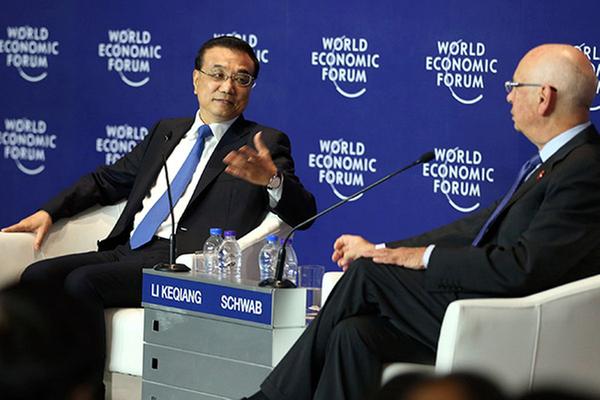 |
| Premier Li Keqiang answers questions from Klaus Schwab, executive chairman of the World Economic Forum, at the Dalian International Conference Center, during Summer Davos, in Dalian, Northeast China's Liaoning province.[Photo by Wu Zhiyi/china Daily] |
Editor's Note: On June 27, following his address at the opening ceremony of the Annual Meeting of the New Champions 2017, Premier Li Keqiang answered questions from Executive Chairman of the World Economic Forum, Klaus Schwab, at the Dalian International Conference Center. On June 28, Li sat down for a dialogue with representatives of international business leaders attending the meeting. Below is the full text of the two interactions:
Professor Schwab: In your speech, you talked about the dynamic development of the Chinese economy as well as relevant policies. I'm sure these policies can help sustain such dynamism. It is a remarkable achievement for China, the second-biggest economy in the world, to grow at nearly 7 percent. Could you please share with us in greater detail what measures the government will take to keep such positive momentum going in the future?
Premier Li: China used to grow at double-digit rates, but now the growth has moderated to a medium-high level of 6.9 percent in the first quarter of this year. Some characterize this trend as a slowdown, but that wouldn't be very accurate, as the Chinese economy has become much bigger than before. Every one percentage point of growth in GDP now would generate the same amount of additional output as 1.5 percentage point growth five years ago or 2 percent growth 10 years ago. I often use the analogy of somersaults to describe such a situation: It is much easier for a child to do a dozen somersaults at one go than for an adult, for whom just three or four would be quite an accomplishment. For major economies with GDPs of $2 trillion or above, a 3 percent growth would be no mean feat. I hope you can view the Chinese economy in an objective way. It will keep growing at medium-high speed, as we have 1.3 billion people, huge market potential and social creativity.
To sustain the positive momentum requires a host of measures. We will keep on working in the following three areas for a considerable time to come.
First, we will maintain stability in macroeconomic policies. This means we will continue to implement a proactive fiscal policy and prudent monetary policy. We will not resort to massive stimulus measures. Instead, we will continue to undertake structural adjustments and provide the market with stable and clear expectations, which is of overriding importance in a market economy.
Second, we will advance reform and opening-up. In undertaking supply-side structural reforms, the government will continue to streamline administration, delegate its power, widen market access and enhance compliance oversight to create a level playing field. We will ease corporate burdens by reducing taxes and administrative fees to unleash the vitality of the market.
Third, we will accelerate efforts to replace traditional drivers of growth with new ones. We will adopt market and rules-based approach to tackle and phase out excess and backward capacity in steel, coal and other sectors. Meanwhile, we will work hard to grow new drivers and encourage the development of new technologies, new business forms and models. In this process, the government will exercise accommodating and prudent supervision to provide an enabling environment for the healthy growth of the new economy. Furthermore, Chinese and foreign-invested companies will be treated as equals.
Professor Schwab: Looking around the world, the Chinese government has been most effective in embracing the Fourth Industrial Revolution. I want to congratulate you and the Chinese government on that. That said, the Fourth Industrial Revolution also has its disruptive effect, including on employment and income distribution. You did talk about this in your opening speech. What steps is the Chinese government taking to reduce such adverse impact?
Premier Li: Thank you, Professor Schwab, for your positive comments on the steps taken by the Chinese government in the Fourth Industrial Revolution or the new industrial revolution, but I would hesitate to say that we are most effective in this aspect. As a Chinese proverb goes, "When the moon reaches its fullest, it begins to wane". We are in constant pursuit of perfection out of a recognition of our own imperfections. I believe the new round of industrial revolution brings more opportunities than challenges, but it is not always the case in all fields and sectors. After all, everything has its pros and cons.
Take employment for example, will the extensive application of artificial intelligence and robots deprive people of their jobs? This is indeed a question, and it is already happening in some industries and sectors. Yet, through the Internet Plus initiative and mass entrepreneurship and innovation, new technologies and new business forms empowered by the new round of industrial revolution, such as online shopping, express delivery and bike-sharing, have generated far more jobs than those taken by robots. In this sense, what we are experiencing is only a structural shift, which calls for adjusting the training in labor skills. We will meet such challenge head on, because it is simply inescapable. More importantly, the development of new technologies, business forms and models makes it possible to accommodate and harness people's individual choices to generate greater market potential and put everyone's talent to best use. By pooling the wisdom of all people, we will be able to create far more wealth and jobs than what have been lost.
This is a race against time. Professor Schwab just said that in the future, it's not going to be the big fish eating the small fish, but the fast fish eating the slow fish. I want to add to that metaphor. The fast fish will certainly do better than the slow fish, but I do hope that the slow fish will move faster and catch up with the fast fish, and the fast fish will also turn around to help the slow fish.
Feike Sijbesma, chairman and CEO of the Royal DSM Group: Premier Li, over the last several years, key tasks have been performed on the supply-side reform. My question is: Could you elaborate a little bit on the progress in these areas and the contribution the international business community can bring to reform in the next stage?
Premier Li: China has focused on supply-side structural reform in comprehensively deepening reform in recent years. One of its key tasks is to phase out and cut overcapacity in coal and steel production. Last year alone, more than 65 million metric tons of steelmaking capacity and over 290 million tons of coal-production capacity were eliminated. At the same time, we are nurturing new drivers of growth and reducing the burden on companies by widening market access and cutting taxes and administrative fees. A multitude of new market entities has since sprung up in China. Over the past four years, the number of Chinese enterprises has doubled, reaching 27 million, and the number of market entities in total has surpassed 90 million. They have spawned a surge in new technologies and new business forms. China's reform, especially supply-side structural reform, has boosted the structural transformation and upgrading of the Chinese economy.
We all know that excess capacity exists in some sectors globally. This is the result of the quantitative easing policies taken by some countries in response to the financial crisis. Nothing short of a global solution is required. In the face of this issue, China has not shied away from its responsibilities. Instead, we have made painstaking efforts to phase out excess capacity through supply-side structural reform, which is also our contribution to the international community.
Over the past three decades, reform in China has always moved forward side by side with opening-up in a mutually reinforcing way. To advance reform, we need the participation of foreign capital, businesses and expertise. Foreign companies are welcome to take part in the merger and reorganization of enterprises in China. While fostering new growth drivers, we will lower market access thresholds in service sectors for foreign investors and introduce a negative-list management model. The policy support enjoyed by Chinese companies in keeping with WTO rules will be equally applied to foreign enterprises registered in China. We welcome continued investment from your company in China.
Alex Molinaroli, chairman and CEO of Johnson Controls: The Made-in-China 2025 strategy has greatly promoted China's manufacturing and innovation capabilities. You have already addressed one of my questions about foreign investment and a level playing field for foreign companies within China when answering the last question. Then what challenges and obstacles are there in the implementation of this strategy and what does the Chinese government plan to do in response?
Premier Li: The Made-in-China 2025 is a forward-looking strategy developed on the basis of the current industrialization level in China. It is designed to raise the quality of Chinese products and equipment. While made-in-China products have acquired a sound global reputation, those products are still at the low and medium level in terms of quality. Similarly, China's equipment is yet to reach a high level, and we still need to import foreign equipment. The Made-in-China 2025 strategy aims to boost the quality of Chinese equipment with the application of intelligent technologies through cooperation with foreign partners.
First, the Made-in-China 2025 strategy will bring huge opportunities for both Chinese and foreign businesses. To enhance the quality of their products, Chinese companies need to introduce advanced techniques and equipment. This can be achieved through cooperation with developed countries. For example, we are synergizing this strategy with Germany's Industry 4.0, and cooperating with the United States. In the future, more foreign equipment-manufacturing products and technologies will enter the Chinese market.
Second, we expect to see more cooperation between Chinese and foreign companies in equipment technologies. For foreign equipment makers to expand their presence in the Chinese market, they need to localize their products. For example, the US company General Motors has been able to take a big share of the Chinese market through setting up joint ventures with Chinese companies and remodeling its vehicles according to road and climatic conditions in China. This has secured a growing market for the company in China.
I want to stress that such cooperation is voluntary and helps companies expand in the Chinese market and even in third countries. The Chinese government does not allow Chinese companies to impose mandatory technology transfer requirements on their foreign partners, still less will we tolerate infringements on intellectual property rights.
Third, in areas of the Made-in-China 2025 strategy, such as green development, where both the Paris Agreement and the WTO encourage governments to provide policy support, foreign-invested companies registered in China will enjoy the same policy incentives offered by the Chinese government as their Chinese counterparts.
Now, let me address a misunderstanding about the Made-in-China 2025 strategy. To those people who seem to believe that the purpose of the relevant policies is to shut the door on imports of foreign equipment, let me say this: First, door-shutting is impossible. We live in a globalized world, where companies make their own choices about the equipment they want to purchase, and they should be given the right to do so in the open market. Second, it is natural for any country to want to make equipment of a higher quality. It is only that in a globalized world, this cannot be done with one's doors closed. Third, given the size of the Chinese market, when China climbs up the quality ladder, this will also boost global demand for manufactured products and equipment.
Mark Benioff, chairman and CEO of Salesforce: It's great to be here in the conference. Your speech yesterday was excellent and was very meaningful to me personally. As you know, there have been a lot of transitions and changes in the US since I was here last just a year ago. I was very interested in hearing your comments about these changes if possible. Now, the Chinese government has placed great importance, you spoke about it last year as well, on the development of new companies and entrepreneurs, and on mass innovation and entrepreneurship, which you also articulated many times. So what challenges do you see based on what is happening in the world today facing this effort? Tell me also how can we both from the US and also the international business community participate more meaningfully in your efforts, including your Belt and Road Initiative.
Premier Li: China and the US are the world's largest developing country and largest developed country respectively. Steady growth of China-US relations and expansion of our economic and commercial relations will bring tremendous benefits to people of the two countries and also to world peace, development and cooperation. No matter how the situation in our respective countries may evolve, we are sure about one thing, that is, China-US relations have always kept moving ahead despite ups and downs in the past several decades. Our two-way trade has seen strong growth, in particular, from just about $1 billion before we established diplomatic ties to over $500 billion last year. It would be fair to say that China and the US now have forged a community of inseparable interests.
The Chinese government's initiative of mass entrepreneurship and innovation is first and foremost about employment. The government faces quite a big pressure in terms of employment, as we need to generate as many as 15 million new urban jobs each year to accommodate new entrants into the labor force. As big companies enhance efficiency and introduce more robots and manipulators, it is only natural that the total number of jobs they can offer has been somewhat declining. With government efforts to widen market access, as many as 15,000 small and micro businesses are getting registered on an average day in China, and they have been a large source of new jobs. Now in China, small and micro businesses provide 80 percent of all jobs. They are the backbone of inclusive growth.
Second, this initiative is intended to meet the needs for innovation. The new industrial revolution has brought about a major shift in the marketplace, which is the exponential growth in individualistic customer demands. Meeting these demands requires flexible business models and innovation in management and organizational structures. The SMEs have an edge in adaptability. As a Chinese idiom goes, it is easy for a small boat to shift direction.
Third, the initiative of mass entrepreneurship and innovation is a response to the trend of integrated development among large, medium and small companies. Not just small companies make innovations to accommodate special needs, many big companies have also been engaged in customized production, which requires adjustments in their organizational structures. I visited a local equipment manufacturer in Dalian, which has opened a lot of maker spaces on its production lines. The maker teams are able to remodel products according to customer needs. Although this company produces large equipment, 85 percent of its products are made to order. Not just this company, many large companies are doing the same.
Naturally, we also need to overcome some difficulties in the process of promoting mass entrepreneurship and innovation.
First, the government needs to shed its vested interests, lower the threshold for market access, and spend more energy on compliance oversight. The playing field ought to be level, and we can never allow sales of shoddy or counterfeited products, fraud and violations of intellectual property rights.
Second, the financial sector has come under strain. It may be a global challenge for SMEs to get loans as all banks seem to favor big companies. China is no exception. This is why we are encouraging financial inclusion in China by providing incentives to financial institutions to lend to SMEs.
Third, as SMEs make innovation and pursue integrated development with large and medium-sized companies, how to incentivize inventors and innovators to make further innovations by protecting intellectual property rights has become a challenge. Now applications for patents and inventions from SMEs account for 70 percent of the total. But this does involve some disputes. For those big companies that have makers and small businesses at maker spaces on their production lines, the challenge is how to share the profits between them and their smaller partners to promote common development.
I cited the example of the company I visited in Dalian, whose owner is a visionary man. He told me that he has been able to involve a lot of makers on his production lines to improve products, and the value generated through such cooperation was divided in a ratio of 30 percent to 70 percent. I asked him who took 30 percent and who took 70 percent. He said 70 percent of the profits went to makers and he took the smaller share. I praised him for his courageous generosity. He replied that had it not been for those makers, he would not be able to get even 10 percent of newly generated revenue.
The story of the company shows that it is necessary to protect intellectual property rights and at the same time incentivize innovations. This requires further efforts on our part to explore an effective approach. Although the makers make use of the equipment of the company for their innovations, the owner of the company recognizes the superior value of the makers' ideas. That said, it won't be easy for everyone to recognize this.
Patrice Motsepe, founder and CEO of African Rainbow Minerals: I am a businessman from South Africa. I was the first Chairman of the BRICS Business Council. I saw how the BRICS countries, but Africa in particular, benefited immensely from the growth of the Chinese economy as well as from trade with China. I have no doubt that the rest of the world has benefited immensely from trading with China. My question is: The WTO's Trade Facilitation Agreement entered into force earlier this year. China has been an active supporter in this area. What will be the major challenges in enforcing the agreement? And what further steps will China adopt to advance global trade facilitation?
Premier Li: You raised a very important question, particularly in the context of the growing backlash against globalization. There have been as many as 3,000 protectionist measures adopted by various countries in the past 10 years since the outbreak of the international financial crisis. The entry into force of the Trade Facilitation Agreement, which was adopted by the WTO in 2013, would be beneficial for global economic recovery and for guiding market expectations.
The TFA is the first multilateral agreement on trade in goods China acceded to after joining the WTO. The Chinese State Council completed domestic procedures for its ratification in less than two years. As things stand, some one-third of the WTO members are yet to go through ratification procedures. We hope all parties will work together for the TFA to be fully implemented this year. According to estimates by experts, the TFA, once implemented, will add at least $1 trillion to global trade. That would undoubtedly be good news for a steady global recovery.
While observing the TFA, China will advance trade facilitation as much as possible in line with its national conditions. First, we will consolidate the mandate of various agencies to streamline customs clearance procedures for businesses by establishing "single window" service centers.
Second, we will make customs clearance faster. We intend to shorten the time needed for customs clearance by another one third this year, and will aim to meet the most advanced international standards regarding customs clearance procedures and speed in the not so distant future.
Third, we will enhance cooperation with other countries, particularly in mutual recognition of inspection between regulatory authorities, to avoid repetitive procedures and lower costs for businesses.
These are the technical measures we will take. What is most important, I believe, is that we must recognize the valuable role of free trade in boosting global economic recovery. Trade liberalization and investment facilitation is the hallmark of free trade. When everyone acts to promote free trade with an open-minded approach, this will provide consumers with more choices and compel domestic companies to innovate and upgrade. In the meantime, we should take account of the varying national conditions of different countries, and adopt measures to cushion the impact on certain sectors through consultation among countries on the basis of mutual understanding and mutual accommodation. But overall, we need to keep to the right direction.
Professor Schwab: Mr Premier, I want to take this opportunity to ask you a question about the development of the internet and digitization. The Internet Plus policy is a very important national strategy. But if we look at digitization, we can no longer make differentiation between digital industries and old-fashioned industries. Today, every industry is digitized. Could you share with us what your experiences and challenges are in this aspect? Particularly, how the international business community could be more meaningfully engaged in China's efforts for overall digitization of its economy?
Premier Li: The introduction of the internet has given rise to a mushrooming of new forms of business. And big data application has become a trend. We must adapt to this trend in order to seize as many opportunities as possible. Traditional industries did come under challenges. I once cited the example of physical stores going through the painful experience of confronting or even conflicting with online shops. Now many physical stores have also opened their own online stores, which have made them more competitive. As we can see, notwithstanding the numerous challenges, we have more ways and means to overcome them.
The Internet Plus strategy the Chinese government has been advancing is inherently open to the world. We have in China a large number of cloud platforms that are attractive to foreign businesses or individuals. Foreign companies are getting registered on such platforms in large numbers. In sectors of basic telecommunications and value-added services in China, many business areas are now open to foreign investors, which represents the highest level of openness so far among all developing countries. This means tremendous opportunities for foreign firms.
Furthermore, China has over 900 million mobile broadband users and over 730 million internet users. We are also actively advancing cross-border e-commerce. Foreign companies can sell their products and services on the e-commerce platforms. Nothing is impossible as long as you act on your ideas. In this process, the Chinese government will exercise prudent yet accommodating regulation to make sure that foreign companies can grow together with Chinese companies and join in our efforts to boost the Chinese economy and deliver greater convenience to the Chinese people. For the online economy to attract more consumers, security is the precondition. We must work together to crack down on fraud, sales of fake and shoddy products online, and theft of trade secrets.
To conclude, let me emphasize one point. Just now a few business leaders have asked questions and introduced their businesses. I hope all the delegates here and the media will pay attention not just to the questions they asked and the answers I gave, but also to what their businesses have achieved in the Chinese market and their support for China's modernization. Thank you.
Professor Schwab: We should be very grateful to the Premier for being here at this dialogue and for having shared with us his insights and many specific policies and measures, particularly some vivid examples. We also want to express our appreciation to the participation of such a prominent government delegation which has accompanied you, Mr Premier. And we wish the Chinese government all the best in the implementation of those strategies. And you can be assured that you have the goodwill of all those here, and you have the strong commitment of the World Economic Forum to contribute to the success of the development of China.