Drug that altered the course of history









In his speech at the opening of the 19th National Congress of the Communist Party of China in October, President Xi Jinping said ancient China was a great nation.
But things changed after the Opium War of 1840, he added.
"China was plunged into the darkness of domestic turmoil and foreign aggression; its people were ravaged by wars, saw their homeland torn, and lived in poverty and despair," Xi told CPC members gathered at the Great Hall of the People in Beijing for the weeklong leadership meeting, which is held once every five years.
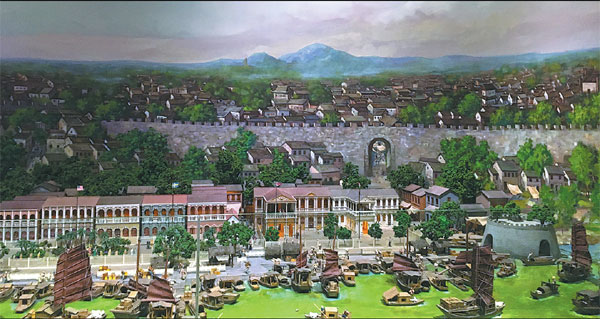
| The artwork at the Opium War Museum in Humen, Guangdong province, depicts an enclave by the Pearl River in Guangzhou where Western traders lived in the 19th century. The province was then called Canton. |
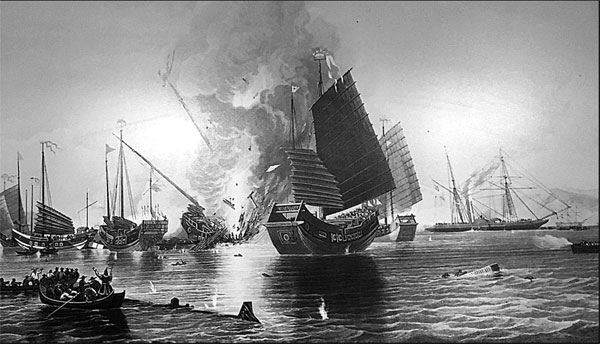
| The artwork at the Thirteen Hongs Museum in Guangzhou illustrates the outbreak of the opium war of 1840, with the British naval attack in Humen. Photos by Satarupa Bhattacharjya / China Daily |
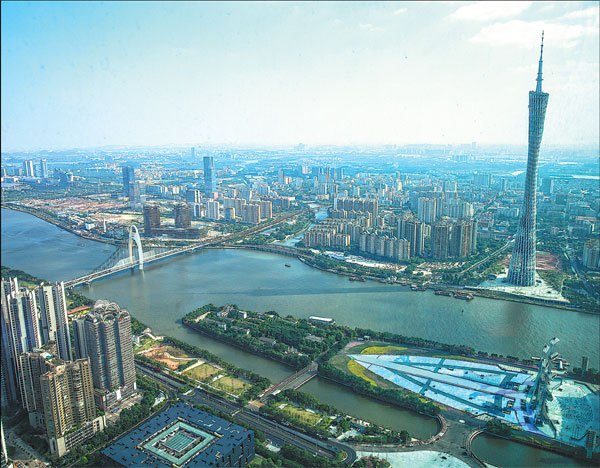
| A view of Canton Tower in present-day Guangzhou, capital of South China's Guangdong province, through which the Pearl River flows. Provided to China Daily |
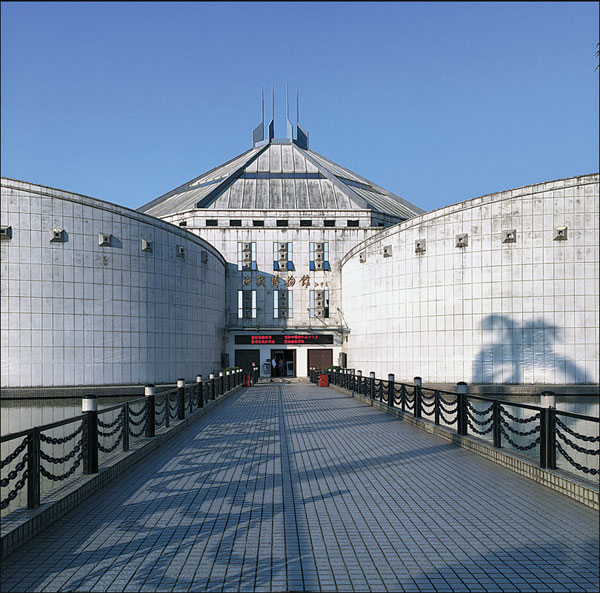
| The entrance of the Sea Battle Museum in Humen, Guangdong province, where visitors can get a glimpse of the history of the opium wars. Photos by Satarupa Bhattacharjya / China Daily |
China is a different place today. It is the world's second-largest economy and has the largest standing army. Besides, the conflict between imperial China and the British Empire ended nearly 160 years ago. So why does it still appear as an important historical reference in contemporary Chinese politics?
China Daily's recent interviews with historians who live in China and Britain, and visits to sites related to the Opium Wars in South China's Guangdong province, formerly Canton, suggest that the lessons - perhaps more than those from other foreign conflicts that followed - have shaped the country's politics, military, diplomacy and society in modern times.
The Opium Wars are broadly divided into two phases: The First Opium War (1839-42) and the Second Opium War (1856-60).
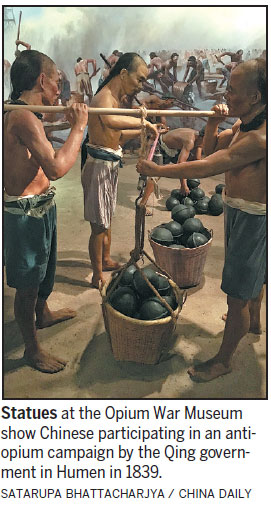
Many Chinese scholars consider 1840 as the most significant year of the entire period, because that year British forces mounted a major attack on China in Humen, a bustling port town on the Pearl River, on the outskirts of Guangzhou, the provincial capital of Guangdong.
The country was then ruled by the Qing Dynasty (1644-1911), with whom the centuries-old monarchy also ended in China.
The wars were triggered predominantly by colonial expansion in Asia and Qing opposition to opium smuggling into China by agents of British East India Co, according to Chinese historians. Until the trade was officially barred in 1800, foreign merchants were freely transporting opium to China.
Following the Qing defeat in the second phase of the war, the trade was legalized in 1859 for a while.
The narcotic drug made from the seed capsules of the opium poppy flower is used as an intoxicant. In medical use, it can induce sleep.
Some 2 million Chinese, mainly male traders, soldiers, officials and lower ranks of the imperial court, are estimated to have been addicted to opium in the 18th and 19th centuries.
'Internationalist China'
After the loss in the First Opium War, also known as the Anglo-Chinese War, the Qing government had to sign the Treaty of Nanjing that gave Britain, and subsequently other Western powers like France, access to such major Chinese ports as Shanghai, Guangzhou, Ningbo, Fuzhou and Xiamen.
The treaty also led to Hong Kong being ceded to Britain.
"1840 is considered essentially to be the beginning of the modern phase of China's history, and for that reason I think even now it is a reference point for Chinese communists," says Rana Mitter, a professor of modern Chinese history and politics at the University of Oxford.
The First Opium War led to what Chinese historians describe as the country's "century of humiliation", a series of colonial military engagements as well as the Japanese invasion.
"So in that sense I think that one of the things that made China very wary about international relations is the memory of the experience of invasion from outside," Mitter says.
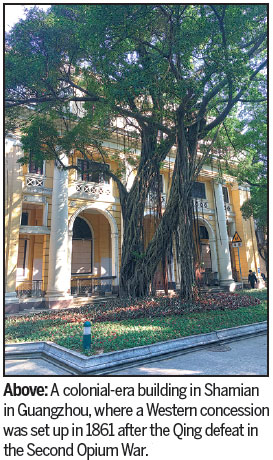
During the Second Opium War, British warships arrived in the northern port city of Tianjin, neighboring Beijing, according to historical accounts. Eventually, the Qing government had to open more ports, allow Western concessions to be set up in Canton, and "lease" Macao to Portugal.
Wu Yixiong, the dean of the history department at Sun Yat-sen University in Guangzhou, says the early Qing rule saw a "closed-door policy to the West", echoing what some Western historians have called China's era of seclusion. But what China learned from the Opium Wars was also to open its eyes.
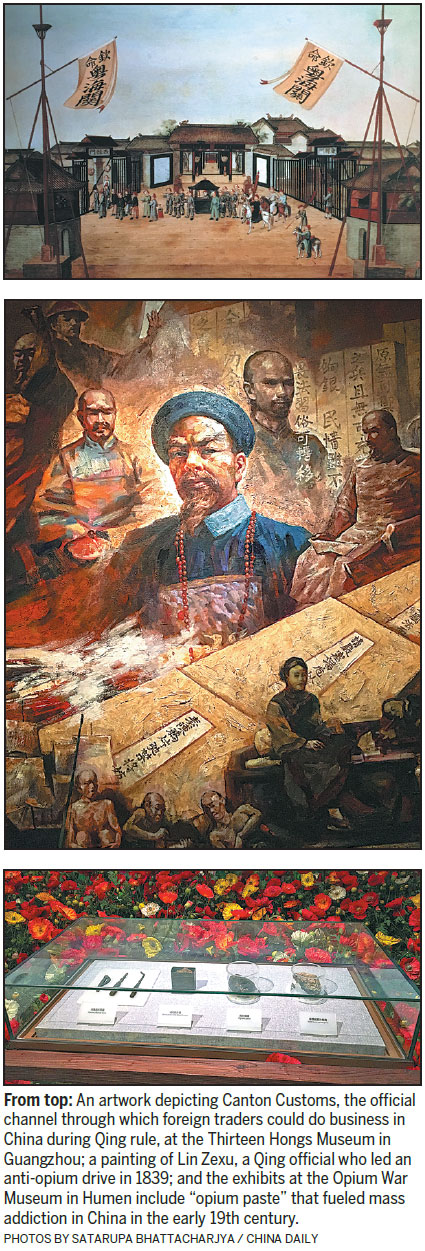
The imperial decree to allow foreign merchants to only trade through Canton Customs was due to the eastward expansion of the Western countries, according to exhibits at the Opium War Museum in Humen.
"It (1840) was the starting point for the great change," Wu says. "The wars made people realize then that China wasn't as strong as earlier thought and that it needed to be stronger to fight external threat.
"But China also realized that it needed to learn about the world outside," he adds.
The Opium Wars had turned the country into a semi-feudal, semi-colonial society, Mao Zedong, the founding father of New China, once said.
After the end of the Qing rule and during the early days of the Republic of China, when the nationalists were in power, Sino-British relations were still uneven. But that began to alter in the 1930s with the rise of the United States, and the relationship was different by the time of World War II, because the US and China were both seen as anti-imperialist powers.
In addition to the Opium Wars, references to events of the 1930s and 1940s by Chinese leaders today are also linked to a "more internationalist China that's looking outward", Mitter says.
China's post-1840 history up to 1949, when New China was founded, is known as jindaishi.
Blow to monarchy
China's last emperor, Puyi, abdicated in 1912 but held onto his royal title until 1924. The original Manchu name of the Qing house was Aisin Gioro, or "golden clan".
Although historians have different views on whether the Opium Wars ultimately resulted in the demise of monarchy in China, most have little doubt that they dealt a huge blow to it.
The wars reduced confidence in the dynasty, not only for its inability to protect the country but also for the ensuing economic crises owing to the excessive outflow of silver to Britain and the heavy taxes levied on the Chinese. People felt the country's economy wasn't safe in Qing hands. The dynasty's control over territory also weakened.
"I think it's fair to say that the wars - the Opium Wars and the colonial wars that follow - did a great deal to destabilize the monarchy, but the monarchy itself did make some attempts to reform and that's worth remembering also," Mitter says.
In the first decade of the 20th century, the Qing initiated political, educational and diplomatic reforms, he says of a lesser-known aspect of the dynasty that is viewed to have failed China in many ways.
Few members of the Qing bloodline are still alive.
Jin Yuzhang, a son of Puren, the fourth younger brother of the last emperor, told People's Daily in 2000 that "conservatism in the Qing era resulted in an underdeveloped state, which made the country vulnerable to foreign attack". Jin was then a Beijing district official but is now retired.
His surviving cousins include a singer and a former schoolteacher.
The Qing government was ineffective in controlling the spread of opium in China, partly due to corruption. British East India Co processed the drug in colonial India, using local labor, and the company's agents smuggled it through Canton to Chinese dealers who then carried it to the rest of the mainland, including the royal court in Beijing.
It was the responsibility of the local Qing officials to crack down on the smuggling in Canton, but it continued unabated as marine troops accepted bribes from foreign agents and let ships with hidden opium through, and when they were asked to increase patrolling by higher officials, the bribe amounts usually grew, according to Chinese historian Wu.
"Growing corruption undermined the national strength, for the offspring of former gallant cavaliers were no longer enterprising, living pleasure-seeking lives instead," Jin said in his earlier interview.
But it wasn't all inaction on the part of the Qing government, as one case of large-scale destruction of opium in Humen indicates.
In 1839, Emperor Daoguang perceived a threat to his rule from opium after he received reports of mass addiction from different provinces of the country. He sent Lin Zexu, an official from Beijing, to Canton as a special commissioner, assigning him the mission of clearing opium smuggling from the Pearl River, which flows into the South China Sea.
Soldiers surrounded the Thirteen Hongs (factories) area in Canton, where foreign traders lived, and seized the opium they found and burned it on the riverfront in neighboring Humen for days in June.
"Later that summer, Lin Zexu learned that the war of 1840 was coming," Wu says of what he thinks was a British response to the Qing resistance.
Gateway Canton
In the 18th century, Britain was buying tea, porcelain ware and silk from China while selling woolens, watches and forks. But the trade surplus emerged in China's favor. For a while Britain also sold cotton to China, but the imports fell due to China's own fiber plantations.
By many accounts, that's when opium entered the picture.
To reduce the trade deficit, British merchants "dumped" opium on the Chinese market, according to an exhibit at the Opium War Museum.
"If they wanted to balance trade they had to bring China something, but they didn't have the products," Wu says.
In the immediate decades before the first phase of the Opium Wars, an estimated 20,000 boxes (60 kilograms in each) were being annually transported to China. A box of opium would sell for between 500 and 800 taels (ancient Chinese currency) of silver in Canton, much higher than what it cost in colonial India.
Once opium was outlawed by the Qing government in 1800, the so-called free traders, with ties to British East India Co, started smuggling it by mixing businesses. They would hide the opium in ships that sailed with commodities that were allowed to be sold legally in China and hand the substance to Chinese dealers at Huangpu harbor in Canton.
An anti-opium drive was launched after 1820, the heyday of smuggling, which made the harbor off-limits for traders and dealers alike. That was when a warehouse on the waters near an estuary of the Pearl River was set up, serving as the new center of the illegal business and later as a site of battle.
The Chinese dealers would pick up the opium there, according to the museum exhibits.
Wu calls it the "dirty trade".
The Opium Wars also exposed the frailties of the Canton system in operation then. It was a monopoly run by the Hong merchants with whom alone foreign traders could liaise for their business in China. Other than the British presence in the Thirteen Hongs area, there were Danish, Spanish, French, American, Swedish and Dutch company representatives.
The Canton system later collapsed from within, mainly because of the lack of financial support.
Liang Fengxin contributed to this story.
satarupa@chinadaily.com.cn
Memories of a trade best forgotten
Present-day Guangdong, one of China's most affluent provinces, was the only gateway through which foreign traders could do business for a period in late imperial China.
Known then as Canton, it was also the site of the Opium Wars in the 19th century. But today it betrays nothing of that battle-scarred past.
Its capital, Guangzhou, recently held the 122nd Canton Fair, the largest and oldest trade fair in China, which the city has been hosting biannually since 1957.
An enclave for foreign merchants in the Thirteen Hongs area was burned down in the years of conflict. The history of the opium trade is laid out in the form of exhibits at three museums: the Thirteen Hongs Museum in Guangzhou, and the Opium War Museum and the Sea Battle Museum, both in Humen, a nearby bustling port town on the Pearl River.
The exhibits include scientific and romantic descriptions of the poppy flowers from which opium is made; Qing Dynasty royal edicts asking British ships to dock only at a designated harbor in Canton and not sail to other parts of China; names of the Chinese Hong (monopoly group) merchants who would collect tariffs from foreign ships; models of British artillery used in the wars, in contrast to the more primitive Qing guns; photos of the opium-processing units of the British East India Co; and images of smoky "opium dens" in China where people lay with a dazed look in their eyes.
(China Daily European Weekly 11/17/2017 page1)





Today's Top News
- Ukraine says latest peace talks with US, Europe 'productive'
- Economic stability a pillar of China's national security
- Xi taps China's deep wisdom for global good
- New rules aim for platforms' healthy growth
- Chinese web literature grows overseas
- Postgrad exam trend points to thoughtful approach