Understanding the new development stage, applying the new development philosophy, and creating a new development dynamic









Understanding the New Development Stage, Applying the New Development Philosophy, and Creating a New Development Dynamic
XI JINPING

Since the Fifth Plenary Session of the 19th Central Committee of the Communist Party of China held in October 2020, all regions and departments have yielded positive results from their hard work to study, publicize, and apply the guiding principles from the Session in line with the Central Committee's requirements. During this special seminar, the Central Committee hopes that we will gain an accurate understanding of the new stage of development through extensive discussions and exchanges of experience, with a view to fully implementing the new development philosophy, accelerating our efforts to create a new development dynamic, and promoting high-quality development during the 14th Five-Year Plan period (2021-2025). Doing so will see us setting the stage for building a modern socialist country in all respects.
I have spoken of the importance of studying and applying the guiding principles of the Fifth Plenary Session both at the Session itself and on many other occasions, such as meetings of the Central Committee Political Bureau and its Standing Committee, the Central Economic Work Conference, and the Central Rural Work Conference. Today, I would like to focus on the following four subjects.
First, we need to have an accurate understanding of the new stage of development.
An accurate understanding of the historical stage that the cause of our Party and people has entered is essential for defining the central task of the current period and setting the guidelines, principles, and policies for our work. This is an important practice our Party has used to move from victory to victory in leading China's revolution, development, and reform.
During the new-democratic revolution, our Party came to realize during the course of its arduous explorations that the Chinese revolution would have to pass through the historical stage of New Democracy. Based on this understanding, it set the tasks, strategies, and tactics that enabled it to lead the people to win the Chinese revolution. When the People's Republic of China was founded in 1949, our Party was keenly aware that a transitional period would be required to move from new democracy to socialism. It accordingly formulated a general guideline for this period, which enabled our country to complete its socialist revolution and move smoothly into the period of socialist development. Following the introduction of the reform and opening up policy in 1978, it reviewed the positive and negative experiences of socialist development around the world, and particularly in China, and reached the major conclusion that China was in the primary stage of socialism and would remain in that stage for a long time to come. Accordingly, it set the basic guideline that ushered in a brand new phase of reform, opening up, and socialist modernization. Since the 18th CPC National Congress in 2012, the Central Committee has built on the sustained efforts of our predecessors by pursuing coordinated implementation of the Five-sphere Integrated Plan and the Four-pronged Comprehensive Strategy. As a result, we have witnessed historic achievements and developments in the cause of our Party and the country, as socialism with Chinese characteristics has crossed the threshold into a new era.

The Fifth Plenary Session determined that China, having accomplished the First Centenary Goal of building a moderately prosperous society in all respects, would build on this achievement to embark on a new journey toward the Second Centenary Goal of building a modern socialist country in all respects, thus signifying China's entry into a new stage of development. This strategic judgment was made based on the following considerations.
From a theoretical standpoint, Marxism blends high ideals with practical tasks, and insists on the unity between historical inevitability and the stage-specific nature of development, in the belief that as human society moves inexorably toward communism, it must complete certain historical stages along the way. While applying the basic tenets of Marxism to the practical problems of China, our Party came to realize that the development of socialism did not only constitute one continuous historical process, but was made up of different stages. Between late 1959 and early 1960, Mao Zedong wrote in his reading notes on the Soviet textbook Political Economy that "It is possible to divide the period of socialism into two stages: one could be called underdeveloped socialism and one comparatively developed socialism. This latter stage," he noted, "may take even longer than the first." In 1987, Deng Xiaoping stated that "Socialism itself is the first stage of communism, and here in China we are still in the primary stage of socialism—that is, the underdeveloped stage. In everything we do we must proceed from this reality, and all planning must be consistent with it." The new development stage we are in today is just one part of the primary stage of socialism, but thanks to many decades of hard work, it is a period that marks a new starting point for us.
From a historical standpoint, this new stage will see our Party lead the people in completing the historic transformation from standing up and becoming prosperous to growing strong. After its founding in 1921, the CPC united with and led the people through a bitter, 28 year-long struggle to establish the People's Republic of China and make the historic transition from new-democratic revolution to socialist revolution. After the founding of the PRC in 1949, our Party led the people in creatively carrying out a socialist transformation by establishing socialism as China's basic system and promoting socialist economic and cultural progress on a large scale. The Chinese people not only stood up, but stood firmly on their own feet and completed the historic transition from socialist revolution to socialist development. On entering a new historical period, it led the people in launching the great new revolution of reform and opening up, which sparked tremendous enthusiasm, initiative, and creativity among all of our people and opened up the path of socialism with Chinese characteristics. As China made large strides in catching up with the times, it took yet another huge leap forward along the course of socialist modernization and embraced the bright prospects of national rejuvenation. Building on the development of the past, we are now writing the new chapter of building China into a modern socialist country in all respects.
In terms of the present reality, we now possess a solid material foundation for embarking on a new journey toward an even higher goal. Thanks to the tireless efforts made since the PRC's founding, and especially in the past 40-odd years since the adoption of the reform and opening up policy, China reached new levels in economic strength, scientific and technological capability, composite national strength, and living standards by the end of the 13th Five-Year Plan period (2016-2020). China is now the world's second largest economy, the largest industrial nation, the largest trader of goods, and the largest holder of foreign exchange reserves. China's GDP has exceeded RMB100 trillion yuan and stands at over $10,000 in per capita terms. Permanent urban residents account for over 60% of the population, and the middle-income group has grown to over 400 million. Particularly noteworthy are our historic achievements of building a moderately prosperous society in all respects and eliminating absolute poverty—a problem which has plagued our nation for thousands of years. These are significant milestones in our process of socialist modernization, and lay a solid foundation for marching toward the Second Centenary Goal during the new stage of development.
Shortly after the founding of the PRC, our Party put forward the goal of building a modern socialist country. Over the course of 13 five-year plans, we have laid a solid foundation for achieving this goal. The next 30 years make up the development stage in which we will finally complete this great ambition. We have worked out the roadmap and timetable for our development going forward. By 2035, or within three five-year plan periods, we will basically achieve socialist modernization. Then, by the middle of this century, after completing another three five-year plans, China will become a great modern socialist country that is prosperous, strong, democratic, culturally advanced, harmonious, and beautiful.
The world today is undergoing profound changes unseen in a century. Recently, the world situation could be best described by the word "chaos," and it appears that this trend will continue for quite some time. The response to the Covid-19 pandemic has highlighted the leadership capacities and strengths of the social systems of all countries. The fact that time and momentum are on our side gives us self-assurance, resolve, and confidence.
That said, we must fully recognize that although China remains in an important period of strategic opportunity for development, and will remain so for some time to come, the opportunities and challenges we face are changing. Though both are unprecedented in their extent, the opportunities generally outweigh the challenges. An ancient Chinese sage once said that we should handle the easy and small things cautiously so as to avoid difficulties and disasters. All of us in the Party must remain modest, prudent, and committed to hard work; we must mobilize all positive factors, unite with all forces that can be united with, and focus on running our own affairs well, as we work unswervingly toward our objectives.
Our task is to build China into a modern socialist country in all respects. Of course, the modernization we are pursuing has distinctive Chinese features and is tailored to the realities of China. At the Fifth Plenary Session, I underscored five characteristics in particular. China's modernization must cover a massive population, lead to common prosperity, deliver both material and cultural-ethical progress, promote harmony between humanity and nature, and proceed along a path of peaceful development. This is the direction modernization in China must follow. It must be embodied in our principles, policies, strategies, measures, and work plans to enable the Party and the Chinese people to work together toward this end.
The new stage of development is an important part of socialist development in our country. In 1992, Deng Xiaoping stated that "We have been building socialism for only a few decades and are still in the primary stage. It will take a very long historical period to consolidate and develop the socialist system, and it will require persistent struggle by several generations, a dozen or even several dozens. We can never rest on our oars." In my opinion, Deng made this remark from a political point of view. He was pointing out that it would take a fairly long period of hard work to turn China into a modern country based on the weak economic foundation of the time. But he was also stressing that we must persist with China's socialist system from one generation to the next, even after modernization is achieved. We must work continuously to find ways to consolidate and develop socialism, for no solution can last forever once developed. Mao Zedong once said that "All things have their boundaries. The way things develop is that one stage leads to another, advancing without interruption. But each and every stage has a 'boundary.' To deny the 'boundary' is to deny qualitative changes or partial qualitative changes." The primary stage of socialism is not a static, cast-iron, or stagnant period, nor is it a spontaneous and passive stage that can easily and naturally be passed through. Rather, it is a stage of dynamism, action, and promise, one that should always brim with vitality. It develops gradually but ceaselessly, moving from quantitative increases to qualitative leaps. Fully building a modern socialist China and basically realizing socialist modernization are essential for China's development in the primary stage of socialism, and essential for China to advance from the primary stage to a higher stage of socialism.
Second, we need to fully apply the new development philosophy.
For our Party, one very important part of leading the people in governing the country is answering the major questions of what kind of development China should pursue and how it should pursue it. On October 29, 2015, at the Fifth Plenary Session of the 18th CPC Central Committee, I stated, "Principles are precursors to actions. All actions in development are guided by principles of development, and it is these principles that ultimately determine the effectiveness of development and its success or failure. Experience tells us that development is a process of constant change, and that the environments and conditions in which development takes place are both subject to change. Therefore, it is only natural that principles of development should also be subject to change."

Since the 18th National Congress in 2012, our Party has, based on the careful assessment of the economic situation, made timely adjustments to our development principles and approach, which have given rise to historic achievements and shifts in the economic development of our country. Here, I would like to mention the most significant of these developments.
First, we have committed to a people-centered philosophy of development. In my address to the domestic and foreign press during the debut of the Standing Committee of 18th Central Committee Political Bureau on November 15, 2012, I stressed that "The people yearn for a better life, our goal is to help them achieve it, and we must unswervingly follow the path of common prosperity." At the Fifth Plenary Session of the 18th CPC Central Committee on October 29, 2015, I put forward the vision of people-centered development. At the Fifth Plenary Session of the 19th CPC Central Committee on October 29, 2020, I further underscored the need to strive for substantive progress in promoting common prosperity for all our people.
Second, we have changed the thinking that the GDP growth rate is the sole barometer of success. At the Central Economic Work Conference on December 15, 2012, I stressed that we cannot blindly pursue rapid growth without regard for objective laws and conditions. At a meeting of the Standing Committee of the Central Committee Political Bureau on April 25, 2013, I stressed that local governments should not take national regulatory targets as the baseline for local economic development, nor should they compete with each other to have higher growth rates. I said that we needed to shift the focus to improving the quality and returns of economic growth, to promoting sustained and healthy economic development, and to pursuing genuine rather than inflated GDP growth and achieving high-quality, efficient, and sustainable development.

Third, China's economy entered a period defined by three overlapping phases. At a meeting of the Standing Committee of the Central Committee Political Bureau on July 25, 2013, I noted that our economy was now in a slowing growth phase, a painful structural adjustment phase, and a phase of absorbing the adverse effects of previous stimulus policies. I emphasized that, at the same time, the world economy was also in a period of profound adjustment, which made for an extremely complex economic development environment. This required us to gain a proper understanding of the characteristics of the current stage of Chinese economic development and to undertake practical reforms and adjustments.
Fourth, China's economic development entered a new normal. I put forward this proposition at the Central Economic Work Conference on December 10, 2013. At the Central Economic Work Conference on December 9 of the following year, I analyzed new development trends in nine respects to explain why economic development had entered a new normal. I emphasized that understanding the new normal, adapting to it, and guiding its development constituted the major theme of China's economic development both at present and in the period ahead.
Fifth, we have enabled the market to play the decisive role in resource allocation and given better play to the role of the government. I stated at the Third Plenary Session of the 18th CPC Central Committee in November 2013 that the market is the most efficient means of allocating resources. A general law of market economies is that the market should determine the allocation of resources. I thus highlighted the need to let the market play the decisive role in resource allocation, thereby redefining the role of the market.
Sixth, we have committed to the idea that lucid waters and lush mountains are as precious as mountains of silver and gold. I put forward this concept during a speech at Nazarbayev University in Kazakhstan on September 7, 2013. I emphasized that developing an ecological civilization and building a beautiful China constitute a strategic task, because we need to make sure we leave behind a beautiful homeland with blue skies, green fields, and clean waters for our future generations. I reiterated this point during a talk with the Guizhou delegation at the Second Session of the 12th National People's Congress on March 7, 2014.
Seventh, we have introduced the new development philosophy. I proposed the idea of innovative, coordinated, green, open, and shared development at the Fifth Plenary Session of the 18th CPC Central Committee in October 2015. I noted that innovative development was focused on addressing the issue of growth drivers, coordinated development on redressing imbalances, green development on creating harmony between humanity and nature, open development on coordinating internal and external development, and shared development on ensuring social equity and justice. I stated that the introduction of the new development philosophy marked a fundamental change for the entire development context of our country.
Eighth, we have initiated supply-side structural reform. At the meeting of the Central Leading Group for Financial and Economic Affairs on November 10, 2015, I said that we should make great efforts to promote supply-side structural reform. I stated at the Central Economic Work Conference on December 18, 2015 that the five priorities in promoting supply-side structural reform were cutting overcapacity, reducing excess inventory, deleveraging, reducing costs, and strengthening areas of weakness. At the Central Economic Work Conference on December 19, 2018, I put forward the policy of consolidating the gains in the five priority tasks, strengthening the dynamism of micro entities, upgrading industrial chains, and ensuring unimpeded flows in the economy. I pointed out that this policy constituted a general requirement for furthering supply-side structural reform and spurring high-quality economic development both at present and in the period ahead.
Ninth, we must deal with unbalanced and inadequate development. At the 19th CPC National Congress held in October 2017, I concluded that the principal challenge facing Chinese society had evolved into one between unbalanced and inadequate development and the people's growing needs for a better life. I emphasized that this represented a historic shift that affected the whole landscape.
Tenth, we must deliver high-quality development. At the same congress, I pointed out that China's economy was transitioning from a phase of rapid growth to a stage of high-quality development. We arrived at this conclusion based on the change in the principal challenge facing Chinese society. In this stage, we need to follow the new development philosophy.
Eleventh, we must modernize our economic system. As I said in the same speech, this is both an urgent requirement for getting us smoothly through this critical transition and a strategic goal for China's development.
Twelfth, we have moved to create a new development dynamic that focuses on domestic economic flow and features positive interplay between domestic flow and international engagement. I put forward this concept at a meeting of the Central Commission for Financial and Economic Affairs on April 10, 2020.
Thirteenth, we have adopted a coordinated approach to development and security. I stressed at a group study session of the Central Committee Political Bureau on May 29, 2015 that we must firmly keep in mind the concept of ensuring security in development. On January 18, 2016, I analyzed the risks and challenges in four fields we faced on the path of open development at a seminar for provincial and ministerial level officials. On January 5, 2018, in a speech at a seminar for new members and alternative members of the CPC Central Committee and principal provincial and ministerial level leaders, I listed 16 risks in 8 areas that required our full attention. On January 21, 2019, we held a seminar for provincial and ministerial level officials on remaining mindful of worst-case scenarios and guarding against and defusing major risks. At the opening session of that seminar, I pointed out that we should guard against and defuse major risks in the political, ideological, economic, scientific and technological, and social domains and in China-US trade frictions, in foreign affairs, and within our Party. I also set forward clear requirements for these tasks, and emphasized the need to always maintain a high level of vigilance, remaining alert to "black swan" events and "grey rhino" risks.
In reviewing this course of events, I wish to underscore the theories and concepts on economic and social development that we have put forward since our Party's 18th National Congress in 2012. Of these theories and concepts, the new development philosophy is the most important. As a theoretical system, it addresses a series of theoretical and practical issues regarding our development goals, drivers, methods, and approaches, and delineates the major political issues with regard to our political stance, values, and model and path of development. The whole Party must fully and faithfully implement the new development philosophy on all fronts. In doing so, we should focus on the following points.
1. We must understand the fundamental aim of the new development philosophy.
As an old saying goes, "As vast as heaven and earth may be, the people must always come first." The people represent the deepest foundation and the greatest source of confidence for our Party in governing the country. Working for the wellbeing of the people and the rejuvenation of the nation is the immutable aim of our Party in leading the modernization drive, and the root and essence of the new development philosophy. We will only have the right view of development and modernization if we follow a people-centered approach, insisting that development is for the people, reliant on the people, and that its fruits should be shared by the people. The Soviet Union was the world's first socialist country and once enjoyed spectacular success. Ultimately however, it collapsed, mainly because the Communist Party of the Soviet Union became detached from the people and turned into a group of privileged bureaucrats concerned only with protecting their own interests. Even in a modernized country, if a governing party turns its back on the people, it will imperil the fruits of modernization.

Realizing common prosperity is more than an economic goal. It is a major political issue that bears on our Party's governance foundation. We cannot allow the gap between the rich and the poor to continue growing—for the poor to keep getting poorer while the rich continue growing richer. We cannot permit the wealth gap to become an unbridgeable gulf. Of course, common prosperity should be realized in a gradual way that gives full consideration to what is necessary and what is possible and adheres to the laws governing social and economic development. At the same time, however, we cannot afford to just sit around and wait. We must be proactive about narrowing the gaps between regions, between urban and rural areas, and between rich and poor people. We should promote all-around social progress and well-rounded personal development, and advocate social fairness and justice, so that our people enjoy the fruits of development in a fairer way. We should see that people have a stronger sense of fulfillment, happiness, and security and make them feel that common prosperity is not an empty slogan but a concrete fact that they can see and feel for themselves.

2. We need to stay problem-oriented.
The China of today stands at a new historical starting point in development. In light of development requirements in the new stage, we need to stick to a problem-oriented approach so that we can implement the new development philosophy with even greater precision. We need to effectively address the issues relating to unbalanced and insufficient development in order to make our development high-quality. For example, greater self-reliance in science and technology, which is essential for us to sustain and develop ourselves, has been hampered by many bottlenecks. The development gap between urban and rural areas and between regions is still too large, and the question of how exactly we should solve this problem involves extensive research into many new issues. In particular, we need to present clear approaches in response to regional divergence and reorganization, accelerated population migration across regions, and the decreasing willingness among rural residents to settle in cities. There is broad consensus about promoting a green transformation in every aspect of economic and social development. But our energy system is still heavily reliant on fossil fuels such as coal, which puts a great strain on the efforts to realize a green and low-carbon transformation in our production modes and ways of life. The targets of reaching peak carbon emissions before 2030 and achieving carbon neutrality before 2060 are extremely formidable. Given the backlash against economic globalization and the complex and changeable external environment, we need to strike a good balance between greater self-reliance and openness and cooperation, between participation in the international division of labor and the safeguarding of national security, and between utilized foreign investment and security reviews, so that China can open wider to the outside world while guaranteeing its national security. In short, as we enter a new stage of development, we need to deepen our understanding of the new development philosophy, so that we can take more targeted and more concrete measures that will truly deliver high-quality development.
3. We must be mindful of the difficulties ahead.
Good planning and preparation are the keys to avoiding difficulties and hardships. As the principal contradiction in Chinese society has changed and the global balance of power is steadily shifting, China will have to contend with more internal and external risks in development than before. We must be more aware of potential dangers, keep in mind worst-case scenarios, and be prepared for more complex and graver situations. The Central Committee prioritized issues of security in its Recommendations for Formulating the 14th Five-Year Plan for Economic and Social Development and Long-Range Objectives through the Year 2035. It emphasized that we should ensure security in all areas and throughout the entire process of China's development. If our underlying security foundations are not solid, the entire edifice of our development will come under threat. We must uphold the unity between political security, the safety of the people, and the interests of the nation, be ready to stand up for ourselves and be adept at doing so, and work to increase our overall strengths, especially the strength of our deterrence.
We should prevent major fluctuations in the macro economy and avoid large inflows and withdrawals of foreign investment in the capital market. We must ensure the security of food, energy, and major resource supplies, as well as the stability and security of industrial and supply chains. We need to prevent the disorderly expansion and unchecked growth of capital, and ensure environmental and workplace safety. We should guard against the risk of large-scale job losses, strengthen public health security, and effectively prevent and handle public disturbances. In strengthening the systems for safeguarding national security, we should draw on experiences from other countries, work out how to set necessary security barriers and locks at different stages, and identify effective solutions for various national security issues.
Third, we need to accelerate the creation of a new development dynamic.
The Recommendations for Formulating the 14th Five-Year Plan for Economic and Social Development and Long-Range Objectives through the Year 2035 defined the creation of a new development dynamic that focuses on domestic flow and features positive interplay between domestic flow and international engagement as a major strategic task that concerned China's overall development interests. This task must be correctly understood and actively promoted according to the overall situation.
In recent years, we have witnessed a backlash against economic globalization and profound adjustments to the circulation patterns in the international economy. The Covid-19 pandemic exacerbated the trend of deglobalization, and many countries have now become more inward-looking. When the epidemic was prevalent, I visited several provinces around the country to gain an in-depth understanding of the situation on epidemic containment and investigate the problems that had emerged in reopening the economy. During my visit to Zhejiang Province, I found that global industrial and supply chains had been partially disrupted due to the pandemic. This had directly impacted flows in the domestic economy. Many companies were forced to suspend operations because they could not bring in the raw materials and personnel they needed or send their goods overseas. I realized just how much things had changed; the environments and conditions that had facilitated largescale imports and exports were no longer in place. Given these new circumstances, we needed to come up with new thinking to steer development. Accordingly, in April last year I proposed that we create a new development dynamic that focused on domestic flow and featured positive interplay between domestic flow and international engagement. At the Fifth Plenary Session of the 19th CPC Central Committee in October 2020, we made comprehensive arrangements for this task. The establishment of the new development dynamic is a strategic and proactive step for taking the initiative in development, a major historic mission that must be fulfilled in the new development stage, and an important measure for applying the new development philosophy.
As a socialist country with a large population and a vast market, China is certain to encounter various pressures and stern challenges in the process of modernization, the likes of which no other country will have ever experienced. In 1936, Mao Zedong made a remark that still holds true for us even today. He said, "No matter how complicated, grave, and harsh the circumstances, what a military leader needs most of all is the ability to function independently in organizing and employing the forces under his command. He may often be forced into a passive position by the enemy, but the important thing is to regain the initiative quickly. Failure to do so spells defeat. The initiative is not something imaginary but is concrete and material." If we can, by dint of our own efforts, ensure unimpeded domestic flow to effectively shield ourselves from harm, we will have the vigor and vitality to not only survive but thrive amid volatile international situations, making it impossible for anyone to keep us down or to back us into a corner. We must speed up our efforts to create a new development dynamic, so that no matter the challenges or difficulties we encounter, whether anticipated or not, we will be better able to survive, compete, and maintain sustainable development. This way, we can ensure the course of national rejuvenation is never delayed or interrupted.
In practice, there are some misunderstandings that we need to guard against. First, some people tend to only speak about the first half, or the domestic flow element as the main factor, of the new development dynamic, and call for China to sharply reverse its opening to the outside world. Second, some others speak only of the latter half, or the positive interplay between domestic flow and international engagement, and still subscribe to the old development dynamic of large-scale imports and exports with two ends of the economic process—markets and resources—being located abroad, despite the changes to the international landscape. Third, acting in one's own way and only focusing on one's own sphere of interest is also a mistake. Some are neglecting the task of building a unified national market and promoting overall domestic flow, preferring instead to focus on their own local or regional market. Fourth, some have equated unimpeded economic flow with smooth logistics and are focused only on this basic level of circulation. Fifth, in resolving technological bottlenecks, some people want to do everything themselves, which result in needless replication, or they carry out extravagant projects that ultimately fail because they don't take account of reality and the industrial base. Sixth, in working to expand domestic demand and boost the domestic market, some people have begun blindly handing out loans for investment and over-stimulating consumption, or even reverting back to energy-intensive, high-emissions projects. Seventh, some are concentrating on demand-side management at the expense of supply-side structural reform, making it impossible to achieve a higher-level, dynamic equilibrium at which supply boosts demand. Eighth, some think that the new development dynamic is a matter for the economic and technology departments and has little to do with themselves. All of these understandings are incomplete or even erroneous; we must guard against them and rectify them should they arise.
The key to building a new development dynamic is to ensure unimpeded economic flow, just the same as a healthy person needs to keep the blood vessels circulating freely to maintain a good balance of vital energy and blood. Economic activity requires the integration of various production factors at the stages of production, allocation, distribution, and consumption in order to realize a circular flow. Under normal circumstances, smooth economic flow will lead to increased material products, greater social wealth, improved wellbeing among the people, and enhanced national strength, giving rise to an upward spiral of development. When obstructions and breakages emerge, economic flow is disrupted. From a macroeconomic perspective, the economic growth rate drops, unemployment rises, risks build up, and the balance of payments falls into disequilibrium. At the microeconomic level, problems such as overcapacity, declining enterprise returns, and falling personal incomes arise.
In the present stage of China's development, the most important task in promoting smooth economic flow is maintaining effective and smooth operations on the supply side. If we have a strong capacity to provide effective supply, we can clear obstructions and bottlenecks in economic flow, enabling us to create jobs and provide income, which will further boost our country's capacity to create demand. As such, we must take furthering supply-side structural reform as our main task, and continue to carry out the priority tasks of cutting overcapacity, reducing excess inventory, deleveraging, lowering costs, and strengthening areas of weakness. We need to comprehensively improve and upgrade the industrial structure, enhance our innovation capacity, competitiveness, and overall strength, increase the resilience of the supply system, and ensure inputs produce higher-quality outputs with greater efficiency, so as to achieve a dynamic economic equilibrium at a high level.
I have previously mentioned that the essence of the new development dynamic is realizing a high level of self-reliance. Currently, the environment for our economic development is changing, particularly with respect to our comparative advantages in production factors. Because labor costs are rising and the carrying capacities of our resources and environment have reached a limit, the production function formula of the past is no longer sustainable, and science and technology are becoming more and more important on all fronts. Under such circumstances, it is important to put more emphasis on independent innovation. As a result, the Recommendations for Formulating the 14th Five-Year Plan for Economic and Social Development and Long-Range Objectives through the Year 2035 put forward two major measures of promoting scientific and technological innovation and removing bottlenecks in industry. We must understand these issues as being vital to the survival and development of our nation. We should comprehensively strengthen planning for scientific and technological innovation to bring together superior resources, and implement the mechanism to competitively award research projects in order to promote strong and steady progress in innovation. We must better align the chains of innovation and industry, and draw up roadmaps, timetables, and systems of responsibility. Where appropriate, relevant departments and local governments should play the leading role in this regard. Where it is appropriate for enterprises to take the lead, governments should give them their full support. Central government enterprises and other state-owned enterprises must have the courage to shoulder the responsibility and take the lead in turning themselves into the source of original technologies and the head of the modern industrial chain.
In today's world, markets are the scarcest resource. China's market is thus a huge advantage of our country. We must make full use of this factor and continuously consolidate it to make it a strong pillar for creating a new development dynamic. Expanding domestic demand is not a temporary policy to cope with financial risks and external shocks, nor is it about unleashing a deluge of strong stimulus policies or increasing government investment. Rather, it is about establishing an effective system to boost domestic demand based on China's actual economic development, moving to tap the potential of demand, working faster to build a complete demand system, strengthening demand-side management, and expanding consumer spending while also upgrading the level of consumption, so that the development of our vast domestic market becomes a sustainable historical process.
To create a new development dynamic and pursue high-standard opening up, we require robust domestic flow and stable economic fundamentals. On this basis, we can create a strong gravitational pull for global production factors and resources, a strong ability to hold our own amid intense international competition, and powerful momentum for the allocation of global resources. We should continue to deepen opening up based on the flow of production factors such as goods, services, capital, and personnel, and steadily expand institution-based opening up with regard to rules, regulations, management, and standards. We should see that China's domestic circulation plays a stronger guiding role in dual-flow dynamics and foster new advantages for China's participation in international economic cooperation and competition. We should work to harness international flow as a means for improving the efficiency and level of domestic flow and the quality and allocation of our production factors. Through competition in the international market, we should boost the competitiveness of our export products and services, and promote industrial transformation and upgrading to increase China's influence in global industry chains, supply chains, and innovation chains. Chinese enterprises now have interests that extend to many countries around the world. This requires that we pay more attention to understanding international affairs and carrying out thorough studies on stakeholders, trading partners, and investment destinations, in order to establish a clear picture of potential benefits and risks.
To sum up, entering a new stage of development, applying a new development philosophy, and building a new development dynamic are determined by the logic of China's economic and social development theory, history, and practices. These three elements are closely interrelated. Our entry into the new development stage clarifies the historic juncture that national development has reached, the new development philosophy makes clear the guiding principles behind our modernization drive, and the new development dynamic elucidates the path that will take us to economic modernization. An understanding of the new development stage will provide us with the practical basis for applying the new development philosophy and creating a new development dynamic. The new development philosophy will provide us with a guide for understanding the new development stage and creating a new development dynamic. Creating a new development dynamic, on the other hand, is a strategic choice regarding our response to the opportunities and challenges in the new development stage and the implementation of the new development philosophy.
Fourth, we need to strengthen the Party's overall leadership over China's modernization drive.
The defining feature of socialism with Chinese characteristics is the leadership of the Communist Party of China, and its most prominent trait is its integration of theoretical and practical innovation and institutional and cultural confidence, all of which imbue socialism with Chinese characteristics with great political, theoretical, institutional, and cultural strengths for promoting development. We should implement the guiding principles of the Fifth Plenary Session of the 19th Central Committee in tandem with those of its Fourth Plenary Session to continue modernizing China's system and capacity for governance, and combining the strengths of overall Party leadership and Chinese socialism with those of the new development philosophy in order to realize Party leadership over socialist modernization through better defined functions, more sophisticated systems, and more efficient management.
How well we implement the guiding principles of the Fifth Plenary Session will have a bearing on the overall development of our Party and country for the next five years, fifteen years, and beyond. The Recommendations for Formulating the 14th Five-Year Plan for Economic and Social Development and Long-Range Objectives through the Year 2035, which were adopted at the Fifth Plenary Session, are rich in content. They incorporate overarching approaches, principles, and strategies as well as detailed requirements, and include strategic decisions that we have been implementing since the CPC's 18th National Congress as well as new major judgments and strategic moves. It is going to require a considerable effort to master this material. If we don't have a thorough understanding of it, we will overlook the essential points and fail to achieve anything of practical value during implementation. Officials at all levels, particularly those in high-ranking positions, need to go through the Recommendations line by line. After acquiring a general understanding, they should delve into the key points and new ideas, and following our fine tradition of linking theory with practice, apply these to the present reality and the long-term horizon to give full play to their enthusiasm, initiative and creativity.
I have mentioned on many occasions that officials in high-ranking positions should be Marxist statesmen and that officials at every level must be politically discerning. Not long ago, I reiterated this point at a meeting of Party members in leadership positions held by the CPC Central Committee Political Bureau. Economic work is not abstract or isolated, but concrete and connected to the whole. Officials at all levels, particularly high-ranking ones, must act in accordance with the overarching strategy of national rejuvenation and the overall context of once-in-a-century world change, continue to enhance their capacity for political judgment, thinking, and implementation, and bear in mind the fundamental interests of our country. They should consistently strengthen their political ability, strategic foresight, and professional competence with regard to understanding the new development stage, applying the new development philosophy, and creating a new development dynamic. They must willingly shoulder their responsibilities and take effective action to implement the Central Committee's decisions and plans.
To lead China, a major country in the East with over one billion people, in achieving modernization, our Party must adhere to the principles of seeking truth from facts, pursuing progress while ensuring stability, and promoting coordinated development. We must plan in a more farsighted, comprehensive, and strategic fashion so that advances are made on all fronts and a balance is ensured between the quality, structure, scale, speed, performance, and security of development. In building a modern socialist country in all respects, we will leave no region or ethnic group behind; at the same time, due to significant regional disparities and the unbalanced nature of development, it is not possible to synchronize the modernization processes of all regions, and we should encourage and support regions with the right conditions to take the lead in modernization so as to pave the way for others.
With the Chinese New Year just around the corner, local Party and government officials should go the extra mile in epidemic prevention and control and in ensuring ample supplies, people's basic needs, and security and stability. We should take timely, specific, and practical measures to defuse risks in order to ensure a peaceful and joyous social atmosphere. We must firmly persist with routine epidemic control, thoroughly implement all prevention and control measures, and act swiftly to effectively deal with any sporadic cases. We should conduct a full investigation of social problems, strengthen analysis and assessment to attain a proper understanding of all potential risks, and take action to guard against and defuse these risks. We need to ensure energy and material supplies and transportation safety during the Spring Festival. We should enhance the crime prevention and control systems and crack down on illegal and criminal activities that affect the lives and property of our people to ensure social stability. We must act as soon as possible to resolve problems that could lead to public disturbances such as overdue payments for construction projects and wage arrears owed to rural migrant workers.
Comrades, I often recall a remark that Deng Xiaoping made in 1992. He said, "If we can make China a moderately developed country within a hundred years from the founding of the People's Republic, that will be an extraordinary achievement. The period from now to the middle of the next century will be crucial. We must immerse ourselves in hard work: we have difficult tasks to accomplish and bear a heavy responsibility." Now that heavy responsibility has fallen to us, and we must shoulder it with courage and determination. We must unite our people and lead them in working hard in a down-to-earth way to make achievements that are worthy of the Party, the people, and history.
This was a speech made by General Secretary Xi Jinping at a seminar for provincial and ministerial level officials on studying and implementing the guiding principles of the Fifth Plenary Session of the 19th CPC Central Committee, January 11, 2021.
(Originally appeared in Qiushi Journal, Chinese edition, No 9, 2021)



- Xinjiang–Xizang rail project marks a key moment
- Roads, power restored in NW China county hit by mountain torrents
- Uncovering Tianjin's unsung resistance heroes
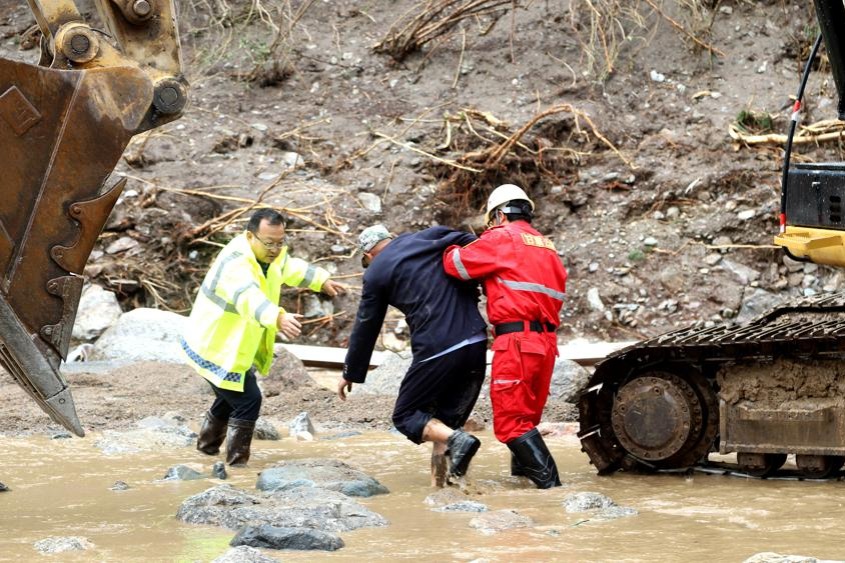
- Relief efforts begin in flood-affected areas of Gansu
- China rehearses 80th anti-fascism victory event
- Roads to flood-hit Gansu villages are reopened