Full Text: China's Space Program: A 2021 Perspective









BEIJING -- The State Council Information Office of the People's Republic of China published a white paper titled "China's Space Program: A 2021 Perspective" on Friday.
Following is the full text of the white paper:
China's Space Program: A 2021 Perspective
The State Council Information Office of the People's Republic of China
January 2022
Preamble
"To explore the vast cosmos, develop the space industry and build China into a space power is our eternal dream," stated President Xi Jinping. The space industry is a critical element of the overall national strategy, and China upholds the principle of exploration and utilization of outer space for peaceful purposes.
Since 2016, China's space industry has made rapid and innovative progress, manifested by a steady improvement in space infrastructure, the completion and operation of the BeiDou Navigation Satellite System, the completion of the high-resolution earth observation system, steady improvement of the service ability of satellite communications and broadcasting, the conclusion of the last step of the three-step lunar exploration program ("orbit, land, and return"), the first stages in building the space station, and a smooth interplanetary voyage and landing beyond the earth-moon system by Tianwen 1, followed by the exploration of Mars. These achievements have attracted worldwide attention.
In the next five years, China will integrate space science, technology and applications while pursuing the new development philosophy, building a new development model and meeting the requirements for high-quality development. It will start a new journey towards a space power. The space industry will contribute more to China's growth as a whole, to global consensus and common effort with regard to outer space exploration and utilization, and to human progress.
We are publishing this white paper to offer a brief introduction to China's major achievements in this field since 2016 and its main tasks in the next five years, in order to help the international community better understand China's space industry.
I. A New Journey Towards a Strong Space Presence
1. Mission
The mission of China's space program is: to explore outer space to expand humanity's understanding of the earth and the cosmos; to facilitate global consensus on our shared responsibility in utilizing outer space for peaceful purposes and safeguarding its security for the benefit of all humanity; to meet the demands of economic, scientific and technological development, national security and social progress; and to raise the scientific and cultural levels of the Chinese people, protect China's national rights and interests, and build up its overall strength.
2. Vision
China aims to strengthen its space presence in an all-round manner: to enhance its capacity to better understand, freely access, efficiently use, and effectively manage space; to defend national security, lead self-reliance and self-improvement efforts in science and technology, and promote high-quality economic and social development; to advocate sound and efficient governance of outer space, and pioneer human progress; and to make a positive contribution to China's socialist modernization and to peace and progress for all humanity.
3. Principles
China's space industry is subject to and serves the overall national strategy. China adheres to the principles of innovation-driven, coordinated, efficient, and peaceful progress based on cooperation and sharing to ensure a high-quality space industry.
- Innovation-driven development
China puts innovation at the core of its space industry. It boosts state strategic scientific and technological strength in the space industry, implements major space programs, strengthens original innovation, optimizes the environment for innovation, achieves industrial production as early as possible, and grows China's independent capacity to build a safe space industry.
- Coordination and efficiency
China adopts a holistic approach in building its space industry. It mobilizes and guides different sectors to take part in and contribute to this key industry, and coordinates all relevant activities under an overall plan. It ensures that technology plays a greater role in promoting and guiding space science and applications, and it facilitates the growth of new forms and models of business for the industry. These measures aim to raise the quality and overall performance of China's space industry.
- For peaceful purposes
China has always advocated the use of outer space for peaceful purposes, and opposes any attempt to turn outer space into a weapon or battlefield or launch an arms race in outer space. China develops and utilizes space resources in a prudent manner, takes effective measures to protect the space environment, ensures that space remains peaceful and clean, and guarantees that its space activities benefit humanity.
- Cooperation and sharing
China always combines independence and self-reliance with opening to the outside world. It actively engages in high-level international exchanges and cooperation, and expands global public services for space technology and products. It takes an active part in solving major challenges facing humanity, helps to realize the goals of the United Nations 2030 Agenda for Sustainable Development, and facilitates global consensus and common effort with regard to outer space exploration and utilization.
II. Development of Space Technology and Systems
China's space industry serves its major strategic needs, and targets cutting-edge technology that leads the world. Spearheaded by the major space projects, the country has accelerated research into core technologies, stepped up their application, and redoubled its efforts to develop space technology and systems. As a result, China's capacity to enter and return from space, and its ability to engage in space exploration, utilization and governance have grown markedly along a sustainable path.
1. Space Transport System
From 2016 to December 2021, 207 launch missions were completed, including 183 by the Long March carrier rocket series. The total launch attempts exceeded 400.
The Long March carrier rockets are being upgraded towards non-toxic and pollution-free launch, and they are becoming smarter boosted by modular technology. The Long March 5 and Long March 5B carrier rockets have been employed for regular launches; Long March 8 and Long March 7A have made their maiden flights, with increased payload capacity.
China now provides a variety of launch vehicle services. The Long March 11 carrier rocket has achieved commercial launch from the sea; the Smart Dragon 1, Kuaizhou 1A, Hyperbola 1, CERES 1 and other commercial vehicles have been successfully launched; successful demonstration flight tests on reusable launch vehicles have been carried out.
In the next five years, China will continue to improve the capacity and performance of its space transport system, and move faster to upgrade launch vehicles. It will further expand the launch vehicle family, send into space new-generation manned carrier rockets and high-thrust solid-fuel carrier rockets, and speed up the R&D of heavy-lift launch vehicles. It will continue to strengthen research into key technologies for reusable space transport systems, and conduct test flights accordingly. In response to the growing need for regular launches, China will develop new rocket engines, combined cycle propulsion, and upper stage technologies to improve its capacity to enter and return from space, and make space entry and exit more efficient.
2. Space Infrastructure
(1) Satellite remote-sensing system
The space-based section of the China High-resolution Earth Observation System has been largely completed, enabling high-spatial-resolution, high-temporal-resolution and high-spectrum-resolution earth observation. China now provides improved land observation services, having launched the Ziyuan 3 03 earth resources satellite, the Huanjing Jianzai 2A/2B satellites for environmental disaster management, a high-resolution multi-mode imaging satellite, a hyper-spectral observation satellite, and a number of commercial remote-sensing satellites.
In ocean observation, China is now able to view multiple indexes of contiguous waters around the globe on all scales, with high-resolution images from the Haiyang 1C/1D satellites and the Haiyang 2B/2C/2D satellites.
China's ability to observe the global atmosphere has achieved a significant increase. Its new-generation Fengyun 4A/4B meteorological satellites in the geostationary orbit are able to perform all-weather, precise and uninterrupted atmospheric monitoring and disaster monitoring to boost response capability. The successful launches of Fengyun 3D/3E satellites enable coordinated morning, afternoon and twilight monitoring, and the Fengyun 2H satellite provides monitoring services for countries and regions participating in the Belt and Road Initiative.
With further improvements to the ground system of its remote-sensing satellites, China is now able to provide remote-sensing satellite data receiving and quick processing services across the world.
(2) Satellite communications and broadcasting system
China has made steady progress in developing fixed communications and broadcasting satellite network, which now covers more areas with greater capacity. The Zhongxing 6C and Zhongxing 9B satellites ensure the uninterrupted, stable operation of broadcasting and television services. The Zhongxing 16 and APSTAR 6D satellites, each with a 50Gbps capacity, signify that satellite communications in China have reached the stage of high-capacity service.
The mobile communications and broadcasting satellite network has expanded with the launch of the Tiantong 1 02/03 satellites, operating in tandem with the Tiantong 1 01 satellite, to provide voice, short message and data services for hand-held terminal users in China, its neighboring areas, and certain parts of the Asia-Pacific.
The relay satellite system is being upgraded with the launch of the Tianlian 1 05 and Tianlian 2 01 satellites, giving a powerful boost to capacity.
The satellite communications and broadcasting ground system has been improved, to form a space-ground integrated network that provides satellite communications and broadcasting, internet, Internet of Things, and information services around the globe.
(3) Satellite navigation system
The completion and operation of the 30-satellite BeiDou Navigation Satellite System (BDS-3) represents the successful conclusion of the system's three-step strategy and its capacity to serve the world. BeiDou's world-leading services include positioning, navigation, timing, regional and global short-message communication, global search and rescue, ground-based and satellite-based augmentation, and precise point positioning.
In the next five years, China will continue to improve its space infrastructure, and integrate remote-sensing, communications, navigation, and positioning satellite technologies. It will:
· Upgrade its spatial information services featuring extensive connection, precise timing and positioning, and all dimension sensoring;
· Develop satellites for geostationary microwave monitoring, new-type ocean color observation, carbon monitoring of the territorial ecosystem, and atmospheric environmental monitoring;
· Develop dual-antenna X-band interferometric synthetic aperture radar (InSAR), land water resources and other satellite technology, for efficient, comprehensive earth observation and data acquisition across the globe;
· Build a satellite communications network with high and low orbit coordination, test new communications satellites for commercial application, and build a second-generation data relay satellite system;
· Study and research navigation-communications integration, low-orbit augmentation and other key technologies for the next-generation BeiDou Navigation Satellite System, and develop a more extensive, more integrated and smarter national positioning, navigation and timing (PNT) system;
· Continue to improve the ground systems for remote-sensing, communications and navigation satellites.
3. Manned Spaceflight
The Tianzhou-1 cargo spacecraft has docked with the earth-orbiting Tiangong-2 space laboratory. With breakthroughs in key technologies for cargo transport and in-orbit propellant replenishment, China has successfully completed the second phase of its manned spaceflight project.
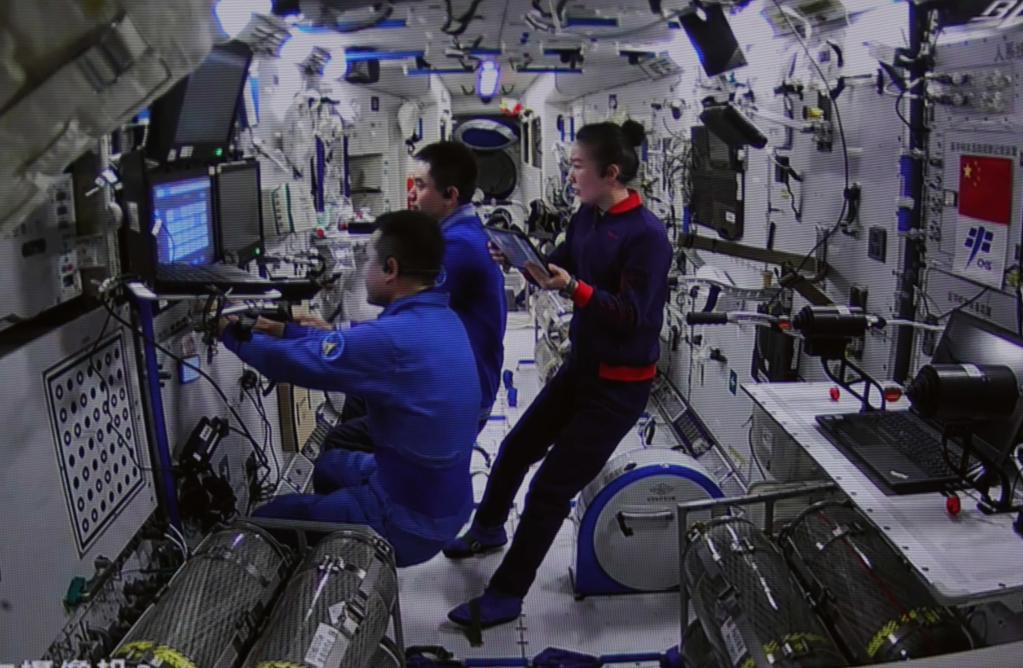
The launch of the Tianhe core module marks a solid step in building China's space station. The Tianzhou 2 and Tianzhou 3 cargo spacecraft and the Shenzhou XII and Shenzhou XIII manned spacecraft, together with the Tianhe core module to which they have docked, form an assembly in steady operation. Six astronauts have worked in China's space station, performing extravehicular activities, in-orbit maintenance, and scientific experiments.
In the next five years, China will continue to implement its manned spaceflight project. It plans to:
· Launch the Wentian and Mengtian experimental modules, the Xuntian space telescope, the Shenzhou manned spacecraft, and the Tianzhou cargo spacecraft;
· Complete China's space station and continue operations, build a space laboratory on board, and have astronauts on long-term assignments performing large-scale scientific experiments and maintenance;
· Continue studies and research on the plan for a human lunar landing, develop new-generation manned spacecraft, and research key technologies to lay a foundation for exploring and developing cislunar space.
4. Deep Space Exploration
(1) Lunar exploration
Achieving relay communications through the Queqiao satellite, the Chang'e-4 lunar probe performed humanity's first soft landing on the far side of the moon, and conducted roving exploration. The Chang'e-5 lunar probe brought back 1,731 g of samples from the moon, marking China's first successful extraterrestrial sampling and return, and the completion of its three-step lunar exploration program of orbiting, landing and return.
(2) Planetary exploration
The Tianwen 1 Mars probe orbited and landed on Mars; the Zhurong Mars rover explored the planet and left China's first mark there. China has achieved a leap from cislunar to interplanetary exploration.
In the next five years, China will continue with lunar and planetary exploration. It will:
· Launch the Chang'e 6 lunar probe to collect and bring back samples from the polar regions of the moon;
· Launch the Chang'e 7 lunar probe to perform a precise landing in the moon's polar regions and a hopping detection in lunar shadowed area;
· Complete R&D on the key technology of Chang'e 8, and work with other countries, international organizations and partners to build an international research station on the moon;
· Launch asteroid probes to sample near-earth asteroids and probe main-belt comets;
· Complete key technological research on Mars sampling and return, exploration of the Jupiter system, and so forth;
· Study plans for boundary exploration of the solar system.
5. Space Launch Sites and Telemetry, Tracking and Command (TT&C)
(1) Space launch sites
Adaptive improvements have been completed at the Jiuquan, Taiyuan and Xichang launch sites, with new launch pads installed at Jiuquan for the commercial launch of liquid fuel rockets, and the Wenchang Launch Site entering service. China has formed a launch site network covering both coastal and inland areas, high and low altitudes, and various trajectories to satisfy the launch needs of manned spaceships, space station modules, deep space probes and all kinds of satellites. In addition, its first sea launch site has begun operation.
(2) Space TT&C
China's leap from cislunar to interplanetary TT&C communications, with growing space-based TT&C capacity, represents a significant progress. Its space TT&C network has improved to form an integrated space-ground TT&C network providing security, reliability, quick response, flexible access, efficient operation and diverse services. TT&C missions of the Shenzhou and Tianzhou spacecraft series, Tianhe core module, Chang'e lunar probe series, and Tianwen-1 Mars probe have been completed successfully. TT&C station networks for commercial satellites are growing quickly.
In the next five years, China will strengthen unified technical standard-setting for its space products, and on this basis will:
· Further adapt the existing launch site system to better serve most launch missions, and make launch sites smarter, more reliable and more cost-effective to support high-intensity and diversified launch missions;
· Build commercial launch pads and launch sites to meet different commercial launch needs;
· Improve the space TT&C network in terms of organization, technology and methodology, grow the capacity to utilize and integrate space- and ground-based TT&C resources, and build a space TT&C network providing ubiquitous coverage and connections;
· Coordinate the operation and management of the national space system for greater efficiency;
· Strengthen the deep-space TT&C communications network to support missions probing the moon and Mars.
6. Experiments on New Technologies
China has launched a number of new technological test satellites, and tested new technologies such as the common platforms of new-generation communications satellites, very high throughput satellites' telecommunication payload, Ka-band communications, satellite-ground high-speed laser communications, and new electric propulsion.
In the next five years, China will focus on new technology engineering and application, conduct in-orbit tests of new space materials, devices and techniques, and test new technologies in these areas:
· Smart self-management of spacecraft;
· Space mission extension vehicle;
· Innovative space propulsion;
· In-orbit service and maintenance of spacecraft;
· Space debris cleaning.
7. Space Environment Governance
With a growing database, China's space debris monitoring system is becoming more capable of collision warning and space event perception and response, effectively ensuring the safety of in-orbit spacecraft.
In compliance with the Space Debris Mitigation Guidelines and the Guidelines for the Long-term Sustainability of Outer Space Activities, China has applied upper stage passivation to all its carrier rockets, and completed end of life active deorbit of the Tiangong 2 and other spacecraft, making a positive contribution to mitigating space debris.
Progress has been made in the search and tracking of near-earth objects and in data analysis. A basic space climate service system is now in place, capable of providing services in space climate monitoring, early warning, and forecasting, and is providing broader applications.
In the next five years, China will continue to expand its space environment governance system. It will:
· Strengthen space traffic control;
· Improve its space debris monitoring system, cataloguing database, and early warning services;
· Conduct in-orbit maintenance of spacecraft, collision avoidance and control, and space debris mitigation, to ensure the safe, stable and orderly operation of the space system;
· Strengthen the protection of its space activities, assets and other interests by boosting capacity in disaster backup and information protection, and increasing invulnerability and survivability;
· Study plans for building a near-earth object defense system, and increase the capacity of near-earth object monitoring, cataloguing, early warning, and response;
· Build an integrated space-ground space climate monitoring system, and continue to improve relevant services to effectively respond to catastrophic space climate events.
III. Developing and Expanding Space Application Industry
To serve the economy and society, China has promoted public and commercial application of its satellites and space technology, growing the industry towards greater efficiency.
1. Boosting Public Services with Satellites
The service capacity of satellite applications has markedly improved. The significant role of satellites is seen in the protection of resources and the eco-environment, disaster prevention and mitigation, management of emergencies, weather forecasting and climate change response, and also felt in social management and public services, urbanization, coordinated regional development, and poverty eradication. The space industry helps to improve people's lives.
The satellite remote-sensing system has been used by almost all departments at national and provincial levels to conduct emergency monitoring of over 100 major and catastrophic natural disasters around the country. It provides services to tens of thousands of domestic users and over 100 countries, having distributed over 100 million scenes of data.
The communications and broadcasting satellite network has made direct services available to over 140 million households in China's rural and remote areas, provided returned data for over 500 mobile phone base stations, and ensured efficient emergency communications during the responses to the forest fire in Liangshan, Sichuan province, to the heavy rainstorm in Zhengzhou, Henan province and to other major disaster relief work.
The BeiDou Navigation Satellite System has guaranteed the safety of over seven million operating vehicles, provided positioning and short message communication services to over 40,000 seagoing fishing vessels, and offered precise positioning services for the freighting of supplies and tracking of individual movement for COVID-19 control, and for hospital construction.
In the next five years, under the overarching goal of building a safe, healthy, beautiful and digital China, we will intensify the integration of satellite application with the development of industries and regions, and space information with new-generation information technology such as big data and Internet of Things. We will also extend the integrated application of remote-sensing satellite data on land, ocean and meteorology, advance the construction of infrastructure for integrated application of the BeiDou Navigation Satellite System, satellite communications, and the ground communications network, and improve our capacity to tailor and refine professional services. All these efforts will help to achieve the goals of peaking carbon dioxide emissions and carbon neutrality, to revitalize rural areas, and to realize new-type urbanization, coordinated development between regions and eco-environmental progress.
2. Space Application Industry
The commercial use of satellite technology is thriving, which expands the applications market for governments, enterprises and individuals. A group of competitive commercial space enterprises are emerging and realizing industrialized large-scale operation. A variety of products and services such as high-accuracy maps using remote-sensing data, full dimensional images, data processing, and application software are improving the service to users in transport, e-commerce, trading of agricultural products, assessment of disaster losses and insurance claims, and the registration of real estate.
The ability to commercialize satellite communications and broadcasting services has further improved. Four 4K Ultra HD television channels in China were launched and TV viewers now have access to over 100 HD channels. Internet access is also available on board ocean vessels and passenger aircraft. Tiantong 1, a satellite mobile communication system, is in commercial operation.
The satellite navigation industry has witnessed rapid growth as evidenced by sales of over 100 million chips compatible with the BeiDou system. Its industrial applications have been widely introduced into mass consumption, the sharing economy, and daily life. Achievements in space technology have helped traditional industries transform and upgrade, supported emerging industries such as new energy, new materials and environmental protection, enabled new business models such as smart cities, smart agriculture and unmanned driving to grow, making a great contribution to building China's strengths in science and technology, manufacturing, cyberspace and transport.
In the next five years, China's space industry will seize the opportunities presented by the expanding digital industry and the digital transformation of traditional industries, to promote the application and transfer of space technology. Through innovative business models and the deep integration of space application with digital economy, more efforts will be made to expand and extend the scope for applying satellite remote-sensing and satellite communications technologies, and realizing the industrialized operation of the BeiDou Navigation Satellite System. This will provide more advanced, economical, high-quality products and convenient services for all industries and sectors and for mass consumption. New business models for upscaling the space economy such as travel, biomedicine, debris removal and experiment services will be developed to expand the industry.





- Vice-chairman of CPPCC Jiangxi Provincial Committee placed under investigation
- Five trapped in flooding accident at Heilongjiang coal mine
- Long March 5 rocket deploys tech demo satellite into space
- China launches communication technology test satellite
- Spokesperson warns against aggression toward mainland fisherman
- Lhasa wetland reserve recognized as world's highest altitude wetland