Premier Li Keqiang meets the press:?Full Transcript of Questions and Answers









Premier Li Keqiang meets the press: Full Transcript of Questions and Answers
March 11, 2022
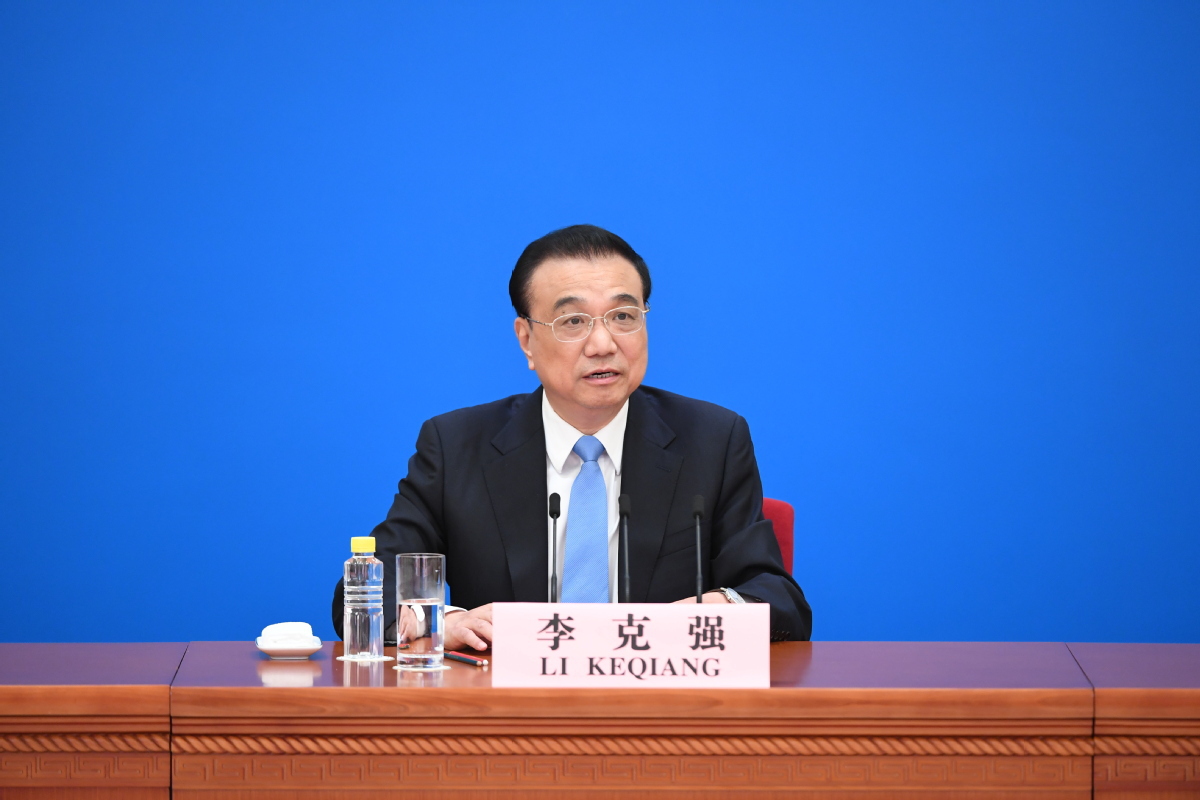
The Fifth Session of the 13th National People's Congress held a press conference at the Great Hall of the People on the afternoon of March 11, 2022. Premier Li Keqiang met with Chinese and foreign reporters and answered their questions at the invitation of Spokesperson Mr. Zhang Yesui.
In his opening remarks, Premier Li Keqiangsaidthat he was delighted to meet friends from the media and thanked the journalists for their hard work in covering China's NPC and CPPCC Sessions. He noted that due to COVID-19the press conference was again held via video link this year and then opened the floor for questions.
Associated Press: I want to get your thoughts on the economic challenges China faces as it transitions from a high-growth era to a more sustainable, equitable and green growth. In the past year, the government has taken steps to reduce debt in the real estate market and regulate the digital economy. At the same time, the government has set a 5.5-percent growth target that many economists see as ambitious given the pandemic and the war in Ukraine. Does this signal that China may make short-term adjustments this year that favor economic growth over a structural change and reducing carbon emissions? How does China balance the two? And specifically on Ukraine, how do China's important trading relationships with Europe and the US factor into the government's response to the crisis? Are you concerned that China's support for Russia could harm those relationships and then in turn the Chinese economy itself?
Premier Li: You asked about China's economic growth. Last year, China's economic aggregate reached over 110 trillion RMB yuan. Continued growth would be growth on a high base. Experience in the global sphere shows that it will be no easy for such a big economy to keep a medium-high growth rate. You said that a 5.5 percent GDP growth target for this year is viewed an ambitious one. I recall that at last year's press conference, a journalist asked me whether a 6 percent GDP growth target was a bit too modest. My response was that we were aware of the possibility for even faster growth of the economy because of a low base of the previous year. But still we decided to set the growth target at above 6 percent, meaning that we left possibilities open for even faster growth, say, 8 percent, and we would welcome that. Nevertheless, we set macro economic policies, including fiscal, monetary and employment policies, against this 6 percent GDP growth target. We cut the deficit-to-GDP ratio and steadily lowered the macro leverage ratio. And we reserved policy space for coping with new challenges this year. We followed the same approach in 2020. In spite of the severe situation, we refused to flood the economy with mass stimulus or excessive money supply. As a result, despite the high inflation worldwide, China's CPI rose less than 1 percent from last year to February this year. I think that very much has to do with our reasonable macro economic policies. Our macro economic policies are informed by China's national conditions, and I have no intention to comment on the policies of other countries here.
Last year, under the strong leadership of the CPC Central Committee with Comrade Xi Jinping at its core, and thanks to the joint efforts of people across the country, we successfully achieved the major goals and tasks for economic and social development for the year, and laid a good foundation for development this year. This year, we face new downside pressures and challenges, with much complexity and rising uncertainty. With China's GDP exceeding 100 trillion yuan, a 5.5 percent increase would generate the amount of output equivalent to the size of a medium economy. Ten years ago, when China's GDP was just over 50 trillion yuan, even a 10 percent growth would only add some 6 to 7 trillion yuan of output. But this year, even with a lower growth rate, the figure would reach 9 trillion yuan in nominal GDP. To use the analogy of mountain climbing, in climbing a 1,000-meter-high mountain, covering 10 percent of the height is a distance of 100 meters. But in climbing a 3,000-meter-high mountain, 5 percent of the height will already be 150 meters. Moreover, the higher one climbs, the lower the air pressure, and the less the oxygen. So the growth may look slower now, but it actually carries more weight.
We aim to achieve about 5.5 percent growth this year to ensure the steady performance of the Chinese economy at a high level, which is in itself a show of progress. To achieve this goal is not easy, and needs the support of a series of macro policies. Take fiscal policy for example, we have lowered our deficit-to-GDP ratio to 2.8 percent this year, a decrease of more than200 billion yuan over last year. But we will beef up government spending this year. One may naturally ask, how to pay for that? I have set it out in the Government Work Report. We will draw on the savings that we didn't tap into over the last two years, meaning we will use the surplus profitsof state-owned financial institutions and state monopoly business operations and funds transferred from the Central Budget Stabilization Fund. In total, government spending this year will rise by no less than 2 trillion yuan. Most of it will be used for tax and fee reductions, particularly tax refund, just like providing oxygen supply for mountain climbers. At the same time, we will roll out a series of supportive financial and pro-job measures too.
Our policies set for this year are not just aimed at addressing immediate needs. They also take into account long-term development needs. They will not sacrifice future interests and are therefore sustainable. Like you said, China is still faced with a series of challenges, such as climate change, income gap, and debt. We need to forcefully respond to them this year and in a medium-to-long run. The measures required are being worked on. China's modernization is a long process. We need to address issues arising in the course of development through development.
On Ukraine, the current situation there is a focus of international attention. China is deeply concerned and grieved. We sincerely hope that the situation will ease and peace will return at an early date. China has all along followed an independent foreign policy of peace, and never targets third parties in our bilateral ties. We want to develop cooperation with all countries on the basis of mutual respect and mutual benefit, to bring greater stability to today's world.
Reuters: Since Russia's attack on Ukraine, there have been two million refugees, hundreds of civilian deaths, and growing worries about the prospect of nuclear escalation. Yet China has refused to condemn Russia's conduct or call it an "invasion". Will China refrain from condemning Russia's conduct in Ukraine no matter what it does? Is China prepared to provide further economic and financial support for Russia as it faces sanctions? And is China concerned about sanctions blowback from other countries if it does so?
Premier Li: As I have just said, China follows an independent foreign policy of peace. Regarding the situation in Ukraine, China believes that the sovereignty and territorial integrity of all countries should be respected, the purposes and principles of the UN Charter should be observed, and the legitimate security concerns of all countries should be taken seriously. On that basis, China makes its own assessment, and is prepared to work with the international community to play a positive role for an early return to peace.
The current situation in Ukraine is indeed disconcerting. Utmost efforts should be made to support Russia and Ukraine in carrying forward negotiations despite the difficult situation to produce a peaceful outcome. We support and encourage all efforts that are conducive to a peaceful settlement of the crisis. The high priority now is to prevent the tense situation from escalating or even getting out of control. There is consensus about this among the international community, including the parties concerned.
China calls for exercising utmost restraint and preventing a massive humanitarian crisis. China has put forward an initiative for responding to the humanitarian situation in Ukraine. China has provided Ukraine with humanitarian assistance, and will continue to do so.
Reeling from COVID-induced shocks, the world economy is already struggling. Relevant sanctions will hurt the world economic recovery and are in no one's interest. China is ready to make its own constructive efforts in maintaining peace and stability and promoting development and prosperity in the world.
CNBC: The National Institute for Finance and Development says that fee cuts help small businesses more, and then second is the tax cuts. But are there exact figures for how the tax and fee cuts exactly helped the economy? And what are the considerations for local governments, especially as they are faced with the property market's slowdown and their effect to revenues? And finally, for the consumer aspect, are there considerations for using consumer vouchers or other measures?
Premier Li: Conclusions should be supported with theories and practices. Our practices in recent years show that tax and fee cuts have worked most directly. I recall that last year I had a conversation with a dozen business representatives in an eastern province. They talked about their corporate difficulties and their hope for more macro policy support from the government. I said that the central government had policies in reserve, yet we need to use them in an integrated way. I gave them three options to pick one they preferred the most. They are, massive investment, which will help them get orders; the second is handing out consumption vouchers to boost consumer spending; and the third is tax and fee reductions for enterprises to stabilize employment and boost investment and consumption. They were only quiet for a moment and almost unanimously chose the third policy option, because they believed it would work most directly in a most equitable and efficient way. Many reports I have received this year also take tax and fee cuts as the number one aspiration for the government's macro policies. Indeed, fertilizer needs to go to the root. When the root is strong, the plant can grow well.
Some worry that tax and fee reductions have been in place for several years, and the marginal effect of this policy will fade. In other words, The policy will not work as well as before. This year, we will combine tax and fee reductions with massive tax refunds, with a total amount of 2.5 trillion yuan. It was also with such policy intensity that we pulled through those very difficult times in 2020. We have made some adjustments this time, and tax refund will be the highlight of policy for 2022. Under the current VAT tax code, there will be tax collection first, and tax refund later for enterprises. This year, we will refund in advance the existing overpaid VAT credits in a lump sum worth 1.5 trillion yuan. If this works well, we are prepared to step it up.
Priority will be given to micro and small firms in the refunding of VAT credits, because these firms cover a wide range of sectors, large in number and provide many jobs. Currently, many of them are financially strapped and are in great difficulty. We will refund all the outstanding VAT credits to micro and small firms in a lump sum by the end of June. Refunding of VAT credits to manufacturing, R&D service providers and other key industries will be fully settled within this year. Newly increased VAT credits of micro and small firms will be refunded on a monthly basis. I recall that in my discussions with CPPCC members, a member who is also a businessman told me that compared with other tax and fee cuts and investment policies, tax refunds work the fastest and the best, whereas investment projects involve a lot of procedures. VAT refunds, however, are like direct funding support for the liquidity of businesses. They are what firms need most. Getting one concrete thing done is more important than making 1000 promises. We must see to it that this policy highlight will be fully delivered.
Tax refunds and fee cuts are making subtraction, but could also be addition in essence. Refunds today could lead to increase in tax revenue in the future. For example, last year, newly registered market entities paid more taxes than the amount of tax reductions for the year. There are clear records for this. Since 2013, with the launch of VAT reform, we have cut taxes by the amount of 8.7 trillion yuan. Back then our fiscal revenue was about 11 trillion yuan. Last year, fiscal revenue exceeded 20 trillion yuan, nearly double the amount in 2013. In this process, businesses have truly benefited and improved their performance. It's like building a deeper pool to farm more fish. The tax refunds and fee cuts have helped create more sources of tax revenue and nurture business growth.
You mentioned new difficulties local governments face in their fiscal revenues. The central government is aware of that. This year the central government's transfer payments to local governments will rise by 18% and reach 9.8 trillion yuan, an amount rarely seen over the years. Most tax refunds will be financed by the central government, and a certain amount will also be shared by local governments. I want to emphasize that tax refunds will go straight to businesses and given the difficulty of primary-level governments, transfer payment subsidies will be channeled to prefecture- and county-level governments and below. All local governments must count every cent and make every cent count to ensure that all funding support for businesses will be fully delivered, and it would be even better if more could be done.
Phoenix TV: Over the past year, elections of the Election Committee and the seventh Legislative Council were held in the Hong Kong Special Administrative Region. This year, election of the sixth-term Chief Executive will be held there. Close attention is being paid to how this election will be conducted under the new electoral system and at a time when the COVID situation in Hong Kong has yet to turn the corner? What is your comment, Mr. Premier?
Premier Li: The current COVID situation in Hong Kong is indeed serious. The Hong Kong SAR government has decided in accordance with the law to postpone election of the sixth-term Chief Executive to concentrate on dealing with the COVID situation. We have full understanding and support for that. The Central Government follows the COVID situation in Hong Kong every day and has deep concern for the life, health and safety of residents in Hong Kong. The Hong Kong SAR government needs to fulfil its primary responsibility in tackling the situation and the Central Government will give full support.
We are steadfast in our commitment to fully and faithfully implement the principle of One Country, Two Systems under which the people of Hong Kong administer Hong Kong with a high degree of autonomy. The change of government in the Hong Kong SAR will happen in strict accordance with relevant provisions in the Basic Law. We hope the SAR government will unite and lead people across sectors in Hong Kong to continue to grow the economy, improve people's lives, consolidate and elevate Hong Kong's status as an international financial, trading and shipping center, and maintain Hong Kong's long-term prosperity and stability.
CCTV: We are seeing unstable business expectations, job cuts in certain industries and layoffs by some companies. Meanwhile, more job seekers are joining the labor force. Mr. Premier, what measures will the government take this year to achieve the goal of stable employment?
Premier Li: Employment bears on people's lives and the country's development. A job helps to generate income, make life promising and create wealth. I recall that in my visit to enterprises last year, the head of a company told me that many of their employees would ask for an advance on wages in August every year, because they need the money to pay their children's tuition fees in September.
Before this year's Spring Festival, I visited rural areas in China's northwest. A local farmer told me that he had one child in college with a cost of 10,000-plus yuan each year, and one other child in senior high school with a cost of more than 8,000 yuan a year. He said that he had to go to work in the city, or he wouldn't be able to make enough money to cover these expenses by just growing grain on his small land plot. I have always been deeply touched by the hard work of our people. Staying in work is not just about earning enough to support family, but also securing a better life for the younger generation.
We will step up the implementation of our macro policies this year, and fiscal and monetary policies need to help us achieve the goal on employment. Hence, our employment-first policy is also a macro policy,whose implementation will be supported by other policies. Each year we need to create over 11 million, preferably 13 million new urban jobs. If we could achieve maximum employment, we would be able to achieve what some people say, China's potential economic growth rate.
There is one concrete example here. In the raging times of COVID-19 back in 2020, we decided not to set a GDP growth target, but we set the target of new urban jobs at above nine million. The outcome was that we created over 11 million new urban jobs. China's economic growth stayed in the positive territory, and reached 2.2 percent. The Chinese economy was the only one among major economies to achieve a positive growth.
This year we will see a record high increase of new job seekers into the labor force, totaling some 16 million. There will be 10.76 million students graduating from college, another record high. There needs to be work for some 300 million rural migrant workers. Jobs also need to be provided to ex-service members. And some people are waiting to get re-employed in case of business insolvency. There is a steady increase in the urban labor force, and new platforms of employment need to be created. The government will provide these new job seekers with training opportunities and other support. More importantly, we need to rely on market-oriented means to resolve employment issues. In recent years, we have pursued the initiative of mass entrepreneurship and innovation, and promoted the development of new technologies, new industries and new business models to foster new drivers of growth. We believe that there is great intelligence and potential in each individual. When their talent and potential is fully brought out, we can open great prospects for employment.
I would be remiss if I did not mention flexible employment here. Over 200 million people are now engaged in flexible employment which takes multiple forms and covers a wide range of sectors. This kind of employment will long exist in a developing country like China. Many of the people in flexible employment are express delivery service providers. They have to work braving winds and rains. Many localities have provided them with heart-warming services. The government should improve policies related to their labor rights and interests as well as social protection, just like providing safety belt to deliverymen. In this way, these new forms of employment will not only meet people's pressing need, but also help unlock market vitality and public creativity.
EFE: We are already two years into the pandemic. And China has remained closed to the world during all this time. So my question is for how long is zero-COVID policy sustainable for China? Is there a roadmap to start reopening the country in the foreseeable future?
Premier Li: The novel coronavirus is a common enemy of humankind. The virus has been with us for two years, yet is still changing. Much remains to be learned about it. Meanwhile, protection through vaccines and R&D of effective drugs need to be enhanced. The international community should embrace unity, cooperation and mutual assistance, show greater mutual understanding and accommodation, and make joint efforts to create conditions for our world's early return to normal.
China has adopted a coordinated approach to COVID response and economic and social development. We have been actively promoting international exchanges and cooperation. We will make our response more scientific and targeted in light of the evolving COVID situation and features of the virus, to protect people's life and health, keep up the normal running of work and life, and ensure the security of industrial and supply chains.
In my many conversations with heads of international institutions and multinationals as well as business leaders since the pandemic started, many expressed the hope for ensuring necessary business exchanges. China has opened the "fast lanes" and "green corridors" to ensure the normal running of companies and projects in key areas. We will continue to gain experience and be adaptable to new developments, to gradually restore unimpeded flow of goods and personnel in an orderly way.
Xinhua News Agency: Recent years have seen steady improvement in China's business climate, as evidenced by a surge in market entities and easier access to government services for enterprises. However, various disturbances to business activity still exist. What more will the government do to improve the business climate and better stimulate market vitality and public creativity?
Premier Li: Every year in the past decade, the State Council would hold a national work conference on the reform of government functions and improvement of China's business climate. I've also noted that improving business climate was high on the agenda of the first meetings of many local governments in the new year. Reforming government functions could be likened to improving soils for the growth of market entities. Our policyof tax and fee reductions is like applying fertilizer and water, and the initiative of mass entrepreneurship and innovation aims to help more market entities take root and grow. When public creativity is leveraged, and the vitality of market entities unleashed, one could well anticipate vibrant economic growth. This requires the government pursue self-targeted reform to see that government power does not revolve around departmental interests. Rather, we need to advance reform to help market entities to emerge and flourish.
Shaking up vested interests could be more difficult than touching the depths of souls. Yet we must keep up the consistency of policy, which is critical for exercising governance. We have pressed ahead with market-oriented reforms and the reform of the government's own functions over the years. Through these reforms, over 1,000 administrative approval items have been canceled or delegated to lower-level authorities. The non-administrative approval requirement was made a thing of the past. It used to take several dozen days, even up to over 100 days, to open a business. But now, it takes only four days, or just one day in some places. About 90 percent of government services can now be accessed inter-provincially, online or through cellphone apps, with no need of making physical visits. These measures have helped eliminate the thickets of vested interests and change the government's traditional way of thinking. And we will work to bring more benefits to businesses and the people.
With an improving business climate in recent years, the number of market entities in China has reached 150 million, a net increase of 100 million over ten years ago. Most of them are privately-held, among which self-employed households now amount to 100 million. No one should underestimate these self-employed households. They support the livelihoods of many families, and meet consumer demand. Entrepreneurs in the CPPCC told me had it not been for the role of those micro and small firms and self-employed households in keeping up unimpeded flows of the economy, bigger companies, even state-owned enterprises and centrally-managed enterprises, would be hamstrung.
With bold reform measures, a sound business climate and a large number of market entities, a place often enjoys bright economic prospects. I have also repeatedly stressed that streamlining administration and enhancing oversight should go hand in hand. Streamlining administration does not mean a diminishing in government responsibilities, and the government has the duty to exercise regulation and supervision. Delegation of authority shouldn't give rise to regulatory gaps either. We will resolutely combat the malpractices of counterfeiting and cheating on marketplace. We will enhance regulation in areas concerning people's life and health and public interests, like food, drugs, workplace safety and the financial sector, and deal with any violation of laws and regulations. As new forms of industry and new business models keep developing, we will improve our regulatory approaches to ensure that market entities can truly compete and grow in a fair and just environment.
Bloomberg News: Fifty years ago, then US President Richard Nixon visited China and began what became known as a period of American engagement with China. Last year, the Biden administration said that period had come to an end, and China and the US were headed instead into a period of intense competition. I wonder Mr. Premier, if you would agree with that assessment? Will things such as bans on American semiconductors being sold in China or bans against Chinese companies listing shares in the US become more and more common?
Premier Li: Fifty years ago, China and the US broke the ice and started a journey of normalizing relations between the two countries. Half a century has passed. China-US relations have all along been moving forward despite ups and downs. We hope that the two countries will act in accordance with the common understandings reached between the two Presidents in their virtual meeting at the end of last year, respect each other, live together in peace and pursue win-win cooperation. We hope the two countries will properly manage differences in a rational and constructive manner, and respect each other's core interests and major concerns. It is preferable to have more dialogue and communication. Now that the door has been opened, it shouldn't be shut again, still less should there be decoupling.
China and the US are both permanent members of the UN Security Council, and the world's largest developing and developed countries respectively. Getting this relationship right serves the well-being of people of both countries. Many global challenges today require the joint efforts and cooperation of China and the US. It is fair to say that China-US cooperation is beneficial to both countries and the world.
China and the US are vastly different in social system, history, culture and stage of development. Disagreements are hardly avoidable. However, we believe cooperation should be the mainstream, because global peace and development hinges on cooperation. Even if there is market competition between the two countries in economy and trade, it should be healthy and fair. Last year, China-US trade exceeded US$750 billion, up nearly 30 percent over the previous year. This shows China-US cooperation has extensive areas and much untapped potential. If the US chooses to ease its export restrictions on China, two-way trade volume will grow even bigger, delivering more benefits to both countries and their peoples. China is ready to work with the US to expand common ground and pursue interests for the long run.
China News Service: We find that due to COVID-19 impacts in the past two years, many street-side eateries and small restaurants have no longer opened for business since closure. In addition to catering, industries like hospitality, retail and passenger transport have also been hard hit. It was proposed in the Government Work Report that efforts will be made to keep business operations stable and ensure job security. Mr. Premier, what measures will the government take this year to help these industries in distress?
Premier Li: COVID-19 has hit the services sector the hardest, especially contact-based service industries. Many firms in these industries are micro, small and medium-sized enterprises who are already quite weak financially and running on a tight budget. The building up of difficulties is too much for them to bear. Supporting their operations is helping maintain job security, because the 100 million self-employed households are providers of close to 300 million jobs. We must provide them with timely help as they play an important leveraging role irrespective of size. Timely support is critical, because it will be too late to water a plant if the root is dried out.
For these industries in special difficulty, we have worked out over 40 supportive measures. Tax refunds alone for catering, tourism, passenger transport and the cultural sector will amount to 180 billion yuan. In addition to fiscal support, we encourage banks to provide loan extension on a seamless basis for promising businesses. We also urge temporary cuts or exemptions of rentals and electricity bills where possible for these market entities, and capable local governments should also extend support. This is also a way of property owners keeping the clients.
Consumer demand is indeed quite subdued now, especially consumption in bricks and mortar shops. We may well imagine a lively city life is very much about the hustle and bustle in marketplaces and shops. Business closure is no good news for anyone. It could even affect people's daily lives. In this sense, policy support for the industries in distress is not just to tide these industries over difficulties; it also helps add warmth to people's lives and bring greater vibrancy to the economy.
ET Today of Taiwan: Under the situation of further spread of the coronavirus and rising uncertainty and instability in the cross-Strait relations, how will the mainland respond to the situation across the Taiwan Strait, and uphold and promote the well-being of people on both sides of the Strait?
Premier Li: Our major principles and policies on work related to Taiwan are clear-cut. I have laid them out in the Government Work Report. That is, we are committed to the one-China principle and the 1992 Consensus. We firmly oppose separatist activities seeking "Taiwan independence" and we will advance the peaceful growth of cross-Strait relations and the reunification of China.
At the end of the day, compatriots on both sides of the Taiwan Strait are members of one family. At no time can this fraternal bond be severed. We will continue to share with our Taiwan compatriots development opportunities, provide those on the mainland with equal treatment, and take concrete measures to benefit them and help them resolve difficulties. When people across the Strait come together and forge ahead in unity, we can surely promote the peaceful growth of cross-Strait relations, and share in the well-being of the rejuvenation of the Chinese nation.
Lianhe Zaobao: The year 2022 is the last year of the current term of the Chinese government. Looking back at the course of governance in the past four years, what do you think are the major achievements of this government? What is the biggest challenge for it? With China's economy under unprecedented pressure, what will be the government's policy priorities in the last year of its term, to keep up public confidence and respond to people's concerns?
Premier Li: Since the formation of this government, there have been much complexity and change in the international environment, as well as entwined difficulties and challenges at home. But the biggest challenge came from the COVID-19 pandemic, which dealt a heavy blow to China's economy. In responding to the challenge, we have not settled for the easy option or shied away from what's difficult and the risks, and have put in our greatest efforts.
I recall that at my first press conference as Premier, held in this very same place, I laid out the basic tasks for the government as sustaining economic development, improving people's lives and promoting social fairness. I also said we need to follow the Great Way, put people first and deliver benefits for all. In other words, the people's wish always points the way for the government. This is what we have been doing consistently and diligently throughout the years. We have been innovative in exercising governance. We have dealt with cyclical fluctuations in economic activity by keeping major economic indicators within an appropriate range. In particular, we have implemented macro policies in a way that is directly responsive to the needs of market entities. We have pressed ahead with reforms to cut red tape and uphold justice. We have nurtured and supported the growth of market entities and new drivers of growth to boost market vitality and social creativity. We have implemented an employment-first policy and focused on ensuring people's basic welfare in keeping with national realities. We are aware that while our people are happy with some aspects of the government's work, there are also areas where we still fall short of their expectations.
You said this year is the last year in the current term of the Chinese government. This year is also the last year of my premiership. We are still faced with a complicated and challenging environment and there are still many difficulties and challenges at play. As to how to respond to these challenges and difficulties, I have set out our policies in the Government Work Report and also in my answers to some previous questions. I and my colleagues will make persistent efforts, conscientiously perform our duties and take solid steps to live up to our promises.
I am confident that under the strong leadership of the CPC Central Committee with Comrade Xi Jinping at its core, with the strong support of various sectors, and especially with the joint hard work of the Chinese people, China's economy will be able to overcome difficulties. We will be able to achieve the major goals and tasks for economic and social development set for the whole year, and lay a due, solid foundation for the future development of the country.
People's Daily: China's per capita income has been steadily rising in recent years. However, many people still find their lives quite hard. In particular, meeting of people's basic living needs has been quite severely affected by COVID-19. Mr. Premier, what will the government do this year to further improve people's lives?
Premier Li: Indeed, in recent years, our people's income has been growing in tandem with GDP. However, China remains a developing country. There is still a notable urban-rural gap. It will take a long time for us to achieve equal access to public services across the country. A report I received early this year listed the people's top ten hopes for their life this year. Most of them concern basic living needs or come from farmers. Ensuring and promoting people's lives should always be the fundamental purpose of the government's effort in growing the economy. The government must continue to make utmost efforts and within its capacity to keep making improvements to people's lives.
China's fiscal revenue has reached 20 trillion yuan, but the country still faces fiscal strains. Nevertheless, we have managed to keep fiscal spending on education above 4% of GDP for ten consecutive years. This is by no means easy. Most of the government spending has gone to compulsory education and supported rural areas, because we still have 760 million registered rural population in China. We will increase government funds to compulsory education in rural and remote areas.
We have established in China the world's largest medical insurance system covering some 1.4 billion people. However, the benefits are still quite modest at the moment. This year, the government will increase the government subsidy by 30 yuan per person. We have established a program of medical insurance for major illnesses, using basic medical insurance funds for the purchase of commercial insurance for major illnesses. In some places this program has enabled reimbursement of 300,000 to 500,000 yuan for some illnesses. And no particular numerical cap is put on the amount of reimbursement in certain regions. On average, some 70% of medical bills of rural and urban non-working residents can get reimbursed, and we will increase the benefits as our capacity grows. In particular, we need to consolidate the outcomes in ending absolute poverty and provide particular support to people who risk falling back to poverty due to illness or struggle with poverty caused by major illnesses.
Meeting basic living needs concerns people's daily lives. Nowadays some 100 million Chinese are in cross-provincial mobility. Some are elderly people living away from hometowns with their children in cities. Some are for employment or education. They face much hassle of travel in getting certain things done. Hence, accessing government services inter-provincially has become a new constant demand among the people. One new policy we will introduce this year is to make ID cards that are in most frequent use in people's daily lives electronic, which helps one get certain things done by a simple code-scanning on cell phones. We will also provide convenience for people who do not use smart phones, especially the elderly. In the meantime, we will ensure information security and individuals' privacy.
To ensure the basic living needs of our people, we must take every bit of solid effort and put heart into it. We must be fully aware of the situation on the ground and always heed the people's call. Livelihood issues are linked with the conditions people face, public opinion and even popular support. The government is duty-bound to follow the aspirations of the people, help them resolve difficulties and enable them to lead a better life.
Here I want to emphasize that a people's government must live up to its responsibility of protecting the people's lawful rights and interests. The recent incident involving gross violations of women's rights and interests is deeply distressing and we feel indignant about it. Those who showed disregard for people's rights and interests must be held to account. Perpetrators of the trafficking of women and children must be brought to justice and prosecuted to the full extent of law. Ensuring people's safety and bettering their lives cannot be separated. Governments at all levels must take it as their basic responsibility and do their best to improve people's lives and protect their safety.
Kyodo News: China is working toward the goal of common prosperity and said it will adopt a traffic-light regulatory approach to prevent unregulated expansion of capital. Regulation over giant internet companies has been tightened. Some foreign investors are hence concerned that China will put more restrictions on corporate behaviors because of the goal of common prosperity. How does China see this? How to alleviate the concerns of foreign investors?
Premier Li: Common prosperity can only be attained through common efforts. As far as China's opening-up policy is concerned, there has been no change in our position, and nor will there be a change. Moreover, there are clear-cut stipulations in China's Foreign Investment Law. If there will be any change, the change will be conducive to China's greater openness, and to promoting investment and trade.
Foreign investors coming to do business in China have developed themselves, and also brought us investment, sales channels and products we need. It benefits us all. Why should we restrict it? I referred to the reform of government functions in previous answers. Under this reform, we highlight the need to streamline administration and delegate power, enhance regulation and upgrade government services. We are opposed to monopoly and unfair competition and will prevent the unregulated expansion of capital. These efforts aim to motivate and support law-abiding businesses, and provide a level playing field for businesses under all types of ownership, and for both domestic and foreign-invested enterprises to compete fairly. We hope all enterprises will grow in a healthy and well-regulated way.
China is a very big country, so it is natural for individual cases to exist. But overall, China's economy has deeply integrated into the world economy. China's imports and exports in goods now take up more than one third of the country's GDP. The level of overall impacts of imports on the industrial sector is over 70 percent. For the past 10 years in a row, China has remained the world's second largest import market, and for the past five consecutive years, the largest trader in goods. On the whole, we are still transitioning from a lower-middle level on industrial chains to medium and high end. However, this also shows that Chinese industries and consumption are upgrading,and there is tremendous market potential and broad space for all types of investment.
China has signed with relevant countries the Regional Comprehensive Economic Partnership Agreement. The agreement has officially entered into force this year. It creates the world's largest free trade area. We will make the most of this opportunity and continue to advance free trade. We will treat state-owned enterprises, privately-held firms and foreign invested enterprises as equals and make continued efforts to make China a popular destination for global foreign investment.
I can tell you clearly that no matter how the international environment may change, China will keep to the course of wider openness, just as courses of the Yangtze and Yellow rivers will not reverse. Over the past four decades, China has all along developed itself in the course of reform and opening up. We will actively pursue anything that is conducive to high-level opening-up of this country. We will firmly uphold the multilateral trading system, as this is necessary for our own development.
It has been 40-plus years since China started opening-up. Through opening-up, China has developed itself, and brought benefits to its people and to the world. We will not and must not close this door of opportunity.
The Press Conference was held via video link between the main venue, the Golden Hall on the third floor of the Great Hall of the People, and the Press Center for the NPC and CPPCC Sessions at Media Center Hotel. It lasted for about 130 minutes.




- China publishes chronicle of CPC events from 1921 to 1949
- China's former senior provincial political advisor arrested for suspected bribery
- Chinese, Russian coast guards jointly inspect North Pacific high sea vessels
- China brings back 20 telecommunications fraud suspects from Myanmar
- Guangzhou medical expert awarded for ethnic unity
- Wuxi launches National Day celebrations with concert