Limits to Growth author: China a leader in climate change response










Half a century ago, the Club of Rome came to the conclusion physical growth cannot continue forever on a finite planet. The Limits to Growth, commissioned by the group in 1970, warned rapid growth in population, use of resources and pollution would have to stop within 100 years if humanity was not going to destroy the global environment.
Now half a century has passed and human progress has increased the pressure on global boundaries, even beginning to exceed some of them - particularly in the climate area. Global warming and associated climate change and extreme weather are emerging as the main threat to human well-being for the rest of this century.
In an exclusive interview with China Daily, Jorgen Randers, co-author of The Limits to Growth, shared his thoughts on the future of humanity and China's role in the global response to climate change.
In the view of Randers, "the politics of the 21st century will be dominated by physical boundaries, especially in the climate area."
The following is the full content of the interview, which was edited for clarity and brevity.

China Daily: In that report (The Limits to Growth), there were several types of collapses prophesied, one of which was environmental collapse. And well, here we are, 50 years later and we're on the verge or are already in the process of seeing this happen.
So besides being vindicated in that way, which is not a pleasant thing, if you would talk about where we appear to be going, what action has been taken, and what action needs to be taken.
Randers: The Limits to Growth warned about overshoot and collapse in the 21st century caused by environmental constraints, basically because the world had limited resources, or limited pollution absorption potential or limited land area.
So now we are 50 years later, and it is easy to see the world has overshot, that we have expanded the population and climate emissions, and to some extent the resource or the use of land, at least the use of forests beyond what is sustainable in the long run.
But we have not yet seen collapse. If there have been collapses, they have typically been very local and not necessarily caused by environmental reasons, more by bad government or mismanagement.
In general, the main overshoot is in the climate area. Humanity is emitting currently twice as much CO2 and all the other greenhouse gases every year as is being absorbed in the oceans and the biomass of the world.
And this remaining half remains in the atmosphere and increases the concentration of CO2 in the atmosphere year by year. And as concentration of greenhouse gases gets higher, the temperature gets higher.
And this is going to continue until not only do we stop emitting CO2, we actually have to suck the CO2 out of the atmosphere in order to draw the temperature back down to pre-industrial levels.
In my mind, what is going to happen over the next 50 years is we will continue the global attempt at reducing greenhouse gasses, but we will do it as slowly and as indecisively as we have done over the last 40 years. And as a consequence, it's getting to be warmer and warmer and more and more unpleasant for people throughout the world.
The big question then is: "Will there be collapse?" We have just finished a big study called Earth for All. And the conclusion that comes out is we do not foresee any big collapse in the climate area or in the resources area there within the next 50 years or so.
But I do think we will experience a number of more local social collapses where people get so frustrated they stop supporting the strong governmental action that is needed in order to solve the problem, thereby making the problem even more serious, then making people even more depressed, and so you get a vicious downward spiral.
This I don't think will be global. In our new study, we indicate the problem can be solved, and you need extraordinary actions to solve the problem. And we're pointing to the fact these things cost a little more than doing nothing. And consequently it's not very easy to get democratic societies to agree on this front in order to make a better life for people 30 to 60 years in the future.
And the climate problem still can be solved, but it will require strong, active governmental action. This is not going to be solved by the market or by voluntary action by individuals. And we think it's very difficult to gather the political support necessary in order to get a strong action going.
China Daily: So it's obviously not a rosy picture, but it's better to be truthful than to be falsely optimistic. And so bringing it to China's climate action, what are your thoughts on China's actions? Do they represent the kind of vast whole-of-society effort that's necessary to make these changes in time to prevent the worst catastrophes?
Randers: Concerning China as a role model, I have already for a decade pushed the view that China is probably going to save the world. It's China that is actually going to lead the way. And the current ambitions of China, if followed by the whole world, are enough to basically solve the problem.
If the whole world peaks its CO2 emissions within the next decade and then draws it down to zero at around 2050 or 2060, in our model system this is enough to keep the temperature rise below 1.5 C .
It isn't the whole rest of the world that needs to follow China to solve the problem. It would be enough if the three greatest emitters of greenhouse gases in the world, namely the United States, the European Union and China, got together and followed the policies of China, that's essentially enough to solve the problem.
So one could leave the other 180 or 170 nations, the world's mostly poor nations, to pursue their main job, which is to remove global poverty.

China Daily: One of the prescriptions that you lay out is the donation of technology and expertise in terms of climate reduction from the global North to the global South.
If you could talk about this notion of the global North assisting the global South, and also the quintessential question of development versus environmental protection. Are they necessarily opposed to one another? Or is it possible to have both? And if so, what are the steps needed to continue developing countries' processes of fixing the poverty problem without contributing to emissions?
Randers: From a global perspective, it is important to remember that the rich constitute roughly 1.5 billion people out of the 8 billion people on the surface of the Earth.
So it's enough for the rich world to simply lower its emissions by 50 percent to give enough room for normal economic development of the rest of the world to $15,000 per person a year, which I see as the threshold for moderately rich.
This is also a fair solution, that the ones that have made the problem spend their time trying to undo the damage, and then you leave it to the others to continue to solve the poverty problem.
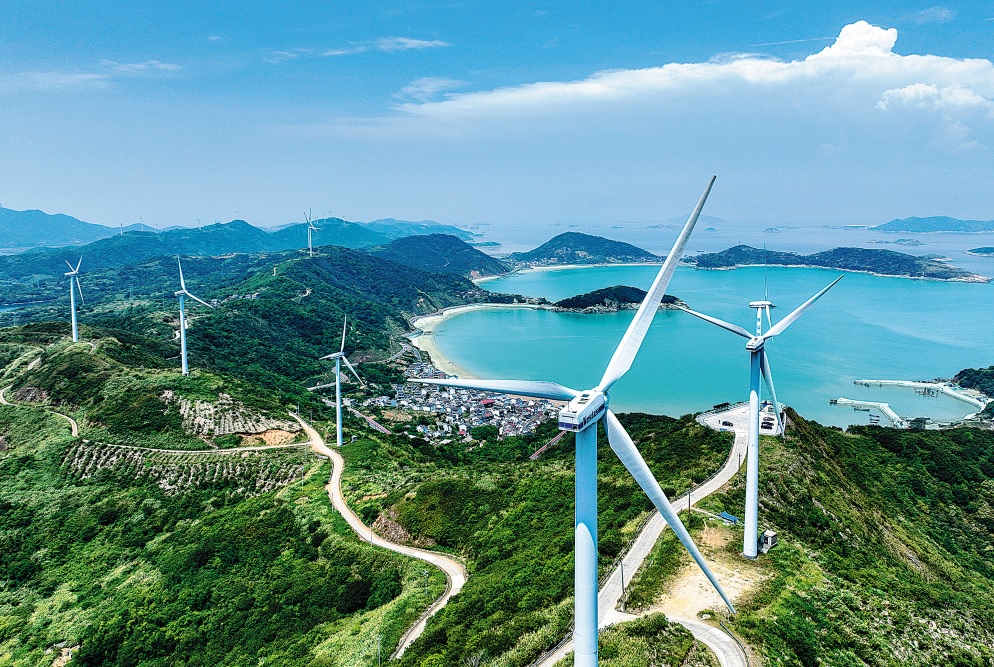
Of course, it would greatly help if the poverty reduction was done in an environmentally friendly manner so instead of building coal-fired utilities in the global South they would be building solar panels, windmills and offshore wind instead.
In my mind, this is perhaps the most useful development assistance the rich could provide to the South was simply to build wind, sun, biomass and other low-carbon energy sources in the South and just give the capacity to the South so they get the energy necessary in order to undertake the economic development which they need.
If they should pay for this power, one should organize it in a manner where they pay 30 years in the future. You know when the poor world needs pension income and when they have evolved the industrial muscle that is necessary in order to repay. So here is the sequence.
And both the climate problem and poverty problem need to be taken seriously. If you only try to solve the climate problem and you try to do this in an unfair manner, you won't succeed because you won't get sufficient support for forward action.
The rich world should try to help as much as possible in the economic development of the South. But it is not easy to pursue traditional development assistance procedures, the Washington Consensus, etc. It does not seem to help.
We have tried for 40 years developing the global South without much luck. At the same time, China has over the last 40 years achieved fast GDP growth for 1.4 billion people, and have in many ways done and proven the economic miracle that we are aiming for in the South can be done.
Concerning the final question: Can the globe handle 8 billion people at $15,000 per person a year? And my answer is yes. It is more or less doable quantitatively. The reason why I believe that is that the world population is going to peak in another 20 years or so, and then decline so the world population at the end of this century will only be around 6 billion people. So we will be back to the population at the entry of this century.
And luckily, it takes time before people get rich and before their footprint increases. And so when poverty really has been removed in the global South, the total world population will be much lower, so the total footprint still will be within the boundaries of the planet.

China Daily: This also leads to the next question about rich countries' cooperation on the climate problem. It's a global problem and requires global solutions. How can countries overcome their differences?
We're in a time right now where tensions, particularly between the US and China, are very high, and there are profound disagreements that exist. So how can countries, with these differences, work together to find common solutions while maintaining whatever other disputes they may have.
Randers: Obviously, this is difficult. Back two or three years, we were at the stage where Europe and China started talking about the possibility of having one carbon market, one common tax on fossil fuels in those two nations, and then putting up a trade barrier around China and the EU so people who did not pay the huge tax on coal, oil, and gas are not allowed to trade freely with the EU and China bloc.
They could, of course, trade freely if they entered the same tax level on their coal, oil and gas, and then they would be admitted into this free trade zone that existed in isolation from the polluting world.
And there was a time when this was on the verge of being possible. And the idea would be then to go to the United States, who would oppose fiercely being locked out of free trade with the EU and China, and then basically force the Americans to introduce the same fossil fuel taxes. This would be hard in the US, because at least half of the population is fiercely against strong government and taxes.
But you know, on the other hand, if that was the price to be paid for continuing trade with EU and China, there was hope. So at this point in time, this is of course less realistic. Getting the US into such a game, I think it is no longer possible.
But still the EU and China could do a thing like this. And in my mind, if the Chinese authorities decided to give it a try, and then invited the EU into a conversation with this joint goal of putting in place a carbon tax inside the EU and in China, you don't need a complicated trading system. You simply have a very high tax on coal and gas. And that ambition would be we continue to trade freely inside, and then we'll try to convince other important players to join the club.
This is the one of the few approaches I still believe could succeed.
That's the international approach. Concerning national approaches, of course what nations should do is build renewable energy capacity as quickly as they can, using the manpower that they currently use for producing coal, oil and gas.
The renewable and sustainable solutions are largely slightly more expensive than the dirty solution. And consequently, the market will not get this strong and fast shift. So it needs subsidies. Basically, the government needs to subsidize what it wants.
China Daily: In terms of China's approach, you've said that if the world followed China's plan, that would be a solution to the problem. Are there any other things China has done or is doing you believe are symbolic or instructive? If you could give some comment on China's establishment of its carbon market as well.
Randers: What has China done that should be emulated by the rest of the world, the first thing is the climate policy, which I think, if copied by the rest of the world, would solve the problem, and particularly if copied by the two other big emitters, namely the European Union and the United States.
But then China has done another thing which should be copied and against which there is fierce resistance in most of the rich world.
China developed its economy, it removed poverty through the use of plans and state investments.
China makes five-year plans at the end of each planning period. The government then looks at the plan, sees what it costs, and then basically prints the money that is necessary to execute the plan. They give the money to state banks, the policy banks which are then responsible for building 15 highways here or 30 airports there. Then at the end of the day, after they have done the construction, what left is not only the highways, Chinese people have also been fed in the process of working on the projects.
So what I'm saying is that China has systematically, over a 40-year period, been using intelligent central bank policy in order to make sure that one-fifth of the economy is actually controlled by the central government. You know, 80 percent of China is a totally normal market economy, but you have that core which actually spends money on what is necessary to build a strong China instead of doing the cheapest thing.