Experts' take on de-dollarization









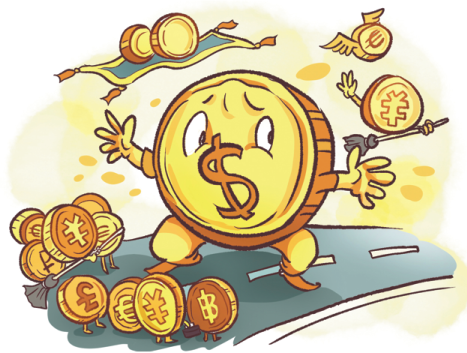
Editor's note: The abuse of the dollar's status as the international reserve currency by the United States and the losses other economies suffer due to the dollar’s wild fluctuations and US economic sanctions are prompting more and more countries to seek countermeasures, by using their domestic currencies to settle trade payments, thus triggering what could be the de-dollarization of the global economy. Four experts share their views on the issue with China Daily.
Why de-dollarization is inevitable
Gal Luft
In 1023, a thousand years ago, the Song Dynasty (960-1279) changed the history of money by introducing paper money, jiaozi, as legal tender and a means of exchange. The shift from cumbersome stores of value such as gold and silver to government-backed paper money started in southwestern Chengdu and eventually became the world standard, which facilitates global trade and commerce to this day.
A full millennium later, China is again set to transform the history of money, first, by spearheading the transition from paper money to the era of digital currency, leading the world in mobile payments and adopting Central Bank Digital Currency, through its digital renminbi and, second, by spearheading the transition away from the US dollar as the global reserve currency.
The dollar's special status is one of the three enablers of the United States' global pre-eminence, the other two being its military power and its alliance system. The US accounts for only one-tenth of global trade but about half of global trade is invoiced in dollars. Until recently, this disproportional reliance on the US currency was widely accepted by most countries in the world, but now more and more countries are saying they want to reduce their dependence on the greenback.
The rallying cry for "de-dollarization" which until recently had been raised by some "ostracized" leaders is now becoming mainstream. This month, French President Emmanuel Macron called for Europe to reduce its reliance on the US dollar to avoid becoming "vassals" of the US. A week later in Shanghai, Brazilian President Luiz Inacio Lula da Silva called on developing countries to work toward replacing the US dollar with their own currencies in international trade.
Driving these calls for de-dollarization are two mutually reinforcing trends. The first is the growing discomfort with the US' international behavior, especially its overly aggressive use of economic coercion and long-arm jurisdiction. Today, one in 10 countries are under US sanctions, and tens of thousands of individuals and corporations are excluded from the global banking system because they violated so-called Washington's rules. Companies are unable to conduct business with their counterparts in countries with which their governments have no dispute just because of the fear of being targeted by secondary US sanctions.
The Russia-Ukraine conflict has set new precedents: freezing and seizing of private and government assets without due process, disconnecting the banks of certain countries from the Society for Worldwide Interbank Financial Telecommunication, and imposing wholesale sanctions on individuals, corporations and other entities, leading many countries at odds with the US to rethink the wisdom of the greenback's continuous dominance of global trade and commerce.
The second trend is one of a growing sense among countries that the dollar is no longer a safe store of value due to the US' economic practices, especially its out-of-control spending and its ballooning national debt which is nearing $32 trillion and is projected to reach $44 trillion by 2027. The US' federal debt-to-GDP ratio has grown over the past 20 years from 60 percent to 130 percent, and is projected to hit 150 percent by 2027.
A quarter of the US debt is owned by foreign countries, many of them no longer willing to increase their holdings of US debt. Last year, Japan and China, the two largest holders of US Treasuries, jointly reduced their holdings by $400 billion — equivalent to half of the US' defense budget. In the same year, US deficit reached $1.38 trillion.
In other words, while the US' borrowing needs are on a perpetual rise, many countries are increasingly reluctant to lend it money, especially when much of this money could be used against their interests, for example, by financing military expansion, and instigating foreign wars and color revolutions.
As the top trading partner of no fewer than 120 countries and as the world's leading commodity importer, China is the only economy that can put a dent in the dollar's reserve currency status. It can shift an increasing part of its trade from the dollar to other currencies and urge its suppliers of energy, food and minerals to not only accept non-dollar payments for their commodities but also to price them in alternative currencies.
China's predominant role in the groupings of the Global South such as BRICS and the Shanghai Cooperation Organization, and its initiatives like the Belt and Road Initiative enable it to propel a change in the global monetary architecture in which the dollar is replaced not by a single national currency but by what can be defined as "currency multipolarity", under which a number of currencies of major economies and groupings compete with each other over their share in global trade transactions.
In a 2019 interview from his prison cell, Lula said the rationale behind the formation of BRICS was to "create our own currency to become independent from the US dollar". After returning to power in Brazil, Lula has made no secret of his plan to join China and other existing and prospective BRICS members in developing alternatives to the dollar based on a BRICS currency basket comprising the Five Rs — real, ruble, rupee, renminbi and rand.
In the thousand years since the Song Dynasty changed the history of money, no fewer than six reserve currencies, each belonging to a superpower of the time, have ruled the markets. Each dominated the global market for 80-100 years, and the tumbling of a currency accelerated the decline of the empire behind it. The dollar has been a global reserve currency for the past 80 years and if history is our guide, we are due for a rerun.
To be sure, both the US and its currency will continue to play a central role in world affairs for many years to come, but in the new order there will be no more room for hegemony, superpowers and winner-takes-all strategies. And, as Republican Senator Marco Rubio recently lamented, the US will increasingly lose its ability to sanction other countries. Under "currency multipolarity", money will return to become what it was always intended to be: a means of exchange and a store of value, not an instrument of economic statecraft.
The author is co-director of the Institute for the Analysis of Global Security and co-author of Dedollarization: The Revolt against the Dollar and the Rise of a New Financial World Order (2019).
The views don't necessarily reflect those of China Daily.
RMB internationalization a long-term process
Shen Guobing/Liu Weiping
China needs to exercise caution while further opening up its financial sector due to two reasons. One, because it lacks well-developed financial infrastructure. And two, because the mismatch in the market-based exchange rate and interest rate and financial opening-up could destabilize its financial market.
Further opening-up of China's financial sector requires the authorities to be vigilant against abnormal fluctuations caused by large-scale short-term capital inflow and excessive appreciation or sharp depreciation of the renminbi. Also, the country could face increased risks due to excessive cross-border capital flows. Therefore, China should build a mechanism that would enable market-oriented allocation of production factors to boost competition in and ensure the healthy development of its financial market.
Given that financial risks will hinder financial opening-up, China should attract more foreign financial institutions to help their domestic counterparts to reduce and overcome competitive risks. The government also needs to encourage domestic financial institutions to "go global", and use "legitimate supervision", instead of "reasonable supervision", over their foreign investment to overcome financial risks. And the authorities should pay closer attention to financial risks arising out of US-China trade disputes.
Besides, the further opening-up of its financial service sector will increase the risks for the financial market in these times of trade shocks and increasing uncertainties. Hence, China needs to strictly monitor capital flows while advancing its two-way opening-up in the capital market, and prevent speculative cross-border capital and hot money inflows and outflows.
There is also a need to build a cross-border renminbi settlement mechanism to promote high-quality financial opening-up, and develop a financial supervision system and a mechanism to prevent and control risks, in order to minimize the volatility risks facing the financial market.
More important, since China is under huge employment pressure, it cannot risk a big deficit imbalance caused by the hasty internationalization of the renminbi.
A sovereign currency becomes a fully convertible international currency on the basis of its country's comprehensive national strength and guarantee to reimburse the value of its currency.
Although China has met some of the financial and political requirements for the renminbi's internationalization, it still faces some difficulties in the internationalization of its currency due to rising trade protectionism and yet-to-be-fully-developed domestic currency, capital, foreign exchange, and financial derivatives markets.
There are two criteria for a country's currency to become an international reserve currency. One, the country has to be one of the biggest consumption destinations of final goods in the world, meaning it should have the capability to inject liquidity into the market. And two, it should be able to attract international investors for initial public offerings on its stock exchange, which would indicate it has the ability to boost liquidity and handle a huge current account deficit imbalance. But since China, as a developing country, cannot yet do so, it should not accelerate the process of the renminbi's internationalization.
Moreover, the number of fresh college graduates this year was a record 11.58 million, up 820,000 year-on-year. To ensure their employment, China needs to achieve sustainable and rapid economic growth, a goal which can be met through massive exports and foreign direct investment. The internationalization of the renminbi being a long-term process could make achieving that goal a bit difficult.
Some foreign media and experts mistake China's currency swap agreements with countries such as Russia, Brazil, Saudi Arabia, France and Iran as significant efforts to accelerate the renminbi internationalization. But according to General Administration of Customs data, China's exports to and imports from Russia accounted for only 3 percent of its total trade in 2022; the figure is 2.7 percent for Brazil, 1.8 percent for Saudi Arabia, 1.3 percent for France, and 0.3 percent for Iran.
In contrast, China's exports to and imports from the European Union, the United States and Japan accounted for 13.4 percent, 12 percent and 5.7 percent respectively of its total trade in 2022, with most of the deals being settled in the US dollar, the euro or the yen. So the internationalization of the renminbi still has a long way to go.
First, it is necessary to see what currency China uses for trade settlement with its major trading partners such as the EU, the US, Japan and the Republic of Korea. Second, it's important to determine the renminbi's share in the Society for Worldwide Interbank Financial Telecommunication. For example, the renminbi's global share stood at 2.15 percent in December last year, while the US dollar and the euro accounted for 41.89 percent and 36.34 percent. And third, it's also necessary to calculate the currency's share of global foreign exchange reserves — by the end of the fourth quarter of 2022, the share of the dollar was 58.36 percent, the euro 20.47 percent, and the renminbi 2.69 percent.
Currency swap agreements between China and some other countries cannot be the sole criterion for the renminbi's internationalization. Actually, some countries were forced to sign currency swap agreements because of the dollar's declining liquidity. Still, irrespective of whether the US Federal Reserve adopts quantitative easing policy again, the US dollar will remain the most important currency for global trade and foreign exchange reserves.
Shen Guobing is a professor at the School of Economics and deputy director of the Institute of World Economy at Fudan University. Liu Weiping is a researcher at the China Development Bank.
The views don't necessarily reflect those of China Daily.
Global economy getting out of the dollar trap
Zhang Monan
The international monetary system is undergoing an unprecedented change, pivoting away from the US dollar — which can be called "de-dollarization". The United States has been abusing the dollar's monopoly in global trade, reaping massive benefits from the greenback's supremacy and frequently imposing economic sanctions on other countries and entities, which have not only exacerbated global economic risks but also eroded its global credibility.
The first manifestation of dollar hegemony is the siphoning off global liquidity in every dollar cycle. The dollar has reigned supreme in global trade and foreign exchange transactions, and as reserve assets, with the US Federal Reserve literally becoming the world's central bank. The Fed's monetary policy steers the global monetary policy cycle, and the fluctuations in US interest rates have a tidal, siphoning effect on global dollar liquidity. The dollar's trajectory has been rising this year, with the dollar index breaking the 110 mark, a 20-year high, while currencies such as the euro, the yen, the Republic of Korea's won and other major non-US currencies have been pushed over a cliff.
According to the Bank for International Settlements, the nominal effective exchange rate of the dollar against a wide range of currencies, including those of developed and emerging countries, was at its highest level since 1994, when such data were first released. The cyclical fluctuations of the dollar have led to drastic swings in global exchange rate markets. That, in turn, has unsettled the macroeconomic and financial systems of countries and even led to frequent financial crises. The US stands to benefit massively as capital flows into its market, and uses its currency to harvest the wealth of other countries.
As such, the dominance of the dollar has become the greatest systemic risk to the international monetary system.
The second manifestation of dollar hegemony is the US' abuse of economic sanctions. The history of the dollar cycle shows that strong cycles have often coincided with "dollarization". But in a departure from the past, the current strong dollar cycle, instead of coinciding with dollarization, coincides with de-dollarization.
According to Bank of International Settlements data, the dollar today accounts for 40.4 percent of international payments, 88.3 percent of foreign exchange transactions, 45.1 percent of international bond notes, 41.73 percent of the Special Drawing Rights basket, and 59.23 percent of global foreign exchange reserves, topping $7 trillion.
However, the fault lines in the international monetary system have long been visible, and the trend of de-dollarization has accelerated, characterized by more decoupling from the dollar-clearing system, US treasury bond sell-offs, overweight gold reserves and declining dollar settlements.
The Russia-Ukraine conflict and the unprecedented financial sanctions against Moscow in its wake are, in fact, accelerating the de-dollarization trend. The US' weaponization of finance has not only cast a shadow over the stability and reliability of the international monetary and financial system but also upended the logic of the functioning of global financial markets, which no longer follow the principle of neutrality.
While assets owned by sovereign states are no longer inviolable, the financial system long controlled by the US, through institutions such as the Society for Worldwide Interbank Financial Telecommunication, has become a tool for unilateralism, making the dollar no longer a risk-free asset. In the long run, this portends serious damage to the credibility of the dollar.
With the monetization of dollar-denominated debt and the use of financial sanctions as a weapon, the foundation of the dollar's hegemony has been shaken. From a global perspective, more overseas creditors, apart from Japan, China and Russia, are increasingly divesting their US debts. In October, Japan's holdings of US debt fell to about $1.12 trillion, a three-year low, and China's US debt holdings dropped to $933.6 billion from $1.32 trillion in November 2013, representing a cumulative sell-off of 30 percent.
Notably, even Saudi Arabia has sold $62 billion of US debt since 2020, a cumulative sell-off of 35 percent. Riyadh said it has abandoned the use of the dollar in oil transactions to bypass the NOPEC Act, which the US passed to target Saudi Arabia. The rifts in the dollar payment system are deepening.
Besides, an alternative global trade settlement system has transformed from concept to reality. A growing number of economies have been devising or have devised independent payment systems to bypass the global financial payment and settlement system dominated by the US. In 2019, Germany, France and the United Kingdom announced the creation of an EU trade settlement support mechanism for Iran, in order to facilitate non-dollar and non-SWIFT transactions and bypass US sanctions. The Instrument to Support Trade Transactions mechanism has also been established, while India has devised an Indian rupee settlement system for international trade to reduce its reliance on the dollar.
The Bank of Israel, too, has begun diversifying its foreign exchange reserves this year, and is set to reduce the proportion of the dollar in its foreign exchange reserves from 66.5 percent to 61 percent. De-dollarization is indeed gathering pace.
Moreover, according to a Brazil central bank report on international reserve management, in 2021, the proportion of the dollar in its foreign exchange reserves declined by 5.69 percentage points from the 2020 level to 80.34 percent, the lowest since 2014, while the share of the Chinese renminbi in Brazil's foreign exchange reserves increased from 1.21 percent in 2020 to 4.99 percent in 2021, the highest level since the renminbi was included in the country's currency basket in 2019.
Also, the first China-Gulf Arab States Cooperation Council summit reached an agreement to establish a system to settle oil and gas trade payments in the renminbi.
All signs suggest the international monetary system will evolve into a system marked by one superpower and multiple major powers. As the internationalization of sovereign currencies of emerging economies advances, a multipolar global monetary system can, to some extent, reduce the privileges of the dollar. However, an alternative trade settlement system needs to be established to strengthen the counterweight to the dollar, paving the way for the balanced development of a multilateral global monetary system.
The author is deputy director of the Institute of American and European Studies, China Center for International Economic Exchanges. Source: chinausfocus.com
The views don't necessarily reflect those of China Daily.