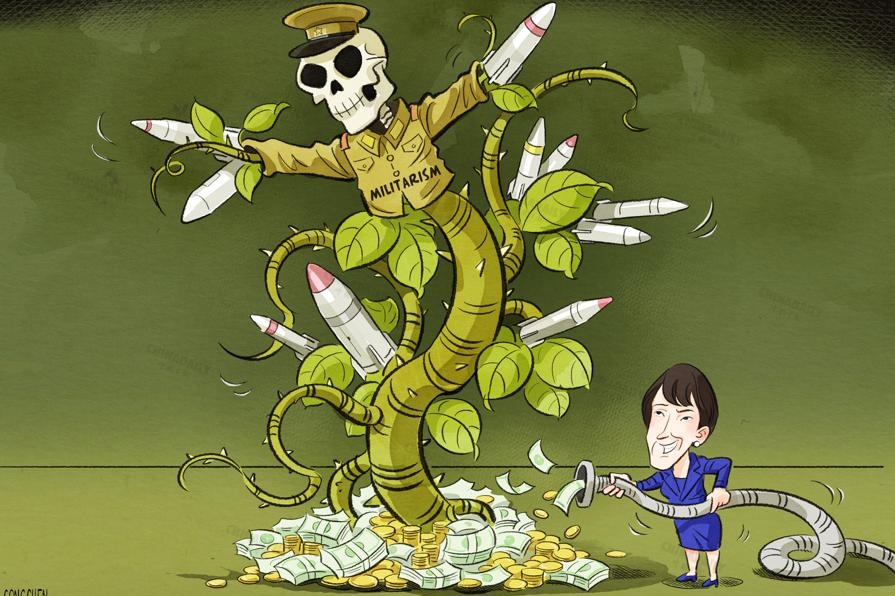
China fully justified in bolstering national security









Dialogues with Thinkers

Editor's Note: This year marks the 10th anniversary of the initiation of the overall national security outlook. How does the outlook help China strengthen national security against the background of increasingly complex domestic and external challenges? And how should one view the recent developments related to national security? Tao Jian, former president of the University of International Relations shares his views on the issue with China Daily’s Zhu Ping. Excerpts follow:

Question 1: In the 10 years since it was proposed, what have been the most important achievements of the national security outlook compared with the traditional national security outlook?
A 1: According to China’s National Security Law, national security means the State not facing any danger or threat internally or externally to its sovereignty, unity, territorial integrity, or the welfare of the people, sustainable socioeconomic development, or the capability to maintain security.
The overall national security outlook has developed in the new era. On April 15, 2014, Xi Jinping, general secretary of the CPC Central Committee, proposed the “overall national security outlook” at the first meeting of the Central National Security Commission of the CPC, pointed out the necessity to adhere to the overall national security outlook, treat the people as the purpose, political security as fundamental, economic security as the cornerstone, military, cultural and social security as the guarantee, and the promotion of international security, to embark on a national security path with Chinese characteristics.
This exposition established the “five-in-one” framework of the overall national security outlook.
In the decade since the proposal, the overall national security outlook has expanded to cover as many as 20 areas — political, military, territorial, economic, financial, cultural, social, technological, cyber, food, ecological, resources, nuclear, overseas interests, space, deep sea, polar regions, biological, artificial intelligence, and data security — embodying the concept of “comprehensive security”.
However, not all the problems the 20 sectors face should be classified as national security threats until they reach a significant scale. For example, an individual telephone scam does not represent a national security problem. But the more than 437,000 tele scams cracked down nationwide in 2023 do present a challenge to national security.
Also, equal efforts are not needed to deal with each of the problems faced by the 20 sectors. Yet it would be wrong to deal with national security issues in a particular sector and ignore the others.
In light of the unprecedented complexity and challenges, the achievements of the outlook have been threefold. First, China has safeguarded national security and maintained political stability, as well as advanced scientific development and helped intertwined high-quality development with high-level security.
Second, the overall nature of the outlook surpasses traditional security concept and thinking. It is tailored to China’s real conditions. Over the past decade, China has been facing an unprecedented challenging external environment due to some Western countries’ China-containment policy. On the domestic front, China’s main contradiction, that is, the contradiction between people’s increasing aspiration for a better life and the unbalanced and inadequate development is evident in income disparities, urban-rural gaps, regional differences and the levels of productivity in different sectors and regions. In this context, the national security outlook addresses a series of major issues.
And third, the outlook highlights the idea of putting people’s security first. It makes clear that security is an important part of the people’s aspiration for a better life.
Q2: How do you evaluate China’s national security situation now? What are the biggest challenges facing China?
A2: China’s national security situation is undergoing significant changes. From an international perspective, China’s current external environment is “extremely complex”.
China’s economic and technological development and international competitive environment are undergoing drastic changes, with major power competition becoming even more severe. The current state and future direction of China-US relations are key variables affecting China’s external security environment.
Beijing’s main geopolitical risks lie across the Taiwan Strait, as well as with the common challenges of climate change and international financing, which could pose a threat to the country’s security. Besides, the political and security situations of small and medium-sized countries involved in the Belt and Road Initiative, and the Russia-Ukraine and Israel-Palestine conflicts require close attention. And the threat of terrorism remains a security issue that China needs to take into serious consideration, as the recent terrorist attacks on the outskirts of Moscow and on Chinese personnel in Khyber Pakhtunkhwa in Pakistan have once again reminded us.
In other words, global economic recovery is weak, geopolitical conflicts are intensifying, and protectionism and unilateralism rising, slowing China’s growth rate.
It is an arduous task, in such a situation, to simultaneously implement reform, advance development and maintain stability. Boosting economic recovery and development in itself is a tough job, especially at a time when deep-seated contradictions accumulated over the long term are becoming more complex.
In addition, following the Russia-Ukraine conflict, the technological and financial war (the freezing of $300 billion of assets of the Central Bank of Russia by the United States and the European Union), and the food, energy and cyber information war waged by the US and other Western economies against Russia have sent a warning to China to prepare for extreme scenarios.
China should therefore strengthen its national security work in key areas such as political security, territorial security, economic security, social security, cybersecurity and external security. There is also a need for China to expedite the construction of a new development pattern to boost its economic resilience, competitiveness and development capability in the face of foreseeable and unforeseeable storms.
Q3: Some foreign media reports claim the recent enactment of the Safeguarding National Security Bill will stifle Hong Kong’s vitality. What is your opinion on the issue?
A3: The passage of the Safeguarding National Security Bill in the Hong Kong Legislative Council on March 19 fulfills the constitutional responsibility and historic mission of enacting a law based on Article 23 of the Basic Law 26 years after Hong Kong’s return to the motherland. Fortifying the “protective wall” for the long-term stability and prosperity of Hong Kong, the law is a big milestone in the development of “one country, two systems” in the new era.
Neglecting security in the pursuit of economic development carries hidden risks. If the foundation of security is not solid, the edifice of development will be shaky. As a special administrative region of China, Hong Kong witnessed rampant violent demonstrations in 2019, leading to the withering of various industries, making it impossible to guarantee even the basic livelihood of the people, let alone boosting economic development.
The bill will help balance the maintenance of national security with the protection of rights, freedoms and economic development, enable Hong Kong to better leverage its status as a global logistics and financial hub to integrate with the Guangdong-Hong Kong-Macao Greater Bay Area, and deepen its open and close exchanges and cooperation with various countries and regions.
The implementation of the bill will not impact normal business activities and international exchanges and cooperation. But it will no longer allow foreign forces that have used Hong Kong as both a financial paradise and a bridgehead for anti-China and anti-communist activists to continue with their activities. The bill, however, will make real foreign investors more confident to invest in Hong Kong.
Q4: Many security issues are now intertwined, coupled with rapid technological developments. How should China improve security governance with emerging challenges addressed?
A4: China needs to strengthen national security coordination, improve the legal, policy, risk-monitoring and early-warning systems, as well as the national emergency management system for national security, and improve the security guarantee in areas such as the economy, major infrastructure, financing, data, resources, nuclear, outer space and oceans. It also needs to improve the layout of national security forces, and build a comprehensive, efficient national security protection system.
In the new era, the national security policy should address not only common security issues in the field of development but also special security issues during the process of the rejuvenation of the Chinese nation.
That some Western powers are trying to sow discord between the Chinese government and the people is not new. They have been trying to do so for decades using various mediums including the radio, television, newspapers and books to feed the Chinese people, especially the younger generation, with anti-Party and Anti-government rhetoric. The Western powers have now shifted their focus to online media, which proves that “political security is the foundation of national security”.
Political security determines the state of security in fields such as economic security, military security and social security. Without political security, security cannot be guaranteed in other fields. In fact, security issues in other fields will reflect the strength of political security. Therefore, it is necessary to promote national security with the ultimate goal of strengthening political security, making the maintenance of political security the primary task in responding to security risks and challenges in various fields, and fully leveraging its role as a fulcrum of the mechanism coordinating security in various fields.
Q5: Some foreign media reports claim the revised laws such as Counter-Espionage Law could accelerate the exodus of foreign enterprises from and decline in foreign investments in China. Are such reports misleading?
A5: Espionage poses a big threat to national security and undermines the interests of a country. It is an internationally recognized practice of sovereign nations to enact legislation to prevent and combat espionage activities and safeguard national security.
The United States’ Espionage Act of 1917, the National Security Act in the early days of the Cold War, the Homeland Security Act following the Sept 11, 2001, attacks, the Foreign Investment and National Security Act, the Enhanced Intelligence Act of 2002, and the periodic release of “counterintelligence strategies” all show the US’ efforts to better safeguard national security through legislation. In fact, China’s anti-espionage legislation lags behind that of Western countries. As such, China needs to strengthen the legal and operational systems to better safeguard national security.
Intelligence agencies of dozens of countries have been conducting espionage activities against China. And the considerable number of espionage cases China’s national security agencies uncover every year represent only the “tip of the iceberg”. Espionage activities pose a significant threat to the China, as they target the core departments of the Party, the government and the military, as well as new fields such as biological and genetic information.
In addition to traditional methods such as recruitment and subversion, espionage activities now include cyber theft and intelligence gathering. This is a crucial reason why China revised the Counter-Espionage Law last year.
The Ministry of State Security has said on its official WeChat account that China’s anti-espionage legal framework is clear and transparent, and will not affect the legitimate operations, investments, work, studies and life of foreign enterprises and individuals in China. Addressing concerns about expanded enforcement powers under the Counter-Espionage Law, and foreign enterprises and individuals being subjected to “data collection” and “arbitrary detention”, the ministry made it clear that the law strictly limits the powers and processes involved in anti-espionage work.
The law also regulates the conditions, procedures and scope for national security agencies to access data, and safeguards the legitimate rights and interests of citizens and organizations.
To be sure, the espionage cases China pursues are generally solid and can withstand scrutiny, and national security agencies are disciplined and professional enough to enforce the law rigorously and effectively.
The revised Counter-Espionage Law incorporates the principle of coordinated development and security into relevant articles. This principle is reflected throughout the entire law. By clearly defining the boundaries and red lines of security, the law better promotes development, and is conducive to creating an environment that is open and secure, as well as vibrant and orderly.
China welcomes foreign enterprises to develop in the country as long as they operate in compliance with the law and have no ulterior motives.
It is important to guard against foreign powers using the Counter-Espionage Law as a tool to undermine China’s business environment. Premier Li Qiang recently emphasized that China will continue to build a first-class business environment that is market-oriented, based on the rule of law, is internationalized and protects the legitimate rights and interests of all types of enterprises in accordance with the law.
Q6: Why do some Western governments abuse the concept of national security? For example, the US administration has falsely accused China of using Chinese-made smartphones to steal user information, and claims that the cranes used in ports and electric vehicles pose a threat to US national security. Does this, by extension of the US’ logic, mean foreign products in China, too, pose a security risk? What are the dangers of the misuse of national security for economic and technological decoupling?
A6: From Wikileaks to former US National Security Agency agent Edward Snowden, security-related incidents have long proved that the US spies on all countries — not only its adversaries but even on its staunchest allies. This time, the US administration’s accusations, inadvertently makes it clear that it intends to showcase its capability to control everything, from Boeing aircraft to computer systems to smartphones, which serves as a forceful warning to countries using US products and services to increase vigilance and enhance precautions.
The US’ politicization, weaponization and securitization of issues related to trade, technology and even personnel exchanges are driven by its strategic decision to view China as the “only competitor with the intention and capability to reshape the international order” and win the competition against China.
For example, in the field of chips, perhaps the US knows that it is violating the market laws, and not only suppressing the rights and interests of Chinese enterprises but also disrupting the semiconductor ecosystem, thereby harming its own interests. The US’ obsession with “harming others without benefiting itself” is evident especially in the field of technology, in which it frequently resorts to tricks, and gets entangled in the “broad securitization trap” it believes it has dug for others.
In response to some Western countries’ efforts to “decouple” from the Chinese economy, China says it does not engage in broad securitization nor does it intend to close the door to the world; instead, it aims to further expand its opening-up.
China’s position is clear: on the one hand, it is against hegemony of any kind; on the other hand, it attaches great importance to safeguarding national technological security and promoting new quality productive forces.
China is pursuing high-quality development, which means it has taken technological innovation as the logical starting point for promoting development, cultivating talents advancing technologies, boosting the economy and strengthening national security.
All of this will be reflected in the new quality productive forces that are driven by advanced technology in line with the new development concept.
The views don’t necessarily represent those of China Daily.