Chinese scientists set world record with magnetic field 700,000 times Earth's









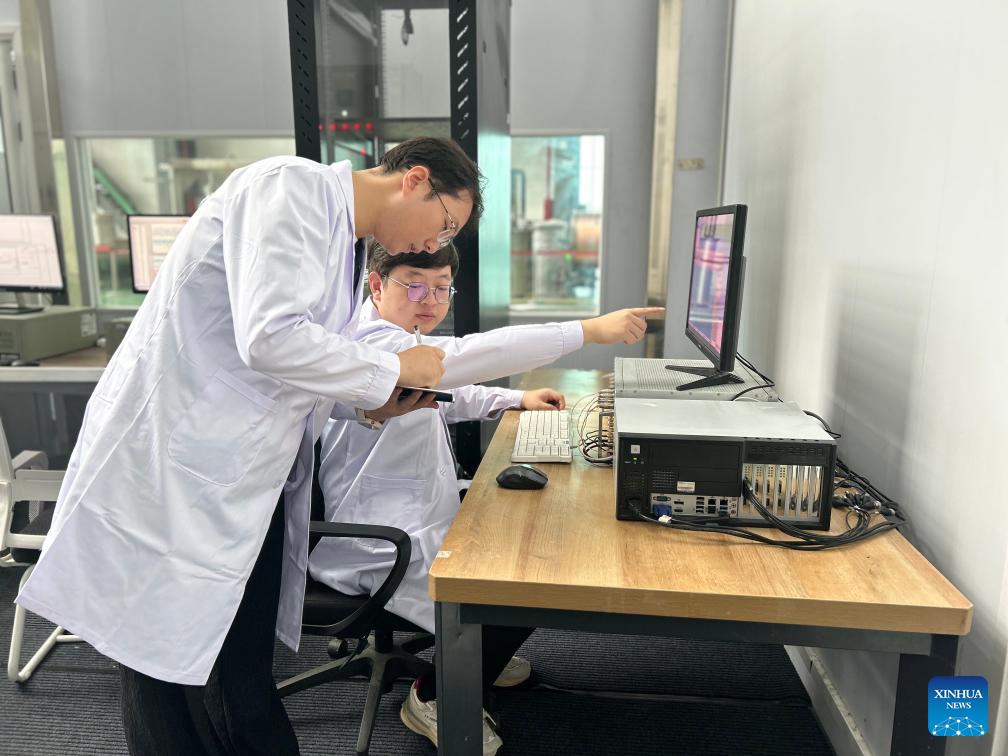
HEFEI -- Chinese scientists announced on Sunday that they have successfully generated a steady magnetic field of 351,000 gauss with a fully superconducting magnet, setting a new world record.
The breakthrough will significantly advance the commercialization of advanced superconducting scientific instruments, such as nuclear magnetic resonance spectrometers, according to the scientists.
It also provides crucial technical support for multiple cutting-edge fields, including fusion magnet systems, space electromagnetic propulsion, superconducting induction heating, magnetic levitation, and efficient power transmission.
The magnet was developed by the Chinese Academy of Sciences' Institute of Plasma Physics (ASIPP), located in Hefei, East China's Anhui province, in collaboration with the Hefei International Applied Superconductivity Center, the Institute of Energy of the Hefei Comprehensive National Science Center, and Tsinghua University.
Earth itself is a giant magnet, generating a geomagnetic field of about 0.5 gauss. Superconducting magnets, fabricated by winding superconducting materials, can generate extremely strong magnetic fields while enabling lossless transmission of large currents.
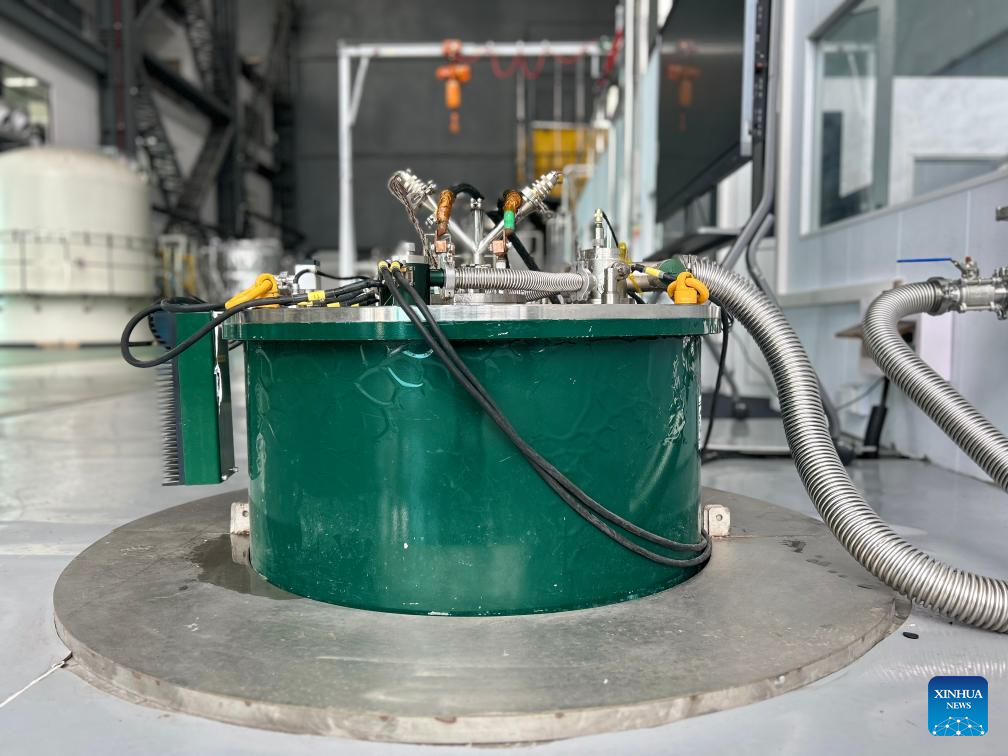
Liu Fang, researcher with ASIPP, explained that the magnet adopts high-temperature superconducting insert-coil technology, coaxially nested with low-temperature superconducting magnets.
The team effectively overcame challenges such as stress concentration, shielding current effects and multi-field coupling effects under low-temperature, high-field conditions. These innovations significantly improved the magnet's mechanical stability and electromagnetic performance in extreme environments.
During the experiment, the magnet was energized to 35.1 tesla, stably operated for 30 minutes, and was safely demagnetized, fully verifying the reliability of the technical approach. The achieved magnetic field strength, over 700,000 times that of Earth's geomagnetic field, also surpassed the previous world record of 323,500 gauss.
Such magnets are also key components of magnetic confinement fusion devices, forming a "magnetic cage" that safely confines high-temperature plasma for sustained burning. ASIPP has long been engaged in fusion research and has recently achieved complete localization of superconducting materials, devices and systems.
As the main unit of the Chinese mission of the International Thermonuclear Experimental Reactor (ITER), the institute has taken on many procurement packages, including superconductors, correction coils and magnet feeders.


- Shanxi ends province-wide blanket fireworks ban
- Audit: China fixes bulk of fiscal problems tied to 2024 budget
- China reports major gains in circular economy
- Chinese lawmakers review draft revision to banking supervision and regulation law
- Top legislature to study draft laws on environment, ethnic unity, national development planning
- Administrative organs must secure people's interests: senior judge