


Forged by fire, sustained by inheritance
Zhu Bingren and his son trace two paths of copper craftsmanship, rooted in tradition but open to new ideas, Lin Qi reports.









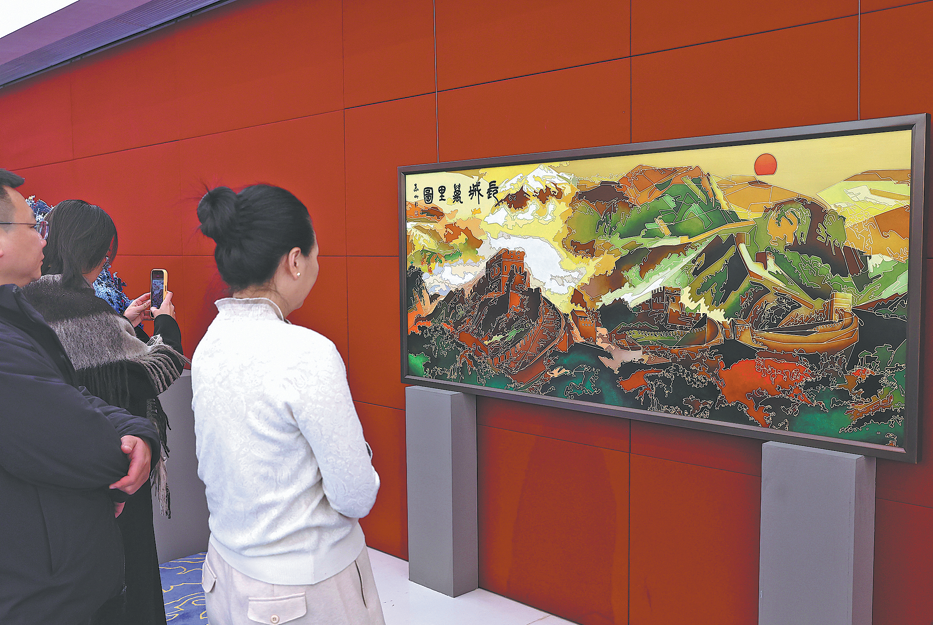
A pivotal moment in the career of Zhu Bingren, a seasoned copper artist, came after a fire in 2006 that took place at a project he was involved in, in Jiangsu province. The blaze consumed the eaves of the first floor of a pagoda inside the Tianning Temple of Changzhou, when the construction work was nearing completion.
Zhu, who was in charge of the pagoda's copper decorations and tiles, rushed to the site. In shock and surprise, Zhu, a national-level intangible cultural heritage inheritor in Hangzhou, Zhejiang province, found the melting copper dripping onto the ground and assuming a distinctively carefree quality in form.
The incident inspired him to develop a signature technique and aesthetic, showing the free-flowing texture of copper on the surface of the wares, sculptures and paintings, an aesthetic which has since become a trademark of his copper art.
Recently, Zhu donated 10 such works to the National Museum of China in Beijing where he held a major show in 2024.