New travel program hailed as 'milestone'
Travel:?HK to install more EV chargers









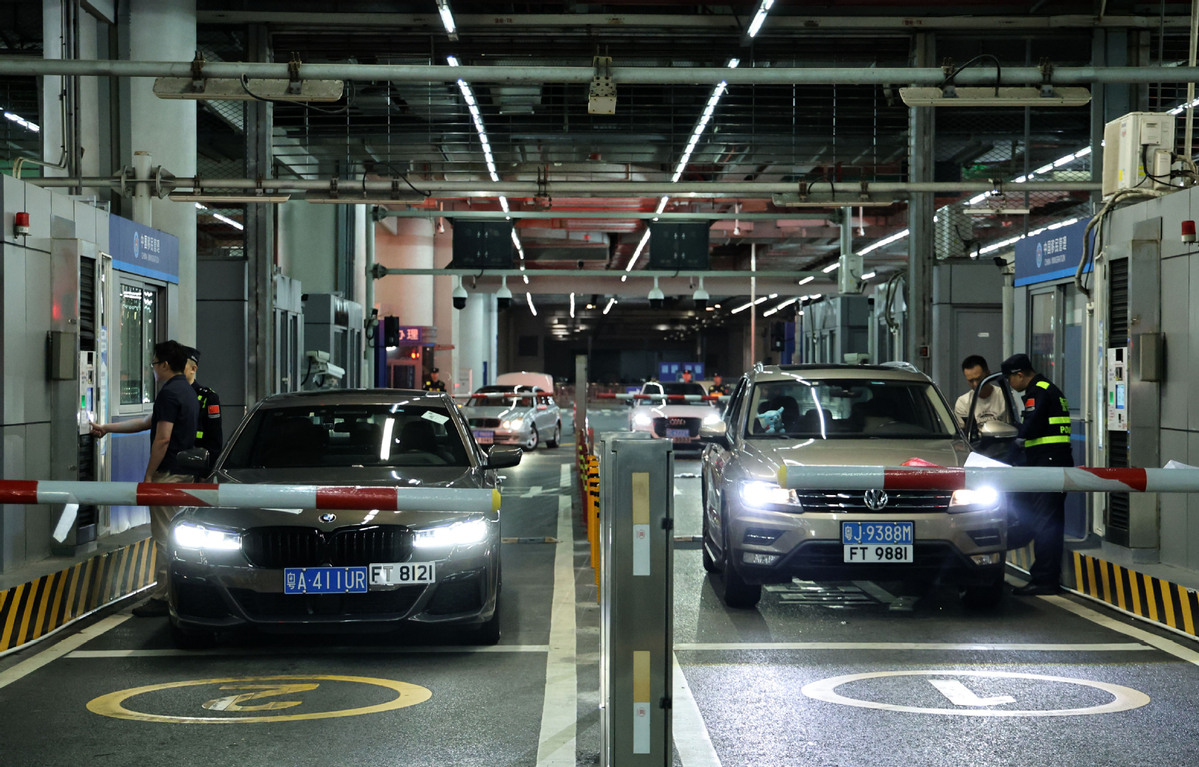
The Hong Kong Special Administrative Region opened its urban roads to the first group of private cars from Guangdong province under a new cross-border travel program on Tuesday, in a move that officials and Chinese mainland drivers have hailed as a milestone for regional integration.
The Southbound Travel for Guangdong Vehicles program allows approved private car owners from Guangdong with confirmed travel bookings to drive into Hong Kong's urban areas via the Zhuhai port of the Hong Kong-Zhuhai-Macao Bridge, with a daily quota of 100 vehicles.
The first phase of the program benefits drivers from the cities of Guangzhou, Zhuhai, Jiangmen and Zhongshan. After six months of implementation, the program will be expanded to other cities across Guangdong.
Each eligible mainland vehicle will be granted a maximum stay of three days per visit.
At midnight on Tuesday, a private car with a Guangdong license plate entered the dedicated outbound lane at the Zhuhai port, preparing to head south to downtown Hong Kong.
After the car owner had completed a temperature check and identity verification using a one-stop clearance system, the lane screen immediately lit up with a green passage prompt.
"I am very pleased to be among the first participants of the policy, driving into the urban areas of Hong Kong," said the driver, surnamed Peng.
Peng, who opened a restaurant in Zhuhai with a Hong Kong partner, often travels to the SAR for business research. The program saves him from the time-consuming transitions between buses.
Five dedicated lanes in each direction have been set up at the boundary for program participants, according to inspection officials on the Zhuhai side, with some drivers saying that the full boundary crossing takes roughly five to 10 minutes.
Mable Chan, secretary for transport and logistics of the Hong Kong SAR government, said the first-day public uptake of the program was "enthusiastic".
Chan said the 100 places on the first day were almost fully taken up, adding that the Hong Kong authorities have been working to process applications from 1,700 mainland car owners selected via a ballot run by the Guangdong authorities last month, who were drawn from an initial pool of 2,388 registrants.
"We expect that … (the program) will further promote exchanges between the people of the two regions, allowing them to truly experience the 'one-hour living circle' between Guangdong and Hong Kong, and further facilitate integration and exchanges within the Guangdong-Hong Kong-Macao Greater Bay Area," Chan said.
Given the popularity of electric vehicles on the mainland, Chan said more EV chargers compatible with mainland standards will be installed across the city.
One such newly added facility is the 24/7 Lantau Charging Station operated by CLPe, a subsidiary of local power supplier CLP.
A Guangzhou resident surnamed Guo and her family used the station to charge their EV before kicking off a two-day trip to Hong Kong on Tuesday. She described the charging and payment process as "simple and fast".
Guo's family previously relied on the high-speed train and a cross-boundary bus to visit Hong Kong. "Now we can just get in the car at home and drive straight to the sights (in Hong Kong) — it's much more suitable for a family outing," she said.
For another mainland motorist, surnamed Lun, the shift from timetable-bound rail journeys to the spontaneity of a private road trip has provided more flexibility. "Now traveling in my own car, I can just book (a hotel room) in the morning and check in that same afternoon," Lun said.
Guo and Lun both said they will recommend the southbound drive to others.
Contact the writers at wanqing@chinadailyhk.com



- Consumer complaints rise over AI customer service failures
- Zhejiang authorities probe death of child in hospital
- China moves to reduce childcare costs
- High-altitude discovery sheds light on early settlers of Qinghai-Tibet Plateau
- Beijing seminar studies legal systems of Francophone countries
- Approved private vehicles now permitted direct access to Hong Kong