Xi Jinping And His Era
On the morning of Oct 18, Xi Jinping, standing behind a lectern in the Great Hall of the People, delivered a report to the 19th National Congress of the Communist Party of China (CPC). The 32,000-character report, the most significant of its kind in recent decades, drew more than 70 rounds of applause from delegates.
In the report, Xi said socialism with Chinese characteristics had crossed the threshold into a new era.
"This is a new historic juncture in China's development," he stated.
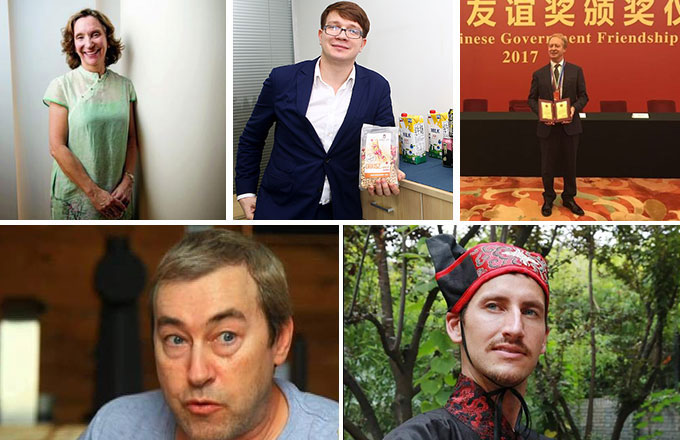
The report has been translated into 10 foreign languages. Most of the translators and foreign linguists involved used the word "powerful" to describe their first impressions.
"I was absorbed the first time I read it. I read from morning till midnight, even forgetting to have meals," said linguist Olga Migunova from Russia.
US expert on China studies and chairman of the Kuhn Foundation, Robert Lawrence Kuhn, said that with this political report and the congress, Xi, who is the core of the CPC Central Committee and of the whole Party, sees China as standing at a new historic starting point.
At the first plenary session of the 19th CPC Central Committee on Oct 25, Xi was re-elected general secretary of the CPC Central Committee for a second term, a reflection of the will of the entire CPC. Media and observers, at home and abroad, see Xi as the right man to lead China from being "better-off" into a great modern country.
In 1949, Mao Zedong announced the founding of the People's Republic of China, marking the end to a century of humiliation at the hands of foreign aggressors.
Deng Xiaoping, who put forward the reform and opening-up policy, then paved the way for the nation to become rich.
The coming five years between the 19th and the 20th Party Congress is the period in which the timeframes of the Two Centenary Goals will converge, Xi said when presenting the new CPC central leadership to the press.
"Not only must we deliver the first centenary goal, we must also embark on the journey toward the second," he said, promising to work diligently to "meet our duty, fulfill our mission and be worthy of CPC members' trust."
He stressed that Chinese Communists "must always have a youthful spirit, and forever be the servants of the people, the vanguard of the times and the backbone of our nation."
A MAN WHO MAKES THINGS HAPPEN
Five years ago, Xi, referred to by media as the first CPC chief of the social-media era, led the newly elected members of the Standing Committee of the 18th CPC Central Committee Political Bureau to meet the press.
"In just a few minutes, the man who will lead the world's most populous nation for the next 10 years laid out his agenda. In short: to make the Chinese nation great again, address the grievances of the people and root out corruption.... Mr Xi used simple language easily understood by non-Party members," said the Financial Times.
"He does seem to have the personality and political strength to start quickly and out of the box," the report quoted expert on Chinese politics at Boston University Joseph Fewsmith as saying.
While praising his relaxed and confident demeanor, five years ago many took a wait-and-see attitude, as the new Chinese leader faced a plethora of headaches: a slowing economy, a widening wealth gap, corruption, and environmental woes.
The waiting and seeing is now well and truly over. Already some speak of "historic change" when describing what happened in the ensuing 1,800-odd days.
A total of 360 major reform plans were put forward and over 1,500 reform measures launched, establishing a general framework for reform in major fields and lending greater impetus to growth.
The economy expanded at an average annual rate of 7.2 percent between 2013 and 2016, outstripping the 2.5-percent average global growth.
More than 60 million people have bid goodbye to poverty.

Hundreds of officials at or above provincial or corps level have been investigated for corruption and a campaign targeting undesirable working styles has ensured that the Party with over 89 million members stayed pure and grew stronger.
The 2 million-strong Chinese military has reshaped its way of thinking and work style, organizational form and armament.
The "strictest environmental protection system" was put in place and numbers of officials were punished for insufficient work in this regard.
Moreover, the country made major progress in scientific and technological fields, seeing successes with a space lab, submersible, radio telescope and quantum satellite.
For the first time in over six decades, leaders across the Taiwan Straits met in person.
China is developing a new type of relations between major countries with the United States and Russia.
The Chinese currency, the renminbi, or yuan, joined the IMF Special Drawing Rights (SDR) basket. A proposal regarding a community with a shared future for mankind and the Belt and Road Initiative were incorporated into UN documents.
None of these were easy, but Xi and his colleagues have made things happen, with Xi's unshakable will and commitment crucial to the cause.
"If the Party and people need us to devote ourselves, we shall do it with no hesitation.... If we cannot do it, then how can we ask others to do it?" Xi once said at a meeting attended by members of the CPC Central Committee Political Bureau.
Xi's roadmap for China's future is inspiring: a two-step approach to becoming a "great modern socialist country," once a moderately prosperous society in all respects is established by 2020. Socialist modernization will be basically realized from 2020 to 2035. From 2035 to the middle of the century, China will become a great modern socialist country that is prosperous, strong, democratic, culturally advanced, harmonious and beautiful.
By then, China will be a global leader in terms of composite national strength and international influence. Prosperity for everyone will be basically achieved, a prospect that the Chinese nation has been longing for since the Opium War (1840-42).
At this point, Xi is the unrivalled helmsman who will steer China toward this great dream.
Xi has been described by the media as "energetic,""ambitious,""sober-minded," and a "pathfinder."
He received the highest rating among 10 world leaders in a survey published by the Harvard Kennedy School's Ash Center for Democratic Governance and Innovation. He also topped the domestic ratings that respondents gave to their own leaders.
A Nikkei report on Oct 19 said Xi had drawn up the blueprint for the country's development over the next 30 or so years and was expected to ensure that China regains its status as a global power.
CPC CORE FORGED DURING 'GREAT STRUGGLE'
When Xi assumed office five years ago, his top priority was to ensure that the whole Party shall obey the Central Committee and uphold its authority and its centralized, unified leadership. The Party had to face up to its lack of drive, incompetence, disengagement from the people, inaction, and corruption. Of those failings, corruption became the biggest challenge. In Xi's opinion, if corruption got any worse, it would cause the collapse of the Party and the fall of the state. Achieving any target in the new era would be impossible.
The campaign against corruption was like no other in the 96-year CPC history, and remains as far-reaching and relentless as any such campaign anywhere in the world. One of the first "tigers" - senior corrupt officials - to fall was Li Chuncheng, former deputy secretary of the CPC Sichuan provincial committee. He had served as an alternate member of 18th CPC Central Committee for less than a month when he was put under investigation in December 2012. Soon, probes of centrally administered officials became an almost regular occurrence. Once as many as seven "tigers" fell under the gaze of investigators in a single month.
Even though the public had witnessed the full force of the campaign, the announcement in July 2014 that Zhou Yongkang, former member of the Standing Committee of the CPC Central Committee Political Bureau, was under investigation came as a bolt from the blue. Previously, Chinese people had doubted that the CPC would investigate officials at such a high level. The international community had not expected that Xi, still quite new to his office, had the capability or resolve to take out such a "big tiger."
Over the past five years, a number of officials with "iron hats" - those who were considered powerful and not easily removed - have been felled for corruption. Besides Zhou Yongkang, there were Bo Xilai, Guo Boxiong, Xu Caihou, Sun Zhengcai and Ling Jihua. A total of 43 members and alternate members of the 18th CPC Central Committee as well as nine members of the Central Commission for Discipline Inspection (CCDI) have been investigated.
Dispelling any doubt, Xi said, "If we did not offend hundreds of corrupt officials, we would offend 1.3 billion Chinese people." To those who worried that corruption would impede economic development, Xi said, "As far as I see, the sky will not fall."
Xi's path has been far from smooth. Rather, it is one of "struggle," a word which appeared 23 times in his report to the 19th CPC National Congress.
In 2015, the anti-corruption drive was described as at "a stalemate." In 2016, the CPC was "gaining ground to overcome corruption." Today, the anti-corruption campaign has built into a crushing tide, is being consolidated, and continues to develop. Fugitives overseas have found themselves hunted down and captured. Domestically, thousands of officials confessed to disciplinary authorities on their own initiative.
While some suggested taking a breather as long as some progress has been made, Xi said the Party must not leave well enough alone in front of an early harvest. Rather, the Party must fight for a "sweeping victory" over corruption. A popular cartoon on the Internet shows Xi on top of a tiger and punching the beast with his fist.
According to the National Bureau of Statistics, about 75 percent of Chinese people were satisfied with the anti-corruption efforts in 2012. The figure had risen to 92.9 percent by 2016.
Xi does not only rely on taking out "tigers" and swatting "flies" - low-level corrupt officials - to win people's support.
In early 2013, when Xi read an article, "Netizens call for curbing food waste" carried by Xinhua News Agency, he gave the instruction that "waste must be stopped." He stressed eradicating waste in public funds. After five years of hard work, the CPC checked the unhealthy trend, a mission once believed to be impossible.
Yang Xiaodu, deputy secretary of the CCDI, declared: "People said public funds spent on recreational activities like dinners and drinking could be about 200 billion yuan every year, but no one knew how to curtail it. With the eight-point regulation on frugality, the problem has been solved."
The regulation made explicit requirements on how officials should improve their work in eight aspects, focusing on rejecting extravagance and reducing bureaucratic meetings and empty talk.
"The eight-point regulation has changed China," Yang said.
"The people have granted power to us, so we must devote our lives to the Party and the country, and serve the Party and the country worthily. We must do what we should. If our work needs us to offend some people, we must offend them," Xi said.
Xi meant what he said. He relaunched the mass-line campaign to bring Party officials closer to the people. He urged officials to meet "strict" and "earnest" requirements: to be strict with oneself in practicing self-cultivation, using power, and exercising self-discipline; and to be earnest in one's thinking, work and behavior. The Party required all its members to have a solid understanding of the Party Constitution, Party regulations, and major policy addresses, and to meet Party standards of behavior.
The CPC will run a campaign on "staying true to our founding mission" to enable all the Party members to arm themselves with new Party theories and become more purposeful in working tirelessly to accomplish the historic Party mission.
The Party has revised its regulations on disciplinary punishments and code on honesty and self-discipline. Those keen on officialdom are losing power and influence. Over the past five years, more than 5,000"naked officials" - those whose spouses and children are overseas - have been removed from their posts. More than 22,000 officials at or above county-level had their posts rearranged on the basis of their performance.
Xi's status as the core of the CPC Central Committee and the whole Party was endorsed at the sixth plenary session of the 18th CPC Central Committee. It is widely acknowledged that when such a big Party as the CPC governs such a big country, difficulties are inevitable. Without a strong core of leadership, it is hard to maintain unity of Party thinking and solidarity across the entire nation. Weak leadership makes any achievement impossible, not to mention victory in a "great struggle with many new contemporary features."
Xi's indomitable spirit originates from his faith in Marxism. One of his colleagues noted in an article that Xi's speeches "exuberate with firm belief in communism and socialism."
When visiting "The Road Toward Renewal" exhibition at the National Museum on Nov 29, 2012, Xi told a story about Chen Wangdao, who was so focused on translating The Communist Manifesto that he found himself eating ink instead of brown sugar. Xi quoted Chen's words: "The taste of truth is so sweet."
Xi also draws strength from his parents Xi Zhongxun and Qi Xin, both of whom participated in the revolution at young ages. In 1962, Xi Zhongxun's 16 years of suffering from political persecution began. However, he never gave in to adversity and ultimately helped clear the names of others who were persecuted.
When his father was wronged, Xi Jinping went through some tough times.
In one of his letters to his father, Xi Jinping noted that even when trapped in hard times, Xi Zhongxun still held "unswerving faith in communism and belief in the Party's greatness, correctness and glory."
"Your words and actions have pointed the correct direction for us to go forward," he wrote.
Xi also recollected that, when he was 5 or 6 years old, his mother bought him picture books about Yue Fei, a patriotic military commander of the Southern Song Dynasty (1127-1279), and the story of how Yue's mother tattooed four Chinese characters on his back to remind him of devoting himself to the country.
"Jing Zhong Bao Guo (To serve the country with total loyalty): I have long remembered these four characters. It is the pursuit of my entire life," Xi said.
During his early life, Xi applied to join the Communist Youth League eight times and the CPC 10 times, before he finally joined the Party at the age of 20.
SERVANT OF THE PUBLIC
"Xi is a very great leader. He works not only in his office, but among the people," said Keovichith Lamngeun, a Laotian who worked as one of the nine foreign linguists on the translation of the 19th CPC National Congress report.
"From my observation, the general public likes Xi because he has brought about changes," said Peggy Cantave Fuyet, who was responsible for the French version of the report.
Many times over the last five years, the general secretary popped up in crowds of ordinary people amid roars of cheering and the sound of mobile phone camera shutters.
He queued and dined with members of the public in a roadside restaurant. He bought festival gifts himself before visiting old acquaintances in the village where he worked as an "educated youth." He stood in heavy rain talking with frontline workers.
He has walked into farmers' barns and kitchens, checked the menu at nursing homes and stressed virtue to young students.
He stayed overnight in a makeshift prefab during a visit to the scene of an earthquake.
He once visited Beijing's hutong in heavy smog, dropping in on residents to ask about their work, salaries, what they burned for cooking and heating, as well as how far their homes were from the nearest toilet.
Xi has visited all of the poorest areas suffering "abject poverty" in China.
At the 19th CPC National Congress, he was a delegate of southwest China's Guizhou province, one of the poorest regions in China, with per capita GDP of around 33,000 yuan ($4,980), close to 20,000 yuan lower than the national average in 2016.
When Xi sat down to talk with other delegates from the province in a panel discussion, no one was quite sure how the conversation would turn. Later, somewhat surprised delegates found themselves discussing pork delicacies, strong liquor and tourism with him, all of which are regarded as effective means to bring in extra income for locals.
Media reports of this discussion have drawn numerous clicks and many "thumbs-up" on the Internet.
The people always take the center stage in Xi's blueprint for "a great modern socialist country."
"The original aspiration and the mission of Chinese Communists is to seek happiness for the Chinese people and rejuvenation for the Chinese nation," Xi told more than 2,300 delegates at the congress.
In November 2013, during an inspection tour to the central province of Hunan, Xi visited Shibadong, a Miao minority village labeled "poor" at the time.
"What should I call you?" asked illiterate villager Shi Pazhuan, as she welcomed Xi into her home.
"I am a servant of the people," Xi introduced himself.
During that tour, Xi first put forward the concept of "targeted poverty alleviation," which refers to measures that include a system to keep track of every household and individual in poverty to verify that their treatment is having the desired effect.
For Shi, "targeted poverty alleviation" meant a government subsidy to finance a kiwi fruit plantation for her and her neighbors.
Xi was visibly pleased on learning later that people of Shibadong had finally shaken off poverty.
He has pledged to lift the country's remaining 40 million impoverished people out of their situation by 2020, a step against poverty unprecedented in human history.
Securing sustenance for all 1.3 billion people of China is, in itself, a huge accomplishment.
He is determined to bring about even more: better education, more stable jobs, higher incomes, more reliable social insurance, better medical services, more comfortable living conditions, a more beautiful environment and a richer cultural life.
As socialism with Chinese characteristics has entered a new era, Xi said the principal contradiction facing Chinese society has evolved into one "between unbalanced and inadequate development and the people's ever-growing needs for a better life."
To meet the needs of the people, Xi is striving to ensure equal access to quality education for every child in the country.
He presided over meetings of the Central Leading Group for Deepening Overall Reform to discuss major medical reforms and made "Healthy China" a national strategy.
A property rights protection system is being improved to give people a greater sense of security.
Reform of household registration system will ensure equal access to public services for more people.
Xi is practicing the CPC principle of serving the people wholeheartedly. What makes him stand out may lie in his experiences of living and working as an "educated youth" - urban youth sent to remote rural areas to "learn from farmers" during the "cultural revolution" (1966-76). He stayed in Liangjiahe, a small village in Northwest China's Shaanxi province, from 1969 to 1975.
"At that time, I did all kinds of work - reclaiming wasteland, farming, hoeing, herding, hauling coal, mounding, and carrying manure," Xi recalled. "I came to understand what reality, seeking truth and the masses meant. These gave me an enduring inspiration in my life."
He is well qualified to be confident about his comprehension of ordinary people's life in this populous country. During his about 44 years in politics, he rose from grassroots Party chief to the CPC leader, from an ordinary citizen to the country's president, from an average military officer to the Central Military Commission chairman.
He has worked in Party, government and military units, holding posts at all levels from village-level to county-level and all the way through to provincial and central authorities. Wherever he works, he makes a remarkable impact.
He leads the CPC in serving the people's interests - usually long-term interests - with foresight and consideration for what can be carried through.
"I respect Xi. The Chinese leader has the qualities necessary for the new era," said Olga Migunova, the Russian linguist on the translation of the 19th CPC National Congress report.
STRATEGIST BEHIND CHINA'S REFORM
To push forward China's modernization in the 21st century, Xi has launched the world's largest-scale set of reforms.
About three weeks after assuming his post of CPC chief in 2012, Xi trod the same route that Deng Xiaoping took in 1992, to South China's Guangdong province, the frontline of reform more than 30 years ago.
There, Xi declared, "reform and opening up decide China's fate."
Being the top decision-maker now is no less challenging than it was in 1978. What remain after decades of economic miracles are the most obstinate barriers, such as outdated mentality, deeply-embedded institutional flaws and strong vested interests.
Many who questioned the country's future cobbled together a series of scenarios on China's outlook, ranging from an economic hardlanding to total collapse.
Xi was keenly aware of his responsibility.
"I have been anxious day and night for fear of failing the trust since being assigned the great task," said Xi shortly after taking office, quoting Zhuge Liang, a politician around 1,800 years ago, known for his strategic thinking and diligence.
Xi made his top-level design and strategic arrangements through the "five-sphere integrated plan" - promoting coordinated economic, political, cultural, social and ecological advancement - and the "four-pronged comprehensive strategy" - making comprehensive moves to finish building a moderately prosperous society in all respects, deepen reform, advance law-based governance and strengthen Party governance.
He defined the current phase of China's economic development as "the new normal," which called for new solutions to growth, structure and a new driving force for the economy.
From April 2013, he led a team of officials on producing a key report for the third plenary session of the 18th CPC Central Committee, a document on deepening overall reform.
"We received more than 10,000 proposals from various departments and local governments. The difficulty was to prioritize them," recalled Zheng Xinli, former deputy director of the CPC Central Committee Policy Research Office. "It was Xi who made the final decision to focus on institutional weakness, the problems that triggered serious social conflict and those that the public most strongly petitioned against."
It was also Xi who made the final call about one of the major breakthroughs in the draft - the report rephrased the market's role in allocating resources, from "a basic role" that had been reiterated by Party documents since 1992, to "a decisive role," a great leap in the relationship between the market and government.
Whereafter, a string of reform projects were undertaken, touching on the most difficult and tangled areas, from state-owned enterprises, household registration, fiscal management and rural land to public hospitals.
Some of these programs used to be considered so sensitive as to be almost impossible.
The 2013 comprehensive reform plan included a policy change about residences provided for senior officials. For years they had been given permanent housing that they and their families could occupy even after retirement. Only accommodating incumbent officials had been discussed but not adopted until Xi's term.
Xi was called "our group leader" by the People's Daily, the CPC flagship newspaper, because, during the past five years, he has headed any number of leading groups covering key areas from overall reform, cyber security, military reform to finance and economic affairs. Xi also announced that the CPC would set up a central leading group for advancing law-based governance in all areas.
Xi was personally involved in the work of these groups, reviewing every draft of major policy sentence by sentence.
Sources close to him told Xinhua that all reports submitted to him, no matter how late in the evening, were returned with instructions the following morning.
Under Xi's leadership, a new-type modern economic system is taking shape in China, featuring large-scale supply-side structural reform, innovation, rural revitalization, co-ordinated regional development, the socialist market economy and new pattern of overall opening-up.
To help officials fully understand the necessity and urgency of supply-side structural reform, Xi told them stories of Chinese tourists traveling abroad to buy foreign-brand rice cookers and electronic toilet seats.
Xi's vision was embodied in the overall goal of deepening reform - improving and developing the system of socialism with Chinese characteristics and modernizing the country's governance system and capacity.
Making institutional system more comprehensive, stable and effective was hailed as "the fifth modernization," an addition to the popular catchphrase of "four modernizations" - agriculture, industry, defense and science - first raised by the Party in the 1960s.
From law-based governance, environmental friendliness, core socialist values to cultural confidence, more components were added to China's grand modernization design.
Xi's vision of "a great modern socialist country," which aims for socialism's triumph over capitalism, not only guides China to avoiding the middle income trap but is a reference for the governance of other socialist countries.
TOP COMMANDER RESHAPING THE MILITARY
As chairman of the Central Military Commission (CMC), Xi is tasked with ensuring the world's largest military take a "crucial leap" in the new era from being simply large to being strong.
To achieve this, the commander-in-chief of an armed force of 2 million servicemen and women has outlined a two-step approach.
"We will make it our mission to see that by 2035, the modernization of our national defense and our forces is basically complete; and that by the mid-21st century our people's armed forces have been fully transformed into world-class forces," Xi said in the report to the 19th CPC National Congress.
Neither of these two goals is easy, and Xi has turned to reviving the army's revolutionary spirit of wartime to seek momentum.
At Xi's behest, a conference on the army's political work convened in 2014 in Gutian township, Fujian province, the very place where Mao Zedong presided over the gathering in 1929 which established the principle of the Party's absolute leadership of the army.
One of Mao's most famous dictums back then was that "political power comes from the barrel of a gun." In the new era, the army faces much different tasks and missions: from safeguarding the territorial sovereignty of a vast land, sea and airspace, to facilitating national unification; from protecting China's ever-increasing overseas interests, to counter-terrorism and disaster relief.
But for Xi, the top priority remains the same as it was eight decades ago - putting the entire military under unified and absolute command, and ensuring that the armed forces follow the orders of the Party.
In the new Gutian conference, Xi reaffirmed the People's Liberation Army (PLA)' s fine traditions and principles of political loyalty and leadership by the Party. He also indicated some outstanding problems which had to be resolved "right away," or the PLA risked degradation and deviation.
Since the 18th CPC National Congress, more than 100 PLA officers at or above the corps-level, including two former CMC vice-chairmen, have been investigated and punished. The number is even greater than that of army generals who died in the battlefield during revolutionary times.
A new disciplinary commission and a commission for political and legal affairs were set up under the CMC on the orders of Xi, and more than 40 military statutes and regulations were adopted in a bid to preserve exemplary PLA conduct, strict discipline and high morale.
Xi also ordered the military to relinquish all business activities, a move that touched upon considerable vested interests. Some had expressed reservations, but Xi went through with it.
"The army shall act like an army," he said.
All these have pressed the PLA to focus on the improvement of its combat capability which, according to Xi, should be the "only and fundamental" benchmark of the military.
Xi is well aware of the need to improve PLA combat capability. Back in 2012, he pointed out that the military was lacking in its capacity to win in modern warfare.
Lagging behind on the military front is lethal to the security of the country, Xi said. "I have read a lot on China's modern history, and it gives me great pain whenever I come across a time when we dropped back (in military building) and fell victim to invasions," he said.
To make sure that painful history does not repeat itself, Xi has spearheaded national defense and military reform since 2015.
Military organizations were revamped and the joint combat command mechanism was improved. The four military headquarters - staff, politics, logistics and armaments - were reorganized into 15 agencies, while the seven military area commands were regrouped into five theater commands.
In the meantime, the percentage of land forces' personnel among the entire PLA was cut to less than half for the first time, and the new Rocket Force and the Strategic Support Force were established.
The number of PLA officers was also reduced by 30 percent, and hundreds of generals switched posts.
Xi's uncompromising resolve yielded solid results. The past five years were witness to the greatest strides the PLA has ever made towards modernization.
A tiered combat command system including the CMC, theater commands and the troops was set up. In addition, a management system links the CMC to services and then to the troops.
Civil-military integration is now a national strategy, and science and innovation have been given greater gravitas.
In the past five years, China's first domestically built aircraft carrier was launched; new transport aircraft and stealth jets were commissioned; and the latest missiles were unveiled. Military hardware research made various breakthroughs.
The PLA is now a much leaner force with an optimized structure and more balanced services, one that takes strength less from its size, but more from its fighting capacity and efficacy.
Military experts believe the latest round of reform launched by Xi was the biggest change ever to the PLA.
Xi's affinity to the PLA dates back to his early days. Indeed, Xi is a PLA "veteran."
In 1979, straight after graduating from Tsinghua University, Xi joined the military, serving as secretary to the minister of national defense in the General Office of the CMC.
He was still often seen wearing his faded military uniform, sometimes with a matching kit bag, three years later when he became deputy Party chief of Zhengding county in Hebei province. As his work took him across the country in the following decades, Xi also held concurrent posts in the military. Even now, he still has a photo of himself in military uniform on his desk in the Zhongnanhai leadership compound in downtown Beijing.
"Ever since I was young, I have learned much about PLA history and have admired the charm and charisma of the army's older generation of leaders," Xi once said. "My earnest attachment to the army dates back to my boyhood."
But Xi does not just command the PLA from behind a desk.
Over the past five years, he had sat in the cockpit of the air force's latest aircraft, boarded the navy's newest submarine, and watched the training programs of ship-borne PLA aircraft.
His domestic inspection tours have taken him to islands, remote border passes, as well as the harsh Gobi Desert, and everywhere he went, he paid his respects to local troops.
He dined with young soldiers, checked the temperature of their dormitory showers, and pressed them to get on with their delayed weddings.
In early 2014, Xi visited soldiers stationed in Inner Mongolia ahead of Chinese New Year. Against chilling winds and raging snow, he climbed the steep stairs to a sentry post and signed his name on the post's registration record.
"Today, I shall keep watch together with you," Xi told the soldiers.
Within five years, Xi had overseen two military parades. Late this July, clad in green military fatigues, he mounted an open-top camouflage jeep and drove past ranks of soldiers standing to attention in the Zhurihe military training base, just days before the 90th anniversary of the PLA.
The PLA rarely held field parades of this kind in the past.
The other parade was in 2015 when China commemorated the 70th anniversary of victory in the Chinese People's War of Resistance against Japanese Aggression and the World Anti-Fascist War.
Under his orders, more than 50 PLA generals made a rare appearance to lead foot formations and air echelons. Nearly 1,000 foreign troops from 17 countries, including Russia, also marched in the parade.
Before the parade, Xi announced a reduction in the number of military troops by 300,000, and highlighted China's aspirations for peace.
The announcement was the crystallization of China's national defense policy, which is defensive in nature. Behind the increase of PLA strength in both combat capability and command lies China's dedication to lasting peace across the globe.
In Xi's own words: "The only one who can end war is the one capable of war. The only one who can prevent war is the one ready for war. Those who cannot fight only leave themselves vulnerable to aggression."
A WORLD LEADER
In January 2017, President Xi went to Geneva, a place that has long been witness to the development of China's diplomacy, and delivered the speech "Work Together to Build a Community of Shared Future for Mankind."
In 47 minutes, Xi won more than 30 rounds of ovation. At key parts of his speech, almost every sentence was greeted with applause.
He described this community of shared future as an open, inclusive, clean, and beautiful world with lasting peace, universal security, and common prosperity.
UN Secretary-General Antonio Guterres said that the United Nations would join China in promoting world peace and development, and in realizing the goal of a community of shared future for mankind.
In February, the 55th UN Commission for Social Development (CSocD) approved a resolution that called for more support for economic and social development in Africa by embracing the spirit of building "a human community with shared destiny."
It was the first time that a UN resolution incorporated the important Chinese concept.
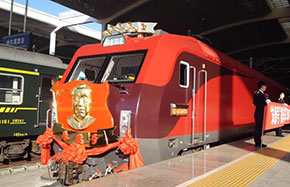
In June 2016, at the arrival ceremony of a China-Europe freight train in Warsaw, Xi and Polish President Andrzej Duda tasted Polish apples together. Today, products like the apples are brought to China with the help of the Belt and Road Initiative.
As the chief architect of the initiative, Xi has provided an inclusive platform for countries to speed up their development. Over 100 countries and international organizations have expressed their support for, or participated in, the initiative.
In May 2017, Xi presided over the Belt and Road Forum for International Cooperation, the most prestigious international gathering China has ever initiated. Representatives from the world's major economies including all G7 countries were present.
To the international community, Xi is a firm advocate for economic globalization. He was the first Chinese head of state to attend the World Economic Forum in Davos.
His speech there was impressive: "Pursuing protectionism is like locking oneself in a dark room. While wind and rain may be kept outside, that dark room will also block light and air. No one will emerge as a winner in a trade war."
German newspaper Handelsblatt commented that the Chinese president was advocating a more just globalization in his speech. At Davos, the leader of the world's biggest Communist Party would become the biggest advocate for free trade.
Advocating shared growth through discussion and collaboration in global governance, Xi pushes for a more just and reasonable international order, and proposes upholding justice while pursuing shared interests.
He wants new thinking on common, comprehensive, cooperative, and sustainable security; open, innovative, and inclusive development that benefits everyone; and cross-cultural exchanges characterized by harmony within diversity, inclusiveness, and mutual learning.
These concepts were to the fore at the BRICS Summit in Xiamen, the G20 Hangzhou Summit, the 22nd APEC Economic Leaders' Meeting in Beijing, the Fourth Summit of the Conference on Interaction and Confidence Building Measures in Asia held in Shanghai, and other international podiums.
In the past five years, Xi has visited 57 countries and major international, regional organizations covering five continents; a combined travel distance equal to circling Earth 14 times. According to protocol officials at the Ministry of Foreign Affairs, his schedules for overseas visits are always tight and busy with one event closely following another.
When presiding over the Johannesburg Summit of the Forum on China-Africa Cooperation in South Africa, he was still attending bilateral meetings at midnight. During the BRICS Summit in Goa, India, he left the hotel at eight in the morning and did not return until almost one o'clock the next morning after his day's work.
He has met with Russian President Vladimir Putin over 20 times since taking on the mantle of president of China. Their solid friendship has led bilateral ties into the best time in history. He has had candid talks with both former and current US presidents Barack Obama and Donald Trump, enhancing trust while reducing suspicion and setting out the future of bilateral ties.
He is the first Chinese head of state to visit the headquarters of the European Union. He has visited all major European countries, exploring each one's special relationship with China. Europe is home to almost one third of the 57 founding members of the China-proposed Asian Infrastructure Investment Bank.
He proposed neighborhood diplomacy of amity, sincerity, mutual benefit and inclusiveness. He visited Africa, Latin America, and the Middle East, advancing China's diplomacy on all fronts.
The Wall Street Journal reported that, "On the global stage, Mr Xi has portrayed China as an alternative to the West, with a unique political system and culture, and as a leader in areas including trade, inequality and climate change."
Many believe Xi's wisdom and solutions have helped avoid a "clash of civilizations," the so-called "Thucydides Trap" and "Kindleberger Trap."
At the 19th CPC National Congress, Xi said that major country diplomacy with Chinese characteristics could "foster a new type of international relations and build a community with a shared future for mankind."
This is a philosophy long held by Xi, out of an emotional commitment to serve people worldwide as his duty. It is a global vision and the undertaking of a major leader, combining China's own development with that of the whole world, transcending traditional Western schools of thought on international relations based on the zero-sum game and power politics.
Xi's extensive knowledge of literature and the arts makes him a consummate communicator in the international arena. When being interviewed, he named more than 10 Russian writers and a host of Russian masterpieces; when visiting Europe, he talked of several French and German cultural celebrities, bringing himself closer to the locals, and voicing his opinions with literary and artistic expression.
In describing "the Chinese road," he often uses vivid language - China is a peaceful, amicable, civilized lion; China is a big guy; China should not be compared to Mephisto. "Welcome aboard the fast train of China's development."
Xi treats everyone with sincerity, warmth, attentiveness, and forthrightness. Putin once said Xi sent him a birthday cake during the APEC meetings in 2013 and they "drank vodka with sandwiches." In July 2016, President of the Republic of Congo Denis Sassou Nguesso visited China for the 14th time. Xi gave him a collection of over 70 photographs of his previous visits as a gift. As civil wars in Sassou Nguesso's country had damaged archives, he said that was the most precious gift he had ever received.
When presenting an award to a Russian veteran who fought for China during World War II, Xi saw the difficulty the old soldier had in moving and said at once, "Let me come over to you. You can stay there." He cherishes old friendships and honored his words with a visit to the family of a late friend, Jim Bacon, in Australia.
A selfie of football star Sergio Aguero and Xi drew a large number of views online. In Argentina, he happily accepted a No 10 jersey with his name on it. When being interviewed, Xi said he likes sports, including football, basketball, volleyball, and boxing. He also takes time out of his busy schedule to swim over 1,000 meters a time.
His wife Peng Liyuan accompanies the president on some trips abroad and has also become a star of China's diplomacy. In the autumn of 2015, Peng walked onto the podium of the United Nations and delivered two speeches in fluent English, one on her Chinese dream: "I hope all children, especially girls, can have access to good education. This is my Chinese dream." The other was about her stories with children orphaned by HIV/AIDS.
Details of their visits abroad show the warmth of a Chinese family. Whenever the cabin door of their plane opened, the couple always walked down the stairs hand in hand, with matching style and gestures. In June 2013, they visited a rural household in Costa Rica. When the host brought them snacks, Xi picked one up and said, "We two can share this one."
Countries often extend an exceptional welcome to Xi on his visits. The Russian Ministry of Defense and the command center of military force opened their gates to a foreign head of state for the first time in honor of Xi. The Queen Mother of Cambodia Norodom Monineath Sihanouk invited Xi to sit in the chair where late King Father Norodom Sihanouk often sat. The chair has been cherished by the royal family since the King Father's passing and had never been used until Xi's visit.
ARCHITECT OF MODERNIZATION FOR NEW ERA
The highlight of the 19th CPC National Congress was "Xi Jinping Thought on Socialism with Chinese Characteristics for a New Era," now written into the newly revised CPC Constitution, and a significant breakthrough of the sinicization of Marxism.
"Since the Party's 18th National Congress, Chinese Communists, with Comrade Xi Jinping as their chief representative, in response to contemporary developments and by integrating theory with practice, have systematically addressed the major question of our times: what kind of socialism with Chinese characteristics the new era requires us to uphold and develop, and how we should uphold and develop it, thus giving shape to Xi Jinping Thought on Socialism with Chinese Characteristics for a New Era," reads the revised Constitution.
Under the guidance of Xi's thought, the CPC has led the Chinese people of all ethnic groups in a concerted effort to carry out a great struggle, develop a great project, advance a great cause, and realize a great dream, ushering in a new era of socialism with Chinese characteristics.
The modernization model Xi proposes is distinct not only from the Western model of modernization through industrialization and colonization but also from the neo-liberal model advocated by the Washington Consensus.
About 150 years after Karl Marx's Das Kapital was published and 170 years after the Communist Manifesto was released, socialist China will soon celebrate the 40th anniversary of reform and opening up.
Socialism with Chinese characteristics entering a new era means that "scientific socialism is full of vitality in 21st century China, and that the banner of socialism with Chinese characteristics is now flying high and proud for all to see," Xi said during his report at the opening session of the 19th CPC National Congress.
In September, Xi presided over a study session for members of the CPC Central Committee Political Bureau which reviewed the development of socialism over the past 500 years.
He studied China's failures in copying the political systems of other countries and the successes that came after choosing socialism, especially the experience of nearly 40 years of reform and opening up. He analyzed the development models of other countries.
"Only the wearer knows if the shoes fit or not," Xi said.
The Party must "neither retrace our steps to the rigidity and isolation of the past, nor take the wrong turn by changing our nature and abandoning our system."
In his report to the congress, Xi said: "The path, the theory, the system, and the culture of socialism with Chinese characteristics have kept developing, blazing a new trail for other developing countries and nations to achieve modernization. It offers a new option for other countries and nations who want to speed up their development while preserving their independence; and it offers Chinese wisdom and a Chinese approach to solving the problems facing mankind."
Development of socialism in China, both in practice and theory, has shown that the country is able to avoid the historical cycle of rise and fall. Likewise, it could evade the "Tacitus Trap," which warns that when a government loses credibility, whether it tells the truth or a lie, it is inevitably thought to be lying.
China offers an alternative answer to such predictions as the "end of history," raised by Francis Fukuyama who argued for the inevitable triumph of Western liberal democracy, and has brought new meaning to the comprehensive development of human society.
Xi has led socialism with Chinese characteristics to a new era, a new era for entire humanity, as we stand together at the crossroads of new development paths.
Xinhua