The militarist's path to revival
Takaichi, first incumbent postwar Japanese PM to threaten China with force, seeks to recast Japan as 'combat-ready' state










Editor's note: In just a month since taking office, Japanese Prime Minister Sanae Takaichi has caused a huge crisis. By asserting that a "Taiwan contingency" threatens Japan's survival, she is the first Japanese prime minister to make a threat of force against China after WWII, signaling a definitive break from Japan's postwar commitment to pacifism. This analysis traces the historical echoes of her revisionism, arguing that her push for a "combat-ready" state violates international norms and risks a catastrophic return to militarism.
When Mark Twain said "History doesn't repeat itself, but it often rhymes", the American humorist and social commentator could scarcely have imagined how heavily his somber aphorism would hang over East Asia today, as the rhetoric emanating from Tokyo under Prime Minister Sanae Takaichi begins to echo the darkest stanzas of the region's past.
Earlier this month, responding to questioning in the Japanese Lower House Budget Committee, Takaichi declared that a "contingency in Taiwan" could represent a "survival-threatening situation" for Japan and directly implied the possibility of armed intervention in the Taiwan Strait. As the first incumbent Japanese prime minister to make such a statement in the country's Parliament, the National Diet, Takaichi's remarks have triggered strong criticism — not only from the Chinese mainland and Taiwan but also from a wide and distressed spectrum of voices within Japanese domestic society. Takaichi's intransigent refusal to withdraw the claim has laid bare her ultimate ambition: to complete the long-term conservative project of remilitarization and tear down the legal firewalls of the postwar order, which will be remembered as the most recent and most dangerous rhyme in East Asia's history.
A recurring pretext for war
This is not a new political tactic.
Before the September 18th Incident of 1931, a provocation initiated by Japan to justify its occupation of Shenyang in Northeast China's Liaoning province and marked the beginning of the Chinese People's War of Resistance Against Japanese Aggression (1931-45), Kanji Ishiwara, the notorious architect and leading figure in the Kwantung Army driving the event, asserted that "Japan faced a crisis of national survival". He argued that, due to resource scarcity and external constraints, the only way to secure Japan's future industrial and military strength was the immediate, preemptive occupation of the three northeastern provinces of China. The war initiated by the September 18th Incident lasted 14 years until Japan's final surrender in 1945. During that protracted conflict, China fought the world's longest anti-fascist war at the staggering cost of 35 million Chinese military and civilian casualties. The horrific Nanjing Massacre alone saw Japanese troops slaughter over 300,000 Chinese civilians and unarmed soldiers in just six weeks.
Similarly, before Isoroku Yamamoto's sneak attack on Pearl Harbor, the warmonger and then-prime minister Hideki Tojo also repeatedly declared that "Japan faced a survival-threatening situation". This pretext was based on the premise that the debilitating oil embargo by the United States had cornered Japan and the country's only viable path to long-term survival was to seize control of Southeast Asia's resources, which first required the complete destruction of the US Pacific Fleet at Pearl Harbor.
Consequently, in portraying the Taiwan question as a "survival-threatening situation" for Japan, Takaichi has dusted off the old playbook of fabricating an external threat to accelerate the country's remilitarization.
Eroding the postwar firewall
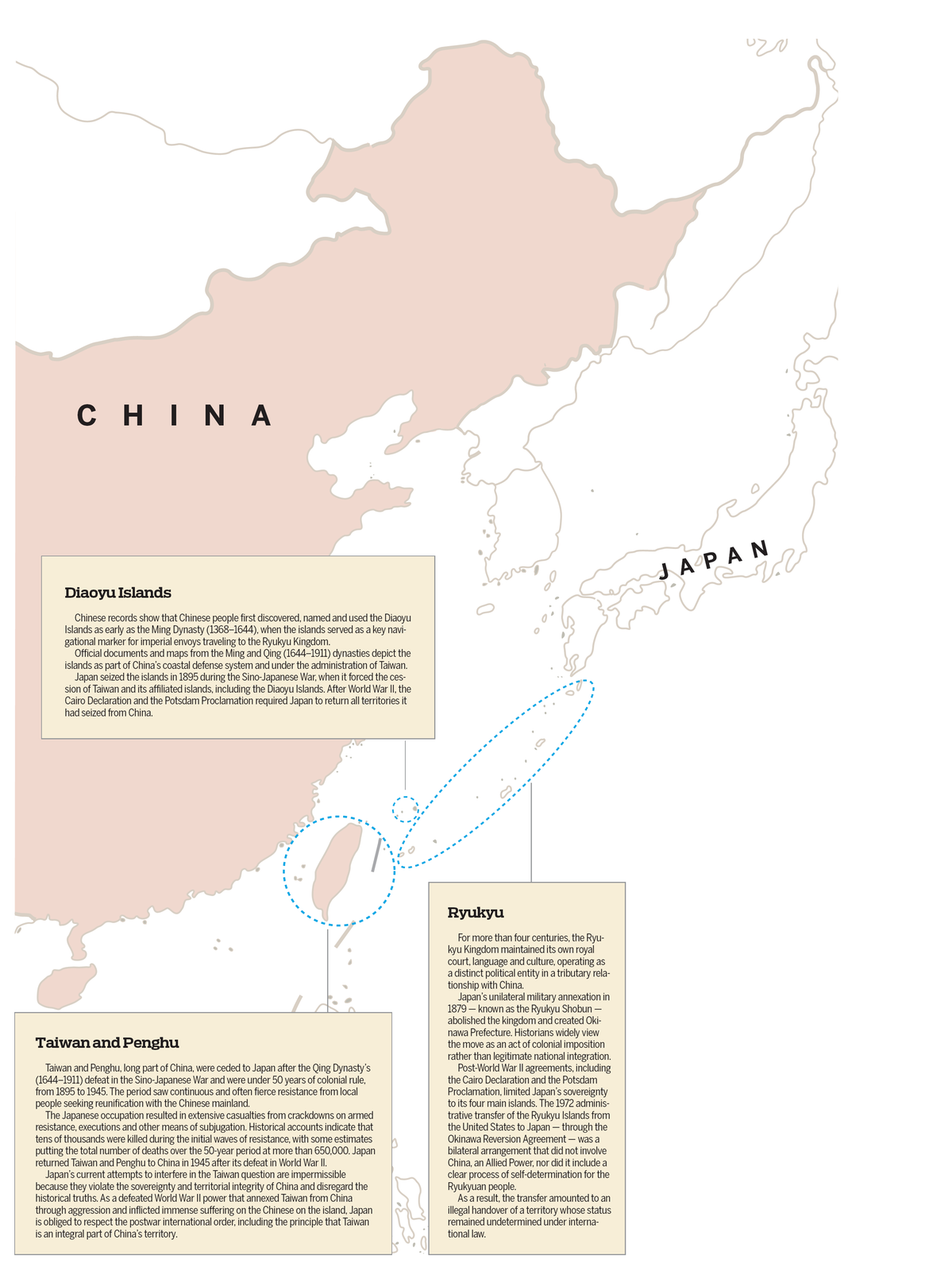
To grasp the magnitude of Takaichi's revisionism, the historical context of the postwar settlement must be precisely understood. The Potsdam Proclamation in 1945 unequivocally stated that "Japanese sovereignty shall be limited to the islands of Honshu, Hokkaido, Kyushu, Shikoku and such minor islands as we determine", a mandate cemented by Article 9 of the Japanese Constitution that declared that "land, sea, and air forces, as well as other war potential, will never be maintained". Yet, this legal firewall has been systematically eroded over decades, starting with a constitutional reinterpretation in 1954. By that time, the survivors of the former Japanese Empire's architects of militarism had evolved into conservative right-wing politicians. They seized on the Cold War atmosphere and exploited a legal loophole: arguing that while Article 9 prohibited maintaining war potential for aggression, it did not waive the inherent right of any sovereign nation to self-defense. This allowed them to establish the Self-Defense Forces as the "minimum necessary force", providing a pinhole breach that paved the way for later expansion. Following this step, the focus shifted to geographic creep after the collapse of the Soviet Union. This meant a deliberate expansion of the SDF's operational scope, starting with the Act on Cooperation with United Nations Peacekeeping Operations (the PKO cooperation law) in 1992, which began the normalization of overseas engagement. Later, and far more dangerously, came the Situations in Areas Surrounding Japan Law in 1999. By defining "surrounding areas" as situational, not geographical, this legislation effectively dissolved the spatial firewall, enabling the SDF to engage in operations across the entire Asia-Pacific.
Institutionalizing collective self-defense
The preceding phase of geographical creep set the stage for the most aggressive demolition of the firewall, which was led by Shinzo Abe, the chief architect of military normalization. Abe realized that the final, insurmountable legal obstacle was the right to collective self-defense — the ability to use force to defend an ally when Japan itself wasn't attacked. Critically, because he was unable to amend Article 9 due to sustained public opposition, Abe bypassed the democratic process entirely, resorting to a Cabinet resolution of 2014. This resolution unilaterally reinterpreted Japan's Constitution, permitting force under an "Existential Crisis Situation". This administrative override, formalized by the 2015 Peace and Security Legislation, was an act of profound constitutional violence, instantly establishing Japan as legally capable of collective war-fighting for the first time since 1945. Ultimately, the passage of this new security legislation in 2015, which allows the SDF to engage in joint operations with foreign militaries, successfully hollowed out the "Peace Constitution" in a systemic way by institutionalizing the country's "right" to engage in war.
Now, Takaichi has thrust the legal instrument toward its most controversial and operationally practical threshold. Abe may have served as the architect for the "constitutional revision trilogy", successfully establishing the crucial legal prerequisite for allowing the use of force (the how). Takaichi's political aim is to utilize her hard-line posture in the National Diet, to directly tie "what happens in Taiwan" to the classification of an "Existential Crisis Situation" (the when and where). By doing so, she completes the "regional and policy activation" of the collective self-defense breakthrough, decisively transforming Japan into a "combat-ready" state — legally and militarily prepared to actively intercede in regional and international disputes — thereby thoroughly subverting the postwar international order.
'Combat-ready' state
This action aligns precisely with the 2022 adoption of the new "Three Security Documents", which substantially altered the "Peace Constitution" by authorizing the construction of large-scale offensive capabilities — such as over 10 types of anti-ship and land-attack missiles with ranges of up to 3,000 kilometers. By making the goal of resolving situations "in a manner favorable to Japan" a strategic priority, this final move exposes the Japanese government's past "self-defense" justifications as outright lies.
The international community, particularly those in the Asia-Pacific region, must be on high alert, because Takaichi's move constitutes a direct violation of the United Nations Charter and the one-China principle and forces neighboring states to view Japan as a potential military threat once more. Japan's hostile posture fuels an inevitable escalation of the regional arms race and accelerates dangerous bloc confrontation. More alarmingly, should the Takaichi agenda proceed to actual intervention, the consequences for Japan and the entire region will be catastrophic. As sternly warned by the official military newspaper of the Chinese People's Liberation Army, the PLA Daily, Takaichi's move puts the whole of Japan at risk of becoming a battlefield, and that "if Japan were to intervene in the Taiwan Strait, the Japanese government would effectively tie the entire Japanese population to a path of self-destruction".
Violating legal and moral norms
Takaichi's final push is not just a regional issue; it is a direct challenge to the fundamental stability of the global order. Beyond the stern warnings delivered by PLA Daily, Takaichi's remarks violate every established bottom line. First, they represent a blatant breach of international law. The UN Charter explicitly commands that "All Members shall refrain... from the threat or use of force against the territorial integrity or political independence of any state". As the leader of a defeated aggressor nation in WWII, Takaichi's explicit threat of force against China and her attempt to undermine Chinese territorial integrity constitute a clear violation of this fundamental legal principle. Second, her stance breaches the essential moral and diplomatic norms. By completely betraying the four foundational political documents signed between China and Japan — most notably the 1972 Sino-Japanese Joint Statement, where Japan "fully understands and respects" the stance that Taiwan is an inalienable part of China — Takaichi renders Japan's credibility worthless. Third, from a practical security risk perspective, Takaichi's policy guarantees strategic isolation and the deterioration of Japan's security environment, as it makes stable relations with China impossible, and China and other neighboring countries will also be wary of Japan as a direct threat. Her policy orientation will therefore fuel a regional arms race.
As a defeated nation that returned stolen territories including Taiwan to China as part of the postwar order, explicitly linking its defense to the Taiwan question, Japan sacrifices strategic autonomy, undermines its postwar commitment to peaceful development, and risks being once again nailed to the pillar of historical shame.
A path to disaster
The Japanese government has clearly failed to inform its people of the true cost of this dangerous decision, which risks plunging the nation into disaster. If China's stern warnings and the strong opposition, both at home and abroad, cannot sway Takaichi, she risks being portrayed not as a national hero, but as the figure who led Japan to pay off its historical debt with interest. Japan must immediately cease its wrong and provocative statements and moves that interfere in China's internal affairs, and stop playing with fire on the Taiwan question. Ultimately, the critical question for the international community is this: When a state uses sophisticated legal mechanisms — not to uphold its constitution, but to systematically dismantle the core international commitments that ended a world war — what precedent does this set? History may rhyme, but the legal foundation of the postwar order is immutable, and the China Takaichi intends to challenge today is not the China of yesteryear.
Here is a reminder to Japan
1. Article 53 of the UN Charter specifically established the "Enemy States Clauses", stipulating that if any of the fascist or militarist states — such as Germany, Italy, or Japan — take any steps to renew an aggressive policy, the founding members of the United Nations (including China, France, the Soviet Union, the UK, and the US) have the right to take direct military action against them without requiring authorization from the Security Council.
2. The Cairo Declaration explicitly stipulates that Japan's sovereignty shall be limited to the four main islands (Honshu, Hokkaido, Kyushu, and Shikoku) and such minor islands as the Allies determined.
3. Article 8 of the Potsdam Proclamation strictly prohibits Japan from maintaining any war potential.
wangxu@chinadaily.com.cn