From poverty to prosperity, China's century









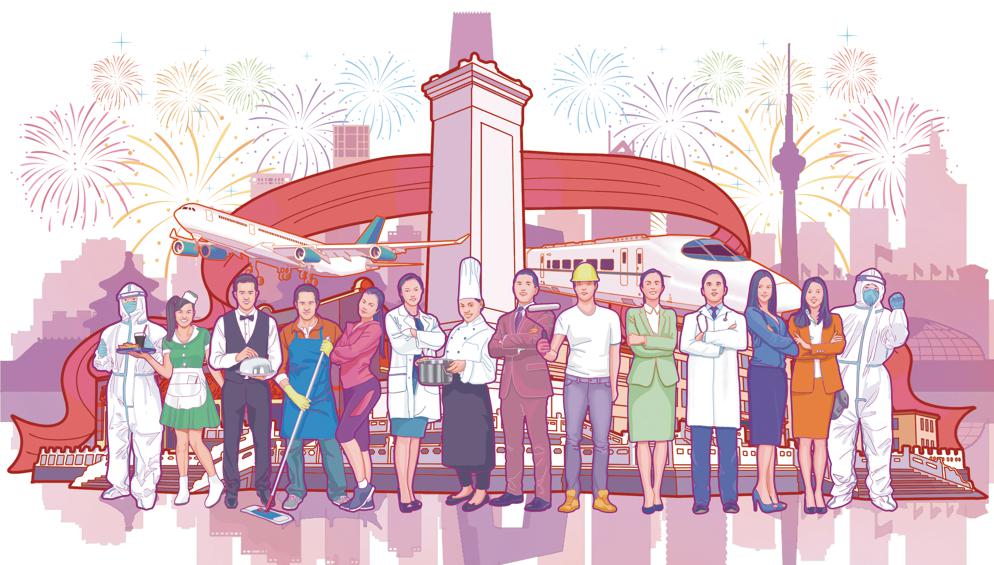
The speed, scale and span of the economic and social transformation of China during the past 40-odd years have been unprecedented in human history.
One hundred years ago, times were not good for China. Its 400 million people lived mainly in rural areas, mired in poverty. It was a nation ravaged by imperial mismanagement, foreign colonialism and civil wars.
On July 23 1921, 13 disillusioned Chinese young men and two representatives from the Communist International, met secretly in an inconspicuous house, 106 Rue Wantz, in Shanghai's French Concession, which began the first national congress of the Communist Party of China (CPC). The police interrupted the meeting on July 30, and the Chinese members shifted their discussions to a tourist boat on the South Lake in Jiaxing, Zhejiang province, to continue the first National Congress. The first congress marked the founding of the CPC.
Mao Zedong became the leader of this fledgling party during the early days of struggle. The Party operated from primitive quarters dug in the hills of inland city of Yan'an. The cave-like quarters of these early leaders are now a far cry from the latest modern houses of Beijing or Shanghai.
It is perhaps unlikely that the pioneers imagined that in only 30 years, the party they formed would govern the nation and continue to lead the country on its successful journey even more than seven decades after that. Nor would they have imagined that the CPC would become the world's largest ruling Party with some 95.15 million members in about a century.
Reform and opening-up lead to rapid development
In 1949, under the leadership of the CPC with Mao at its core, the People's Republic of China was born.
The next pivotal transformation of China occurred in 1978, under the leadership of Deng Xiaoping, with the launch of the policy of reform and opening-up.
Prior to 1978, food shortages were a constant problem in China. Thus, initial institutional reforms started in the agricultural sector with two fundamental policy changes. First, prices of agricultural products were increased. Second, the collective farming system was gradually abolished and replaced with "household responsibility system". Under this new system, each household had a fixed quota of grains that it had to sell to government at official prices. However, any extra produce could be sold at the market price, which was much higher.
These reforms were progressively implemented and were completed by 1984. Consequently, China's agricultural output increased by 47 percent during 1978-1984.This solved the recurring food scarcity problems and initiated a structural transformation, leading to allocated surplus agricultural labor to industry. Within six years, over 49 million workers, 19 percent of China's labour force, shifted from agriculture to industry.
Further reforms were implemented in the agricultural sector from 1990. Government interventions were reduced significantly. Except for some restrictions on land ownership, China now has one of the least distorted agricultural economies in the world.
This remarkable success in agriculture led to two major market reforms in the industrial sector during the early 1980s. First, State-owned enterprises were given production inputs and outputs quotas at official prices. However, beyond these quotas, they were free to buy inputs and sell outputs at market prices. Non-State-owned enterprises, including foreign-owned companies in special economic zones, were allowed to enter some sectors that were previously banned and could buy inputs and sell outputs at market prices.
Second, from 1980, many economic decision-making powers were devolved to lower levels of government, with added fiscal incentives. Consequently, State-owned enterprises at provincial, city and country levels, and collectives at township and village levels, proliferated.
All these reforms ensured China became the manufacturer of the world, boosting national GDP and people's income.
In 1978, before the launch of the reform and opening-up process, China's per capita GDP was one-fortieth that of the United States and one-tenth of Brazil. By 2020, its per capita GDP, at $10,500.40, was about one-sixth of the US, but 54 percent higher than Brazil. In terms of GDP, Japan Centre for Economic Research now forecasts China will surpass that of the US by 2028.
One impressive part of China's policymaking is it does not have any preconceived ideas or dogmas. New policies are tried in pilot areas. If a policy works, it is further fine-tuned before it is rolled out nationwide. Accordingly, its record of successfully implementing nationwide policies is higher than most other countries.
An important success of its social and economic policies has been that it has now completely eradicated absolute poverty. In fact, a primary reason why the poverty alleviation target of the Millennium Development Goals of United Nations was achieved, was due to China's success in lifting about 800 million people out of poverty in the past four decades, a remarkable 70 percent of entire global poverty eradication during this period.
Glorious future lies ahead
China had announced two national centenary goals. The first was achieved by the end of 2020, a year before the 100th anniversary of the founding of the CPC. No country has managed to bring about 800 million people out of extreme poverty in only 40-plus years.
The second centenary goal, to be achieved by the middle of this century (2049 being the 100th anniversary of the founding of the People's Republic), is to "develop China into a great modern socialist country that is prosperous, strong, democratic, culturally advanced, harmonious and beautiful".
This second goal is ambitious. However, China's continuing record in terms of enormous investments in all types of infrastructure, education (especially in science, technology, including engineering and medicine), heavy investments in research and development (R&D), and steady economic growth, should enable it to meet the target in time. This will be further helped by its ability to formulate, and speedily implement, policies which most societies may find difficult to replicate.
Take for example the COVID-19 pandemic. How it has been managed by China, compared with major industrialised countries of the US, United Kingdom or Germany. China, with a population of 1.4 billion, has had 5,000 death to date due to pandemic. In contrast, the US, with a population of 330 million which is less than a quarter of China, has a death toll of 756,000, or 146 times that of China.
Economically, after a contraction during January-March 2020, the first time in four decades due to the pandemic, China recovered its economic mojo much faster than any other country.
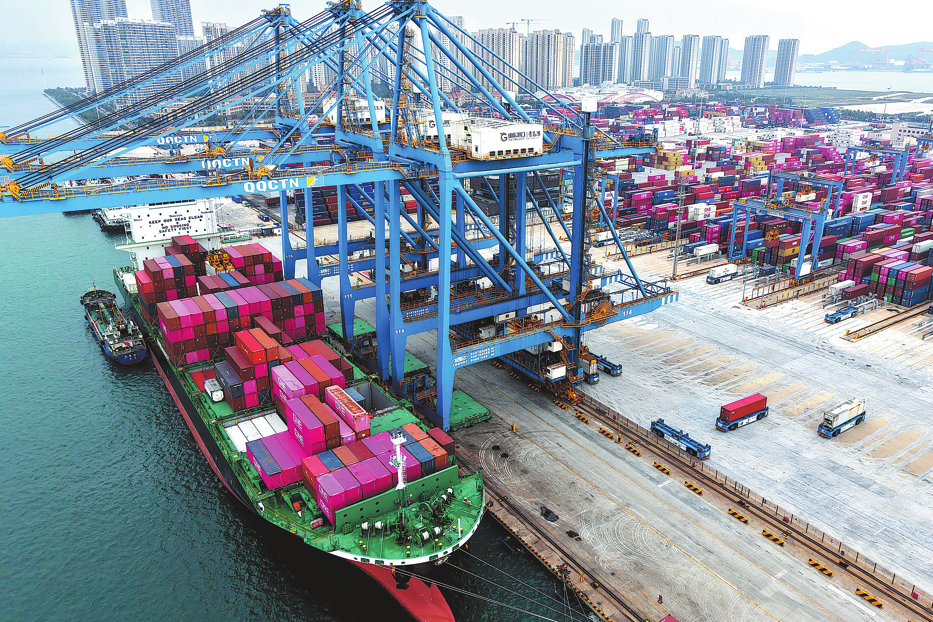
What helped the Chinese economy to recover were the efficient and targeted pandemic prevention and control measures. Such has been the economic recovery that last month China's exports increased by a whopping 27 percent year-on-year.
China has generally focused on geoeconomics rather than geopolitics. Accordingly, most countries searching for economic prosperity have looked at China for help. Currently, China is the main economic partner for most countries.
The Belt and Road Initiative, which is aimed at improving infrastructure connectivity and boost trade, is likely to further accelerate China's economic and trade position by substantially improving and integrating world trade among the countries of Asia, Europe, Africa and Latin America. By constructing new connectivities and strengthening existing ones, the initiative is increasing total trade volumes within and beyond the involved countries, accelerating industrialisation and development processes, attracting additional foreign direct investments, catalyzing efficient production processes and further advancing regional and global collaboration on many fronts.
More important, the Belt and Road Initiative is likely to help build a community with a shared future for mankind.
In October 2020, the Fifth Plenary Session of the 19th CPC Central Committee charted a new development road map for China. Domestic consumption will become increasingly important because of the pandemic and intensifying disruptions to the global supply chain. The plan is to significantly increase it by spurring its progress in all possible ways and expanding investments. Known as the "dual circulation" paradigm, the objective is to allow domestic and international circulation to reinforce each other.
The "dual circulation" paradigm will further uphold the central role of modernization in China's continued quest for economic innovations and implementation of innovation-driven strategies. China has decided to accelerate green and low-carbon developments, increase efficiencies of resources utilization and continue to improve the environment and stability of ecosystems.
To achieve these targets, China's annual R&D expenditure has increased significantly since 1995. Between 1995 and 2018, China's R&D expenditure increased annually by over 15 percent. According to OECD, China's annual R&D spending reached $463 billion in 2018, only $89 billion less than the US figure. By most accounts, China's R&D spending will overtake that of the US by 2025.
Results of this phenomenal increase in the country's R&D input is already evident. It has raised the country's economic and political status on the global stage, so has its technological ambitions, innovations and accomplishments. In several areas, China has overtaken, or is on the verge of overtaking, many developed countries in terms of advances and deployments of specific technologies.
An ever-increasing budget for technological innovations, plus a focus on developing and retaining scientific and technological talents, the concerted efforts, including the smooth coordination among government departments, to cultivate and retain scientific and technological talents have enabled China to overtake its Western counterparts in many fields.
China's approach to global technology leadership has been threefold: significantly improve and expand domestic education, attract overseas Chinese talents to return to China and attract foreign talents.
China's domestic education reform has been remarkable. Annual science and engineering degrees awarded more than quadrupled between 2015 and 2020, from 360,000 to 1.7 million.
China is now the world's biggest source of foreign-born talents. Countries are now competing to attract and retain them. Equally, China has been increasingly successful in attracting and retaining returnees through attractive salaries and generous R&D budgets. This success has made some Western countries concerned about their competitiveness and national security. The success could also bring more challenges in the coming years as certain countries could increasingly consider China to be a fierce competitor in many sectors.
Dual carbon targets display responsibilities
On the environmental front, President Xi Jinping's pledge that China's carbon emissions will peak before 2030 and reach carbon neutrality before 2060, have given the country a golden opportunity to restructure its transportation and industrial sectors, and also all other domestic and commercial sectors. This massive transition in less than four decades could facilitate further technological innovations which could be transformational for the country.
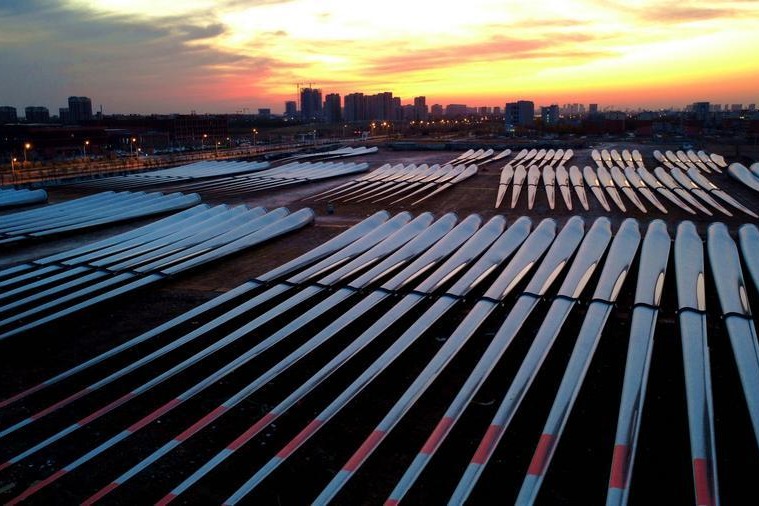
To a certain extent, this transformation has already started. China is now a global leader in solar, wind and hydropower generation. It has a strong position in the solar power industry in terms of installed capacity, solar panel manufacturing and technological exports. In 2020, China exported wind turbines to 22 countries, valued at $1.1 billion, a 20 percent increase from 2019. Of the world's 10 largest wind turbine manufacturers, seven are from China. It is primarily due to China's R&D efforts that the costs of solar and wind power have declined markedly during the past decade.
At the 15th Conference of the Parties to the Convention on Biological Diversity in Kunming, Yunnan in October 2021, President Xi made another announcement: the construction of the first phase of a solar and wind project with an installed capacity of 100 gigawatts in Bayannur, Inner Mongolia autonomous region. Similar developments and extensive R&D in solar and wind energy will ensure China remains an important global player in these areas.
In hydropower, too, China is by far the leading global power, not only in terms of construction within the country but also internationally. Globally, China has participated in construction of 416 hydropower projects by 2020. It signed 11 new agreements in 2020 alone.
China has now leapfrogged all countries not only in design and construction of large dams but also miles ahead of others in terms of use of sensors, robotics, big data and artificial intelligence. Based on our knowledge of Chinese advances in these areas, it is at least five years ahead of rest of the world. If one considers the best in China, Dadu River Hydropower Development Co Ltd, it is probably 10-15 years ahead not only in terms of its application of latest technologies but also successfully training thousands of engineers to move from their traditional roles to data analytics management.
These three sectors will continue to remain growth poles in coming decades as the world transitions to decarbonisation. Other growth pillars could be electric vehicles and battery technologies, where China now excels. Sales of electric vehicles in China increased by 10.9 percent year-on-year in 2020, to 1.37 million units, by far the highest in any country.
Becoming carbon neutral before 2060 will need major investments to restructure the country's entire economy. Current estimates range from $31 trillion to $46.6 trillion by 2060. At the higher figure, it will mean investments of 7.5 trillion yuan each year, up to 2060, equal to about 10 percent of annual investments in the country. Given the high domestic saving rates, this is doable and manageable.
Such a major national transformation will have many benefits. Air pollution in the country, and thus associated health and social costs, will decline steadily. As China moves to more renewable energy, its fossil fuel imports will decline. This would mean that it would progressively insulate itself from any future energy supply disruptions, including intensifying trade conflicts, which could affect its national energy security and thus economic growth. Simultaneously, China's advances in technologies for new energy systems, including its continuing pre-eminence in solar panel and wind turbine manufacturing, hydropower generation and battery storage advances, should mean other countries will continue to look at China for transition to low-carbon development.
While it is not easy to foretell the future because of many uncertainties, some of which could be external and beyond China's control, on currently available evidence, the country should be able, for the most part, to transform itself radically to realize carbon neutrality before 2060. During this process, its economy is likely to transform itself.
Asit K. Biswas is a distinguished visiting professor at University of Glasgow, UK, and the director of Water Management International Pte Ltd of Singapore. Cecilia Tortajada is a professor at the School of Interdisciplinary Studies, University of Glasgow, UK.
The views don't necessarily represent those of China Daily.
If you have a specific expertise, or would like to share your thought about our stories, then send us your writings at opinion@chinadaily.com.cn, and comment@chinadaily.com.cn.